
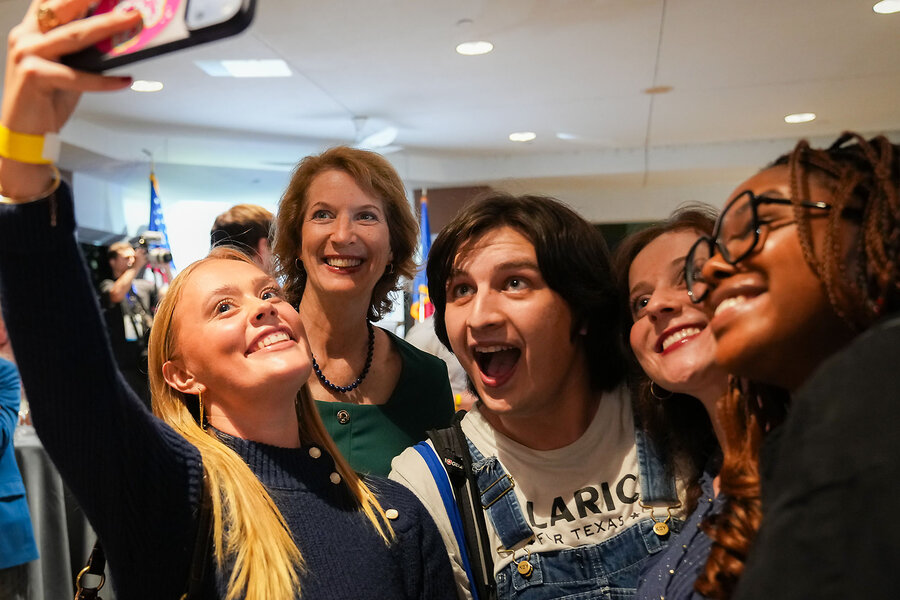
Washington | Nov. 28, 2026, 5:00 a.m. ET | 5 min read The numbers are staggering. Come January, Democrats will have substantial majorities in both houses of Congress – a return from the political wilderness unlike any seen in the United States in decades.Republicans have reacted to the midterm blowout with a mix of recriminations and resolve, some blaming an unpopular President Donald Trump, and many pledging to do the hard work of winning back voters’ trust in 2028.And Democrats, still basking in the larger-than-expected blue wave, are looking ahead to the new year with both excitement and trepidation. Their 56-44 Senate majority and 259-173 advantage in the House (with three races still undecided) mean plenty of opportunity to show voters what they stand for. It’s the largest House majority for either party in three decades and, in the nationwide vote count for House seats, the biggest margin of victory (14%) since 1974. Democrats face the challenge of governing with a defiant Republican president, whose new chief of staff, Stephen Miller, has signaled plans to bypass Congress with aggressive use of executive authority.But it’s a new day for the party, which will soon enjoy all the constitutional powers that come with running the legislative branch. To some prominent Democrats, the 2026 results point to nothing less than a recasting of the electoral landscape after losing the “trifecta” – House, Senate, and White House – in 2024.“This is a realignment,” Democratic Sen. Raphael Warnock of Georgia, seen as a potential presidential candidate in 2028, told reporters after the midterms. Others aren’t so sure. What happened on Nov. 3, they say, was not a permanent shift in allegiance toward Democrats but a referendum on President Trump – and a cry of frustration over the cost of living, the Iran war, the harsh treatment of immigrants, and perceived corruption. Daniel Heuer/ReutersVoters fill out their ballots at Beacon Heights Elementary School in Riverdale, Maryland, Nov. 3, 2026. Those top issues combined to produce a big leftward swing among some groups that had, just two years earlier, moved toward Mr. Trump’s Republican Party: young people, Hispanic voters, and Black voters.“We tried to talk about a realignment after the last presidential race” – and look what happened, says Amy Dacey, head of the Sine Institute for Policy and Politics at American University and a former executive director of the Democratic National Committee. If anything, this year’s election is “a reminder that no political coalition is permanent, and no party can take its voters for granted.”An opportunity “to build on”Political observers credit the Democratic Party with strong candidate recruitment this cycle and skilled campaigning in red states such as Texas, Iowa, and Kansas that won seats once seen as out of reach.For Democrats, these gains are an opportunity “to build on,” says Charlie Cook, founder of the nonpartisan Cook Political Report. That will mean passing legislation – and perhaps daring Mr. Trump to veto it – as well as using other constitutional powers to show they stand for what voters want.On Capitol Hill this month, Democratic Rep. Delia Ramirez of Illinois made clear that she knows her party’s work has just begun.“Ultimately, what people have said is, ‘Democrats, we just gave you this vote. It wasn’t because we believe in you or because we think that you are the most effective party. It’s because we cannot take one more day of what Republicans have done to us,’” Representative Ramirez told reporters. “‘Now prove to us that you’ve earned our vote.’” Polls show that despite their big midterm gains, Democrats are almost as unpopular as Republicans. In the run-up to the elections, Gallup found that the GOP was viewed favorably by only 35% of Americans; 43% viewed the Democrats favorably. In recent years, dissatisfaction with both parties has become the norm: Partisan control of Congress (one or both houses) or the White House has flipped for seven elections in a row.Outgoing Republican Sen. John Cornyn of Texas, who lost a bitter primary contest to Trump-backed state Attorney General Ken Paxton – who then lost in the general to Democrat James Talarico – says Republicans made a mistake in this election by doing “really no outreach to what I would call non-MAGA, traditional Republicans and independents.”“We need those people in the general election,” Senator Cornyn says. “They were treated with disdain, even contempt, by some of the MAGA Republicans.”Other GOP lawmakers say the Trump administration lost sight of the issues that matter most to its own base, particularly on the cost of living. Nathan Howard/ReutersRepublican Sen. Josh Hawley of Missouri greets an audience member after a hearing on Capitol Hill, in Washington, Nov. 17, 2026. Republicans need to get “back to the working people of this country,” says GOP Sen. Josh Hawley of Missouri. Otherwise, the party will be “in permanent minority status.”Senator Hawley says he’s willing to work with Democrats on affordability issues, including Medicaid funding, bringing down the high cost of healthcare, and keeping rural hospitals afloat. He calls the 2026 midterm results a sign that the public is not realigning but “dealigning” politically – away from the party coalitions he grew up with in the 1990s.Evolving coalitions, third-party threatsAmerican political parties, in fact, are always in a state of evolution – especially in the modern-day two-party system, where third parties or political independents have risen and fallen in influence, but rarely win major office. A potential new “America First” coalition of Trump allies-turned-critics on the right emerged over the summer, including figures such as commentator Tucker Carlson, former Rep. Marjorie Taylor Greene of Georgia, and departing Rep. Thomas Massie of Kentucky. Congressman Massie has expressed interest in running for office again, including possibly for president as a Libertarian.But the U.S. political system is effectively a Republican-Democratic duopoly. One indicator: On Nov. 3, Democratic-backed independents failed to win Senate seats in four red states, when actual Democrats were winning in other equally red states.Within that duopoly, the last big realignment came some 20 to 30 years ago, says Mr. Cook. That’s when “the Democratic Party started skewing upscale, college-educated, and the Republican Party started skewing more [toward] non-college whites.”The Democratic coalition that will take over Congress in January includes a vocal contingent of self-described democratic socialists, some of them members of the Democratic Socialists of America. One question is how willing they’ll be to work within the new, ideologically diverse Democratic majority, which will include moderates who just won in deep-red states and districts.Representative Ramirez, the Democrat from Illinois, identifies as a progressive, not a democratic socialist, but some of her positions align with the DSA. She supports, for example, abolishing U.S. Immigration and Customs Enforcement, saying she wants to “create something new.” Deepen your worldviewwith Monitor Highlights.Politics with respectGet political stories with respectful analysis.There‘s a world of new ideas in everyBooks newsletter.There‘s more to life, enrich yours withCulture & Learning weekly.Follow humanity‘s discoveries withScience & Nature stories in your inbox.Gain a spiritual perspectivefrom the stories in your inbox.Want to understand the deeper impact of critical events? Learn the Monitor‘s insight.Already a subscriber? Log in to hide ads. That’s the kind of far-left policy that could quickly spark a backlash against Democrats, says Ari Fleischer, former White House press secretary under Republican President George W. Bush. The same, he says, goes for policies such as “Medicare for All,” ending aid to Israel, enlarging the Supreme Court, abolishing the Electoral College, and creating new states.The 2026 midterms were “unequivocally a rejection election – a rejection of President Trump and the Republican Party,” Mr. Fleischer says. “It was not a 1980-style affirmation of a candidate or cause. And that’s crucial, because it means the Democrats are on borrowed time.” Bring news welcomed in any home into your home45% off$110/year → $60/yearJournalism that gets above the fray and brings perspectives you won't get anywhere else.Already a subscriber? Sign in
A realignment of US politics? What Democrats’ midterm blowout really means.
Full Article
Original Source
Read the full article at Csmonitor →KhanList aggregates and links to publicly available news content. We do not host full articles from third-party sources. Always verify important information with original sources.