
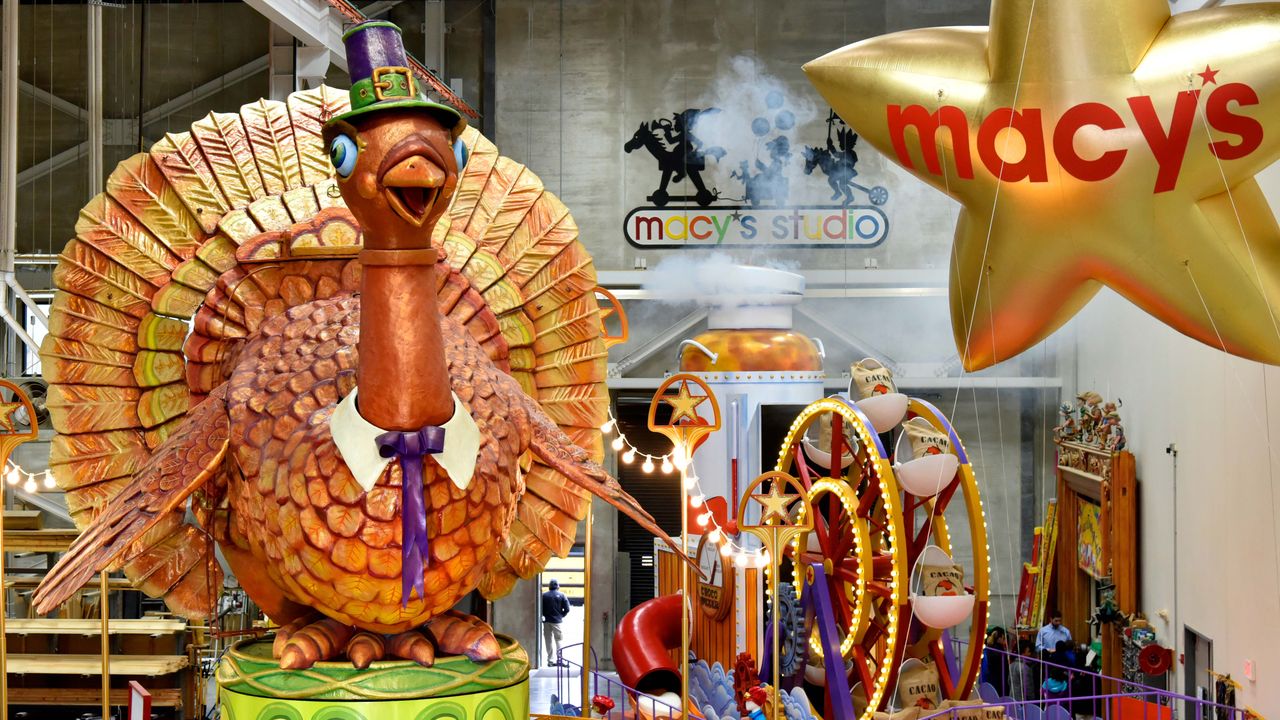
All year long, a team of 60 artisans tinker away to ensure the Thanksgiving morning procession is nothing but more delight.GettySanta’s workshop just might be inside a rather plain red-and-black brick building in northern New Jersey. Sitting about 10 miles northwest of Midtown Manhattan in Moonachie’s industrial park district, the 72,000-square-foot warehouse is home to Macy’s Parade Studio, where 60 designers, carpenters, welders, seamstresses, and other artisans chip away year-round to prepare for one morning a year: the Macy’s Thanksgiving Day Parade.This year, the festivities are grander than ever, as the team has toiled for two years in preparation for a major milestone: the parade’s 100th edition. Instead of the normal 50 to 60 inflatables, there will be nearly 100. The usual 500 new costumes will be upped to 1,000, while more than 11,000 volunteers will be a part of the milestone event.A snapshot of the Macy's Thanksgiving Day Parade from 1940 GettyIt’s a massive endeavor for a tradition that started as a two-block-long procession of Central Park Zoo animals, a handful of bands, and Santa, all traveling six miles from Harlem to the department store’s flagship in Herald Square at 34th and Broadway in 1924 (it was suspended for three years during World War II from 1942 to 1944). The parade led to the unveiling of Macy’s window displays with puppets by marionette artist Tony Sarg to kick off the holiday—and retail—season.“It started as a bunch of Macy's immigrant coworkers coming together to create a party like they had in their home countries,” Brendan Kennedy, director of creative production, tells me during a visit in late September. But soon, the animals were deemed to be “too scary” for children. Three years later, the balloons debuted, the work of Sarg, who he calls “one of the godfathers of puppetry” and “our Walt Disney.” His genius idea: flip marionettes upside down to become high-flying balloons on strings, creating the iconic tradition we know today.Taking a peek at the concept art hanging inside the Macy's workshop Macy's CommsWandering through the facility is like making your way through a pop culture fun house. A pair of Minions hang from the rafters, mingling with Pokémon’s Pikachu and Goofy, who is stuck in a wreath. A Planter’s Peanut Ferris wheel spins in the center, while models of the parade’s own famous characters, Tom Turkey, Blue Hippopotamus, and the fishy pair Rainbow and Greybow Trout, sit out to dry in front of shelves lined with paint buckets of every hue.“This is like our own Hollywood lot,” Kennedy says. Indeed, there’s the distinct feel of a soundstage paired with the wildest arts and crafts studio you've ever seen, all together feeling like something out of Willy Wonka’s dreams. Before making its home here in 2011, the Parade Studio was located inside the old Tootsie Roll factory in Hoboken, New Jersey, for decades.Despite the holiday joy bursting from every seam, parade preparation is serious business. Every single element is handcrafted and hand-painted. "Generally it all starts with a napkin sketch,” Kennedy explains of the initial rough drawing. “It goes into full modeling in 3-D, and then engineering, where we have to figure out how to get this thing into the real world.”But year after year, like the true elves of the holiday season they are, they pull it off—testing every float and balloon for any and every possible weather condition—so that on Thanksgiving morning, the 3.5 million lining the Manhattan route as well as the nearly 35 million watching the Macy’s Thanksgiving Day Parade at home (airing on NBC and Peacock from 8:30 a.m. to noon) can just sit back and revel in the delights of the season.“What makes the parade so special is that it is an event that has been produced by colleagues since it began in 1924, and it continues to be Macy Studios colleagues' gift to New York City and gift to people who are tuning in around the country to watch on television,” Macy’s director of production operations Kathleen Wright tells Traveler.Below, we peek behind the scenes of the Macy’s Parade Studio as the team prepares for the 100th parade, and how they plan to honor the traditions of the last century.Some of the 3-D printed models that serve as the blueprints for the parade's iconic floats Macy's CommsBringing the floats to lifeThe larger-than-life magic of the parade starts on the smallest scale. In the Studio’s 3-D print room, nearly a dozen machines hum away, creating miniature models—the first step in conceiving how to build each float. But that’s not the only tool used. Recently, engineers and sculptors have turned to augmented reality goggles, not just to picture the elements, but even wearing them while sculpting to make sure they get details right in a 3-D space.The day I visit, the team is problem-solving on the new Purina Dog Chow Salute to Service Dogs float, which features three oversized dog puppets.An array of the painted models inside the studio Macy's Comms“When floats come to life through some sort of animation is when it’s at its peak,” Kennedy says. While animatronics could provide the movements, they would lack the human touch. “With a puppet, I can look directly at you, give you a little show, and then pan to the next person. You get a lot more energy and excitement. There’s a long history of puppetry in the parade, so we made a concerted effort to include it.”The team works through solutions for the best way to have a puppeteer lie below the float bed, controlling the motions from below while positioned with body pillows that still allow them to see the parade-goers through a scrim. They consider using delivery truck slats to increase the height of the float so the puppeteer can remain comfortable and still operate the puppet.Mr. Peanut is the historic parade's oldest character. Macy's CommsIn another section, another new float is going for a test spin. Planters’ Mr. Peanut Power Plant will celebrate the parade’s oldest character, with peanut-shaped confetti erupting through his top hat, as well as a rotating Ferris wheel showcasing his evolution from 1916, starting with the napkin sketch created by a 13-year-old boy from Virginia.Also on the floor is a puppet of the original character Mr. Inspector, a stern-looking comic book character with a top hat and magnifying glass, who first appeared as a balloon in the 1929 parade. This version of the character was taken out of the archives and freshened up in order to be part of Macy’s own Tony Sarg’s Amazing Marionettes float.“Everything has to be refurbished,” Kennedy says. “These are New York City streets—it’s not like a perfect Narnia land. So they hit a bump, we have to work through it, or if it rains, we have to check for water damage.”While the methods are precise, the methodology is all about creativity and resourcefulness. Case in point: While working on the Wednesday Addams float in 2024, Tim Burton himself asked for more decay and rot. So a sculptor modified his glue gun to spray spider webs around the entire float. “It’s a good example of how anything can become a tool,” he says of making fiction come to life.But there are some strict restrictions. Floats have to fold up to the size of a standard city bus in order to fit through the Lincoln Tunnel into Manhattan. The massive convoy travels in two nights before Thanksgiving. Once settled, the team reassembles every piece, some using cranes, as every float gets its final touches before the big day.Peeking inside the planning of the parade's Mickey Mouse float Macy's CommsPreparing the balloons for take offNext, we step into the Balloon Studio, where again, everything starts with a 3-D model. After it’s approved, a larger form “white model,” roughly a few feet long, is generated (clay models were used in the past) and used to hand-draw lines that determine the shapes and sizes of each piece of balloon fabric that needs to be cut and how they’ll be melded together, much like sewing with a dress pattern.Dangling from beams above is a display of white models of the past, with the monotone versions of Super Mario, Buzz Lightyear, Snoopy, and the Pillsbury Doughboy, among others. But today the focus is on the freshly-completed Sorcerer’s Apprentice Mickey Mouse, hanging from a little stand to mimic levitation. I count no less than nine pieces of fabric sketched out in pencil just for the nose—and about 18 for the front side of each ear.Artisans stitch together all the massive textiles that go onto the floats. Macy's CommsAt the next station, we see a pair of artisans doing seemingly mundane work stitching large swaths of fabric together with sewing machines. To a trained eye, though, the scene is actually chock full of proprietary Macy’s secrets. While rubber was used in the past, today the balloons are made of off-white secret material the makeup of which is closely guarded. The material is heat-sealed together using these Macy’s-designed machines with wheels that heat up to 410 degrees Fahrenheit. Then the material is painted using a formula that’s also—you guessed it—proprietary.The secrets all come together as the completed balloons are first inflated indoors to make sure that the paint looks good and to check how it behaves with air. Some are inspected in the Studio while others that require more space are pumped up from the floor since it would float at the nearby Prudential Center. The balloons are inflated at various stages to ensure the air is filling up as intended.The big test came on November 7, when they hosted the annual Balloonfest at MetLife Stadium to see how the balloons behave in outdoor conditions, as well as give city agencies the chance to approve everything.Once that’s checked off, the night before the parade is the Balloon Inflation (which is open to the public; stay tuned for details here), when each character is blown up on the streets of the Upper West Side and prepped for its own turkey trot through Midtown. “They really are flying pieces of art,” Kennedy says.A shimmering Christmas tree costume Macy's CommsA dress from the costume operations studio Macy's CommsPlaying dress upWhile the floats and balloons may get the headlines, there would be no parade without the nearly 11,000 volunteers who help make the day happen, which is now 2.5-miles from the Upper West Side to Herald Square—and they all have to be dressed for the occasion. This year at least 1,500 more costumes are needed, but that doesn't intimidate costume director and associate producer Kimberly Montgomery, who’s been doing this for 27 years. “It’s gone so fast because it’s just been so darn fun,” she says of her tenure.Costumes follow after the design of the float, with the larger backdrop serving as the source of wardrobe inspiration. Macy's CommsEvery costume always begins in the same place. “We start with the design of the float and then riff off of that to tell a story with live people,” she explains. Just then, she catches a glimpse of a new design of a float with street signs and immediately starts brainstorming: “Maybe people on bikes will give it some texture and energy.” After all, she sees the floats as roving stages. "They're like mini Broadway shows.”When the very first 1924 parade arrived at Macy’s, it was met by employees dressed as clowns—and this year there will be 1,000 clowns throughout the parade, just a portion of the costume packets that she’s been working all year to assemble. And it's not just with what they'll wear. The late November weather is a major consideration as well. Costume kits also include ear and hand warmers, “the first two areas to get cold,” she says. Most costumes are also made loose enough so that the paraders can layer up underneath.There are roughly 3,500 costumes produced for the balloon handler brigade. Macy's CommsBalloon handlers get a different treatment. “Their costumes are a lot simpler because they have to pay attention to what they're doing,” she says. In fact, some balloons, like Buzz Lightyear, Sorcerer’s Mickey, and the Minion have nearly 100 people handling them. In total, about 3,500 of the costumes are for balloon handlers. “It’s serious business, so they get a coverall and a tabard that’s color coded with a picture of the character they’re holding.” She points out Toad the mushroom for Mario and an alien planet for Buzz Lightyear. And for the Minions, the team even has little cowboy hats.Of course there are odes to the past in the costumes too. Some historic costumes have been pulled out of the archives, like an intricate Broadway-quality Mother Goose dress. Others have been given new interpretations, like the original character Harold, who debuted in 1945 as a clown, but had stints as a baseball player (as he was seen in Miracle on 34th Street), fireman, and policeman. For this centennial, there will be 100 Harolds—25 of each iteration—as inflatable costumes (balloons aren’t the only ones that are blown up here!).Prepping for the big day begin bright and early at 4:30 a.m. Macy's CommsWith all this prep, dressing thousands of people then operates like clockwork, as they arrive around 4:30 a.m. at ballrooms around town in their street clothes and exit transformed. For 2.5 hours, shuttles transport them all to the parade start line.After all the pomp and circumstances are over, Montgomery turns to a new phase of the process: Laundry. “All of this goes in giant piles of whites, darks, and colors. We’ve got to get it laundered and put back in size order.”And once everything is back in order, they start again on the following year’s parade. “No matter what holiday it is, we always have our finger on the pulse of Thanksgiving,” Wright says.With more than two decades of editorial experience, travel and pop culture journalist Rachel Chang is a regular contributor to Condé Nast Traveler and Travel + Leisure and has also written for BBC, Vogue, Afar, Lonely Planet, Wall Street Journal, Washington Post, and The New York Times for Kids, among others. ... Read More
A Real-Life Santa’s Workshop: How Macy’s Parade Studio Works All Year to Prep for Thanksgiving Day Magic
Full Article
Original Source
Read the full article at Cntraveler →KhanList aggregates and links to publicly available news content. We do not host full articles from third-party sources. Always verify important information with original sources.