
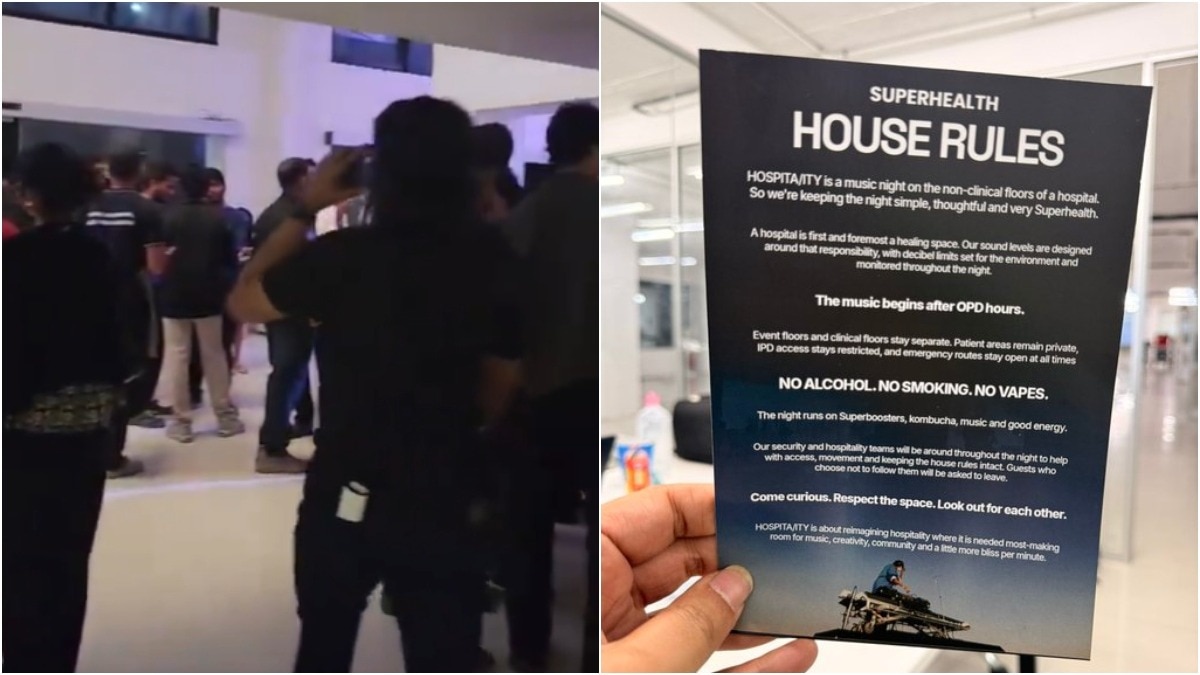
A Bengaluru hospital's music night has triggered a fierce debate online. Critics call it insensitive; supporters say hospitals don't have to be cold, frightening places. So where should the line be drawn?A hospital in Bengaluru organised a music night and raised many concerns. (Photos: X/@iamgaurangdesai)A hospital is rarely just another building. For one person, it may be where a child is born, for another, it may be where they hear the words “you have cancer.” It could be the place where a family waits outside an ICU through the night, where someone wakes up after surgery, or where a patient lies awake waiting for a test result that could change their lives.Which is perhaps why videos of a live music event inside a Bengaluru hospital triggered such a strong reaction online on Sunday. The event, organised at Superhealth Bengaluru in partnership with Localhost HQ, was presented as an attempt to make hospitals feel less intimidating and more human.But for critics, the idea of a music night inside a functioning hospital crossed an invisible line. The debate that followed was bigger than one Saturday night. Should hospitals be places of joy as well as places of healing? Or is there something fundamentally wrong about partying in a space where people may be fighting for their lives?Superhealth founder and CEO, Varun Dubey, says the event was rooted in a very different idea. “Hospitals don’t scare people.” In a post defending the event, he acknowledged that the concept might sound unusual, but said the guest list was curated and every patient and attendant was invited. "Some attended because they were bored, some wanted a distraction, while others simply found a hospital a lonely place to be on a Saturday night...," he writes. Dubey also argued that the reaction exposed how deeply we have accepted hospitals as places that must feel “cold, frightening and morose”. If people can be offered a few hours of distraction, warmth or joy without compromising their care or rest, he wrote, “we believe that effort is worth making.”Yes, the hospital was not turned into a nightclub, but that did not end the debate. For many people, that distinction did not make the idea any less uncomfortable. Because a hospital is still a hospital.SAME SOUND CAN MEAN SOMETHING VERY DIFFERENT Imagine being admitted with severe pain while music is playing somewhere else in the building, or imagine waiting for a biopsy report, sitting beside a parent in critical care or recovering from a major operation. You may never see the event. You may not even hear it. But the knowledge that a celebration is taking place in the same building where you are going through one of the most difficult moments of your life can still feel strange.There is also a more practical concern — noise.Hospitals are already full of it. Monitors beep, alarms go off, trolleys move through corridors, phones constantly ring, the staff is talking, announcements are made, doors open and close For someone who is unwell, sleep is not simply a comfort, it's a part of recovery. That is why hospital noise has become a subject of concern among doctors and researchers.In a BMJ article examining noise in hospitals, consultant geriatrician Dr David Oliver argued that hospitals should be therapeutic environments and highlighted the impact that noise can have on sleep, communication and recovery. Older people and patients with cognitive impairment can be particularly vulnerable.The concern is not that every sound is harmful. It is that a patient has very little control over the sounds around them. And that matters. A healthy person attending a music event chooses the noise; a patient in hospital may not have that choice.HOSPITALS SHOULD NOT BECOME STRESSFUL ENVIRONMENTSThat is the strongest argument against bringing entertainment into a healthcare setting. Dr Oliver’s broader point about hospital noise is that the environment around patients matters to their recovery. A hospital may be clinically excellent, but if the surroundings constantly disturb sleep or increase stress, something is being lost.Dr Divya Sharma, who criticised the Bengaluru event publicly, took an even harder line. Reacting to the event, she questioned the idea of turning a medical facility into a social entertainment space and raised concerns around the special responsibilities that come with healthcare settings, including privacy, ethics and patient trust.Their arguments point to something that can easily get lost in the social-media debate."A hospital is not a blank piece of real estate. It is a place where people are vulnerable, patients are often anxious, sedated, in pain or unable to control their surroundings. Relatives may be grieving or exhausted. Doctors and nurses may be dealing with emergencies. That vulnerability is what makes a hospital different from a hotel, restaurant, auditorium or club," explains infectious disease expert Dr Ishwar Gilada.BUT SHOULD HOSPITALS ALWAYS FEEL FRIGHTENING?This is where the argument gets complicated, because there is another side to the story, and it is one worth taking seriously. Why have we accepted that hospitals must look and feel cold? Why should the experience of being in hospital automatically mean fluorescent lights, white walls, beeping machines, anxiety and silence?Patients do not stop being human when they become patients. They still have favourite songs, they still want to laugh, they still miss their families, and they still want to celebrate birthdays and festivals. And caregivers are not machines either.Someone sitting beside a sick parent for 12 hours a day may be exhausted, frightened and emotionally drained. A small moment of music or conversation can sometimes provide a welcome break from the intensity of the hospital experience.There is, in fact, a growing body of work exploring the role of music in healthcare.IN THE WEST, HOSPITALS ARE ALREADY BRINGING MUSIC INSIDEThe idea of music and healthcare existing together is certainly not new. Hospitals in the UK have experimented with carefully designed music programmes for years. Oxford University Hospitals, for instance, has a programme that brings live music to patients, visitors and staff. Musicians perform in different hospital spaces, including at the bedside.NHS Lothian has also worked with the Edinburgh International Festival to bring live performances into hospital settings, including courtyards, gardens and wards.The important difference is the purpose and design of these programmes.They are generally created around the needs of people inside the hospital. That is very different from asking whether a hospital should function as a conventional entertainment venue.MUSIC THERAPY IS NOT A PARTYDr Renu Singh, a gynaecological surgeon at Queen Mary Hospital in Lucknow, has spoken about using patients’ preferred music during procedures performed under regional anaesthesia. "The patient remains awake during such procedures and can hear the sounds of the operating environment. Familiar music can help distract patients from those sounds and reduce anxiety."Dr Sunil M R, director of Cadabams Hospital in Bengaluru, has also spoken about music therapy being useful as a supportive intervention for people dealing with mental-health conditions such as anxiety and depression.However, there is important evidence in the other direction. Music doesn't automatically belong on the list of things that hospitals should keep out. But there is an important distinction — music therapy is not a music night. While one is a structured intervention designed around a patient’s needs, the other is a social event.Evidence that music can reduce anxiety does not automatically mean that a live entertainment event belongs inside every hospital. The setting, volume, timing and audience also matter.SO WHERE EXACTLY SHOULD THE LINE BE DRAWN?Perhaps this is the question Bengaluru has really forced us to confront.Dr Seema Chaudhury, a pulmonologist at Medanta Hospitals, asks us to consider four situations."A musician quietly playing the piano in a hospital lobby; a performer visiting a ward for a short concert for patients; a music-therapy session designed for people undergoing treatment, and a large social event where people come specifically to listen to live music. It's true that all four involve music, but they are not remotely the same experience," she explains.A hospital could potentially accommodate the first three without much controversy if they are properly planned. The fourth is where the ethical questions become harder. How far away are the patients? Can they hear music? What happens if an emergency requires access through the event area? Are families comfortable with the presence of a large crowd? Is patient privacy genuinely protected? What happens to staff movement?And perhaps the most important question, would the event still be considered acceptable if the patient most affected by it had been given a choice? Patients rarely get that choice.ORGANISERS HAVE A POINT, BUT CRITICS DO TOOSuperhealth’s argument is relatively simple. Hospitals do not have to be frightening places. The hospital said its event was designed around the idea of creating spaces that are less intimidating and more inviting. That argument deserves to be heard. Healthcare is not only about medicines, machines and procedures. The physical and emotional environment matters too.But the criticism also deserves to be heard. Because following the rules is not necessarily the same as addressing the ethical concern. A hospital can keep an event away from the ICU, maintain emergency access and stay within a decibel limit — and still make some people uncomfortable. That discomfort should not automatically be dismissed as being anti-fun or old-fashioned.Maybe the answer is not silence — or parties. A hospital should provide spaces where patients can rest without being disturbed. It should provide privacy for families going through difficult moments. It should protect clinical care from unnecessary disruption. But perhaps it should also provide spaces for music, art, conversation, sunlight, gardens and moments of normal life.Those things do not have to compete. The challenge is designing them so that one person’s need for connection does not become another person’s unwanted noise.REAL DEBATE IS ABOUT WHO GETS TO CHOOSEThat may ultimately be the most important distinction in this entire controversy. A person at a concert chooses to be there, a person in hospital often does not. So if hospitals want to become less intimidating, they have to begin with the people who have the least control over their environment — the patients."Where appropriate, create separate spaces where music and community can exist. That way, a hospital does not have to choose between being humane and being clinical. It can be both," stresses Dr Chaudhury.The question is not whether hospitals should have music. They can. The real question is whether we can make hospitals feel more human without forgetting that, for someone inside them, healing still has to come first.- EndsPublished By: Deebashree MohantyPublished On: Aug 24, 2026 16:19 IST
A 'rave party' in a hospital: When the pursuit of joy collides with the reality of illness
Full Article
Original Source
Read the full article at Indiatoday →KhanList aggregates and links to publicly available news content. We do not host full articles from third-party sources. Always verify important information with original sources.