
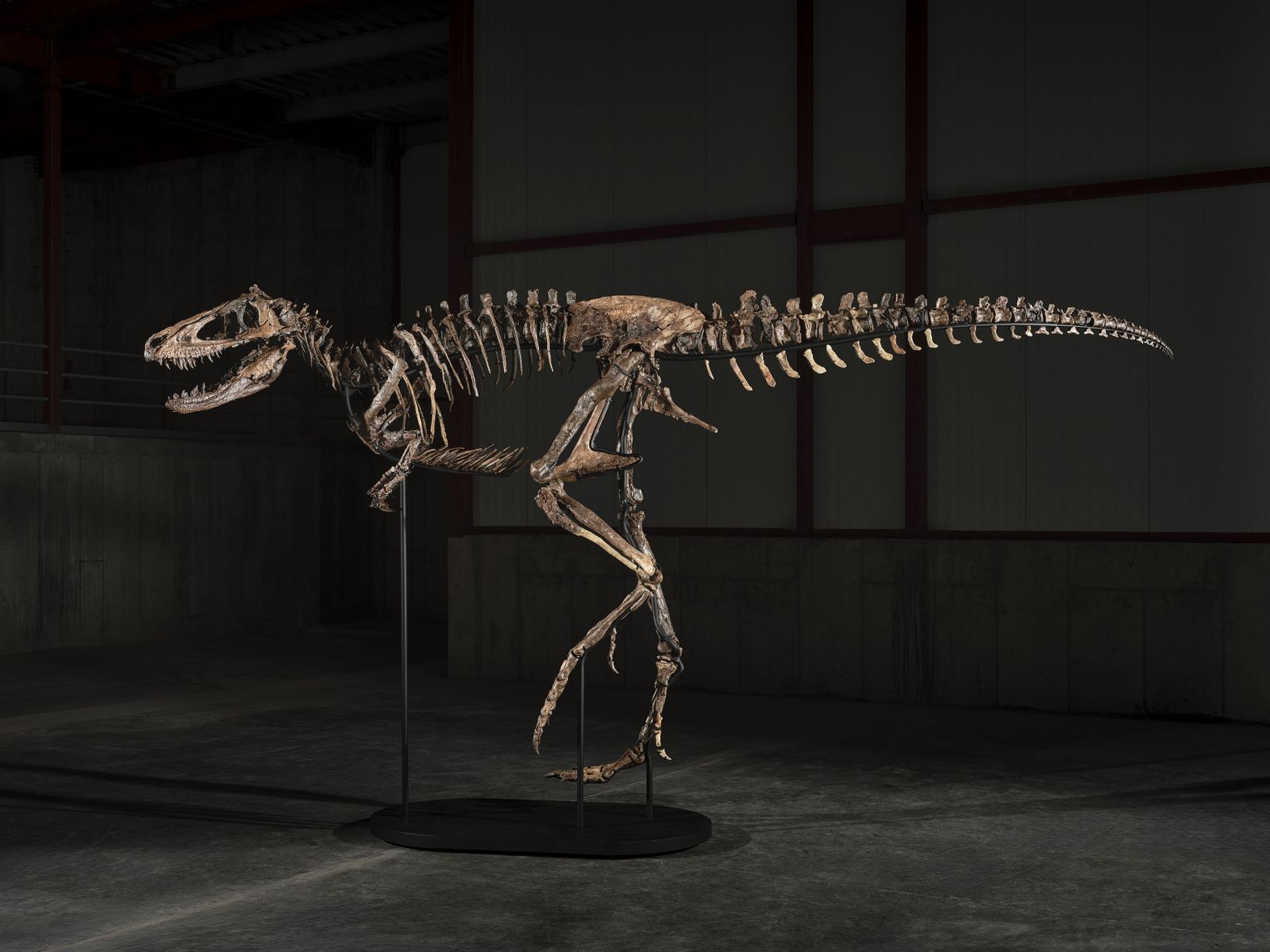
Paleontologists have long argued over whether some small tyrannosaur skeletons belonged to a new genus, called Nanotyrannus, or were young Tyrannosaurus rex. “Jodi” was sold just one year after researchers reported the most conclusive evidence yet that Nanotyrannus is valid October 29, 2026 10:00 a.m. "Jodi" is the most complete known skeleton of a Nanotyrannus Matthew Sherman One year after the Nanotyrannus genus was largely confirmed as separate from its Tyrannosaurus rex cousin, the world’s most complete Nanotyrannus skeleton sold at auction for a whopping $47.3 million dollars. It’s now the second most valuable dinosaur ever sold, although auction house Sotheby’s has not disclosed the buyer. Dubbed “Jodi,” the roughly 67-million-year-old skeleton measures nearly 10 feet tall and just over 19 feet long. The adult specimen represents one of three mostly complete Nanotyrannus skeletons and features bones including a skull, around 50 teeth, a pelvic girdle, many leg and arm bones, claws, and dozens of vertebrae and ribs, according to another statement. The fossil’s namesake, rancher Jodi Pierson, discovered the Nanotyrannus remains on her land in Montana in 2019. The fossil was preserved in the Hell Creek Formation, a fossil-rich rock formation that stretches across Montana, the Dakotas and Wyoming. Pierson’s cousin Clayton Phipps, a commercial paleontologist nicknamed the “Dinosaur Cowboy,” excavated the skeleton. Jodi was found on private land in Montana. Matthew Sherman This exceptional fossil became part of an enduring debate. It all started when paleontologists in Montana excavated a small Tyrannosaurus rex-like skull in 1942. Analyses of it split the research community into two camps: those who suspected it represented a new genus and species, N. lancensis, and those who instead suspected that it was just a young T. rex. More than 80 years later, Nanotyrannus supporters appear to have won. In a Nature study published in October 2025, researchers claimed to have conclusively demonstrated that Nanotyrannus was its own genus and includes two known species, N. lancensis and N. lethaeus. They investigated a teensy tyrannosaur specimen from a larger fossil unit nicknamed the “Dueling Dinosaurs,” in which a Nanotyrannus and Triceratops look like they’re fighting. Jodi was found just eight miles from where the Dueling Dinosaurs were discovered in 2006. Jodi is a Nanotyrannus cf. lancensis, though “cf.” means that the identification is still uncertain. In fact, the New York Times’ Sopan Deb reports that some scientists still argue over whether there are two distinct species in the genus. Sotheby’s estimated Jodi would fetch between $6 million and $9 million. But by the end of an intense 12-minute bidding battle between six contenders on October 27, the skeleton sold for more than five times the high end of its maximum evaluation. Only one dinosaur—“Gus” the T. rex—has sold for more money. That fossil went for $50.1 million this past July. Quick fact: Gus is massive At 38 feet long, Gus is about twice Jodi’s length. The T. rex stands at 12.5 feet tall. “It does feel like this is a bubble of prices on dinosaurs which must burst at some point; they can’t keep rising forever,” David Hone, a paleontologist at Queen Mary University of London, tells CNN’s Jacopo Prisco. Hone was very surprised about Jodi’s steep winning bid. The exceptional selling point prices out many public institutions, and some scientists worry about such special specimens disappearing into the hands of private owners. “We’ve really just found out that Nanotyrannus is real, and now one of the best skeletons is about to be sold to the highest bidder,” Steve Brusatte, a paleontologist at the University of Edinburgh in Scotland, tells BBC News’ Angus Thompson. “It’s harrowing to think it could disappear into the vaults of a collector rather than displayed on a museum where it can wow and inspire kids and families and the public at large.” “A person really interested in paleontology could do vastly more good by supporting the ongoing operations of multiple museums than the sale of one specimen,” Thomas R. Holtz Jr., a paleontologist at the University of Maryland, tells the Guardian’s Anna Betts and Jenna Amatulli. But Megan Jacobs, a paleontologist at the University of Portsmouth in England, doesn’t “begrudge the people involved for wanting to sell it for such a large amount of money,” she tells BBC Radio 4’s “Today” program, per BBC News. “Although it’s a scary prospect, actually a lot of [dinosaurs sold to private collectors] have ended up in the public eye.” For instance, a Stegosaurus skeleton called “Apex” was purchased by hedge fund billionaire Kenneth Griffin in a 2024 auction, but it’s currently on long-term loan at the American Museum of Natural History. “These things without a doubt will end up in a museum at some point,” Jacobs adds. You Might Also Like Get the latest stories in your inbox every weekday. More about: Auctions Dinosaurs Fossils Montana Paleontologists
A Rare Nanotyrannus Skeleton Sells for $47.3 Million, Becoming the Second Most Valuable Dinosaur Ever Auctioned
Full Article
Original Source
Read the full article at Smithsonianmag →KhanList aggregates and links to publicly available news content. We do not host full articles from third-party sources. Always verify important information with original sources.