
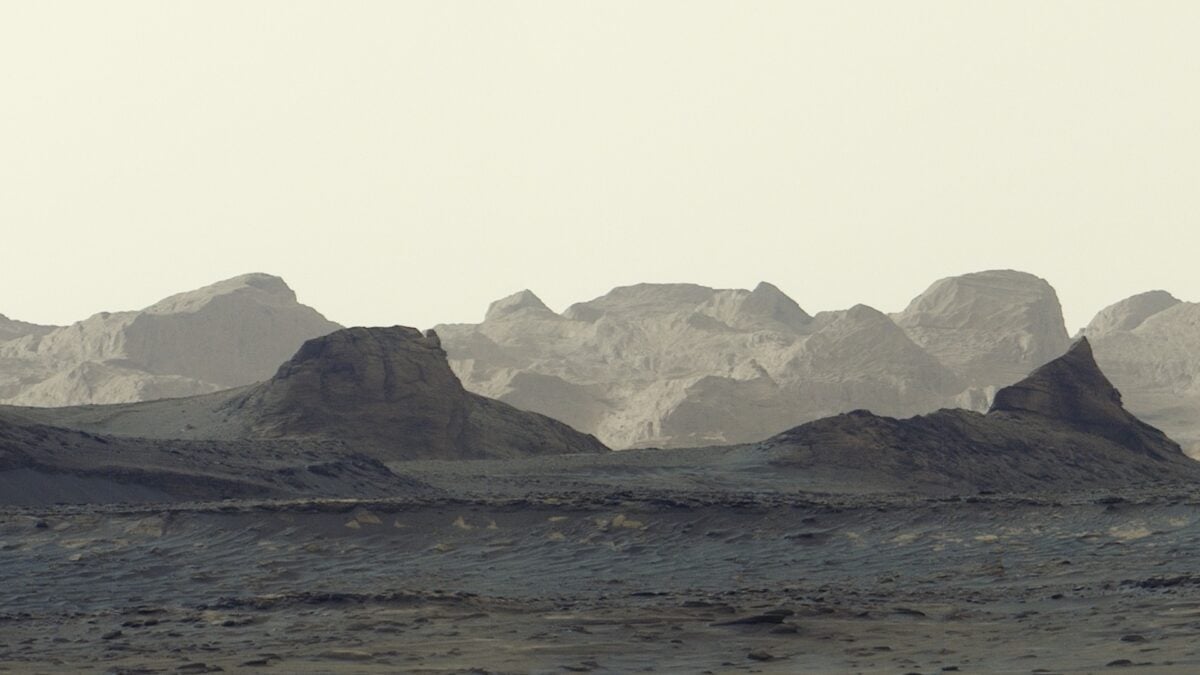
NASA just released a striking new image of the Martian landscape taken during the quiet, early morning hours of dawn. The image reveals the captivating shapes of wind-carved cliffs as they are gently illuminated by the Sun’s first light. NASA’s Curiosity rover captured the scene on August 11 at 8:30 a.m. local Mars time, about an hour after sunrise. Using the rover’s Mastcam, scientists were able to get the most detailed view yet of steep, rugged crags, known as yardangs, scattered across the horizon. This layer of rock formation is unlike any other seen by Curiosity so far, and scientists aren’t quite sure how it came to be. “The yardang layer looks out of place. It’s the wrong color, the layers tilt at an odd angle, and it almost appears plastered on,” Ashwin Vasavada, Curiosity project scientist at NASA’s Jet Propulsion Laboratory, said in a statement. “But that’s what makes it exciting to reach.” Martian dawn The newly released panorama is made up of six individual images that were stitched together to create the dramatic scene. Unlike most images taken by Curiosity’s Mastcam, NASA chose to process this one without white balancing to preserve its early morning appearance. 📍Gale Crater, Aug. 11, 2026, 8:30 a.m. local Mars time. The Curiosity rover captures the Sun rising on crags known as yardangs, a scene that scientists have long been waiting to see up close. 1/2 pic.twitter.com/NJQH9yNEYR — NASA Mars (@NASAMars) October 6, 2026 The resulting image allows us to see Mars in a different light, literally. Instead of the familiar scene of a red-hued, jagged desert, the recently released panorama invokes a soft stillness that, while decidedly alien, still seems awfully familiar. Journey up the mountain Curiosity first landed on Mars’ Gale Crater in 2012 and began climbing the lower slopes of Mount Sharp two years later. Mount Sharp is a 3-mile-tall (5-kilometer-tall) mountain at the center of the impact basin. It’s made up of layers, each preserving a different piece of history from Mars’ past. The rover recently reached 0.6 miles (1 kilometer) of elevation, the most ever climbed on Mars. As it continues on its journey up the mountain, Curiosity is now getting closer to the yardangs. The yardang layer extends roughly 10 miles (16 kilometers) across the northwestern reaches of Mount Sharp, and it may have formed around 3 billion years ago along with the rest of the mountain. “No one is sure exactly what created this layer, but one idea is it may be ash deposited by ancient volcanic eruptions,” Vasavada said. The team of scientists behind the mission are hoping that Curiosity will reach the base of the yardangs by 2027, where the rover will be able to use its robotic hand to collect data on the mysterious rock formations.
A Rare Image of Mars at Dawn Reveals the Beauty of Its Ancient Cliffs
Full Article
Original Source
Read the full article at Gizmodo →KhanList aggregates and links to publicly available news content. We do not host full articles from third-party sources. Always verify important information with original sources.