
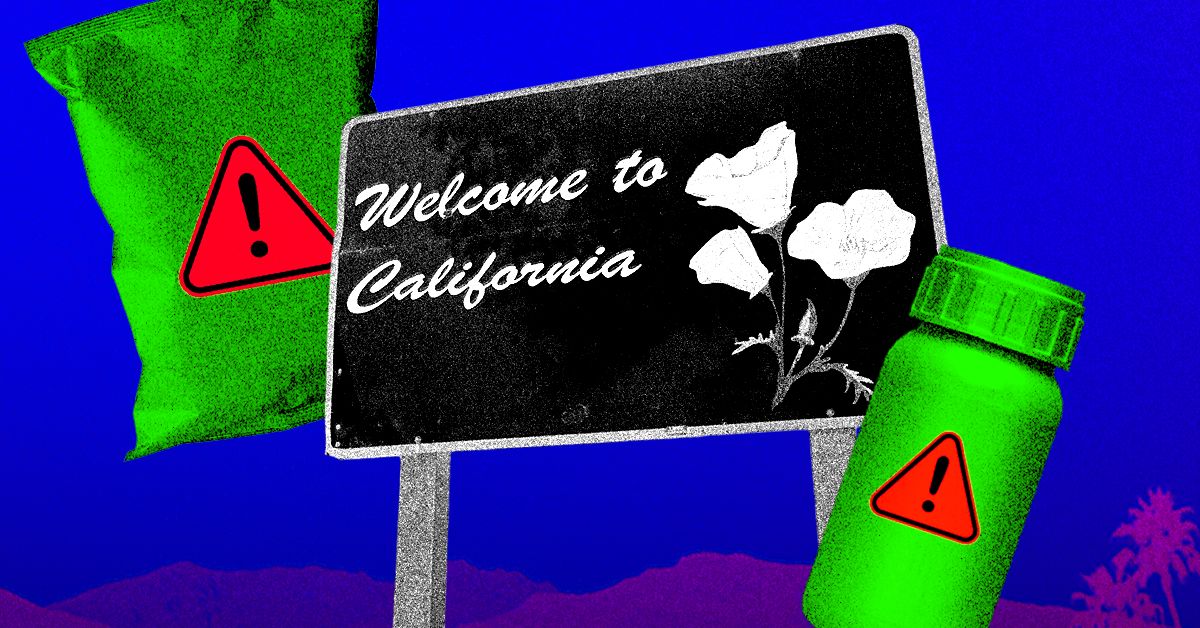
My first encounter with a Prop 65 warning was on the back of my TV.I was selling it on Facebook Marketplace, and when the buyer arrived to pick it up, he spotted a warning I had never noticed. “California Proposition 65 Warning: This product contains chemicals known to the state of California to cause cancer and birth defects or reproductive harm.” Neither of us had seen such a label before, and for a moment, he didn’t want the TV anymore. We did what anyone would do in this situation: We Googled it. He ended up taking the TV. I kept Googling.California’s Proposition 65, officially called the Safe Drinking Water and Toxic Enforcement Act, applies to a dizzying range of products, from food and cosmetics to electronics and household goods. Passed in 1986, the law turns 40 this year, yet that ominous little label still confuses the average consumer.So, should you steer clear of all products with a Prop 65 warning? Not necessarily. Here’s what you need to know before you panic-buy a new TV.Courtesy of Stephen Osman/Getty ImagesProposition 65, ExplainedIn November 1986, California voters approved Proposition 65 by a landslide margin of about 63 percent to 37 percent. It’s a right-to-know law, meant to inform Californians about potential exposure to chemicals that may cause cancer or reproductive harm over a lifetime.It doesn’t ban those chemicals; instead, it requires businesses to provide a warning when their products could expose people to a listed chemical at levels above specific thresholds.“At that time, it was part of a broader effort to address a growing concern that the public had about toxic chemical exposure,” says Megan Schwarzman, environmental health scientist at UC Berkeley’s School of Public Health.The idea is that consumers can use that information to make their own decisions. A warning might prompt someone to choose an alternative, use a product less frequently, or take other steps to reduce their exposure. Prop 65 also gives businesses an incentive to reformulate products or change manufacturing practices to avoid issuing a warning that may deter customers.And because California is such a massive consumer market, products often need to comply with Prop 65 requirements even when they’re manufactured or sold by companies elsewhere. Some large retailers, such as Target and Amazon, also require their vendors to comply with Prop 65 warning requirements.Prop 65 Is EverywhereProp 65 covers a broad range of products and potential exposures. You can find warnings on fortified foods, smartphones, and appliances. The law is concerned with exposure, not simply whether the chemical is detectable. California's Office of Environmental Health Hazard Assessment (OEHHA) establishes the so-called safe-harbor levels for many listed chemicals. Generally speaking, a warning is required when anticipated exposure exceeds these levels.The Prop 65 list contains both naturally occurring and synthetic chemicals that California has determined are known to cause cancer or reproductive harm. Supplements, for example, can contain trace amounts of naturally occurring or environmental contaminants, including lead, cadmium, and arsenic. The list is updated at least annually, and chemicals can also be removed from the list as scientific evidence evolves.Chemicals can be added to the Prop 65 list through four mechanisms: through California’s Labor Code; through evaluations from California’s Carcinogen Identification Committee (CIC) or Developmental and Reproductive Toxicant Identification Committee (DARTIC); through identification by certain authoritative bodies, like the US Food and Drug Administration (FDA); or through identification by a state or federal agency.Mariana C. Stern, cancer epidemiologist and member of the CIC, says the committee includes epidemiologists, toxicologists, molecular biologists, and cancer scientists who review the available literature before deciding whether a chemical belongs on the list.“We may spend the whole day trying to dissect one chemical,” Stern says. “It’s not uncommon that we end up deciding we don’t have enough evidence to add this compound to the list.”But seeing a warning doesn’t necessarily mean a product contains a dangerous amount of a chemical, or even that the product itself has been tested. According to Schwarzman, “some companies have opted to warn rather than test or reformulate, but from our research, I believe that is much less common than when companies post a warning because of the actual presence of the chemical above a certain threshold.”From a consumer standpoint, the ubiquity of Prop 65 labels also means that it can be harder to prioritize which ones actually warrant attention. “We definitely have a concern with over-warning,” says Tina Cox, section chief of the OEHHA’s Proposition 65 Implementation Program. “Any unnecessary warnings do make it difficult for consumers to identify where the real exposures are, and it does dilute the value of Prop 65 warnings.”As a result, California has started trying to make them more useful by requiring short-form warnings to name at least one chemical, rather than relying on the generic “may cause cancer or reproductive harm” language. Businesses have until January 2028 to fully comply with the new requirement. The state is also conducting more outreach to help companies understand when a warning is required and when it is not.Courtesy of zimmytws/Getty ImagesThe Warning Isn’t a VerdictProp 65 was meant to inform consumers, not to tell them which products to buy. By the same token, a product without a warning isn’t necessarily free of hazardous chemicals.“You’re never going to be zero exposure, even if you avoid all Prop 65 labels,” says air pollution scientist Shahir Fouad Masri. “If you have a product that doesn’t have a label, it’s one of two things: It was tested and it didn’t exceed Prop 65, and therefore it’s safe, or simply nobody ever sent it to the lab.”That said, a Prop 65 warning is still useful information, and there are ways to reduce your exposure to these harmful chemicals. “Everybody has different risk tolerances and different priorities,” says Schwarzman. Consider how frequently you use the product and at what dose.“Exposure from that one product, in many cases, is not going to cause cancer,” adds Cox, “but maybe over a lifetime of exposure, or exposure to similar products that have the same chemical, will increase your risk for cancer or reproductive toxicity.”One example is holiday lights. Flexible plastic components can contain phthalates, which are added to PVC (polyvinyl chloride) to make it more pliable. Those chemicals migrate out of the plastic and come into contact with your hands or enter household dust. “My own choice around that is to handle them briefly and wash my hands,” says Schwarzman. “I don’t have my kids handle them, and I do make a different decision about that than something I’d be consuming on a daily basis.”On a similar note, if you’re concerned about a warning on a tool, Masri suggests wearing gloves to reduce direct skin contact. There’s also a difference in dermal absorption rate. The skin on your hands, for example, is generally thicker and more calloused than the skin on your face, which means less absorption. So you might think differently about a screwdriver you occasionally handle with gloves than an LED mask you put directly on your face every day, where the potential for absorption is higher.TL;DRIf you’re considering a product with a Prop 65 warning, don’t fret. Instead, look for more information.Determine what chemical triggered the warning, if identified.Check whether the manufacturer provides testing or contaminant information. Look for credible third-party certification, where appropriate.Consider how frequently you’re using the product and how extensively. Occasional exposure is different from using something every day.Don’t assume the absence of a Prop 65 label means the product is free of contaminants.For consumers who want to dig deeper, P65warnings.ca.gov has information about individual chemicals and ways to reduce exposure. There’s also a dedicated Help Desk for Prop 65, along with an email and phone line for specific inquiries.If you’re pregnant, trying to become pregnant, taking medications, or managing a medical condition, talk to a qualified health professional.Prop 65 is a right-to-know law meant to raise awareness and ensure that we, as consumers, have an impact on the type of products we’re exposed to in our daily lives. As Schwarzman puts it, “I want to encourage us all not to feel like the toxic things are inevitable, and there’s nothing we can do, because there often is something we can do.”Tina Cox, senior environmental scientist (supervisory) and section chief of the Proposition 65 Implementation Program at the Office of Environmental Health Hazard Assessment (OEHHA)Mariana C. Stern, PhD, a cancer epidemiologist and professor of preventive medicine and urology at the University of Southern California, Keck School of MedicineMegan Schwarzman, MD, a physician and environmental health scientist at UC Berkeley’s School of Public HealthShahir Fouad Masri, ScD, an air pollution scientist at the University of California, Irvine
A Prop 65 Crash Course: What You Need to Know (2026)
Full Article
Original Source
Read the full article at Wired →KhanList aggregates and links to publicly available news content. We do not host full articles from third-party sources. Always verify important information with original sources.