
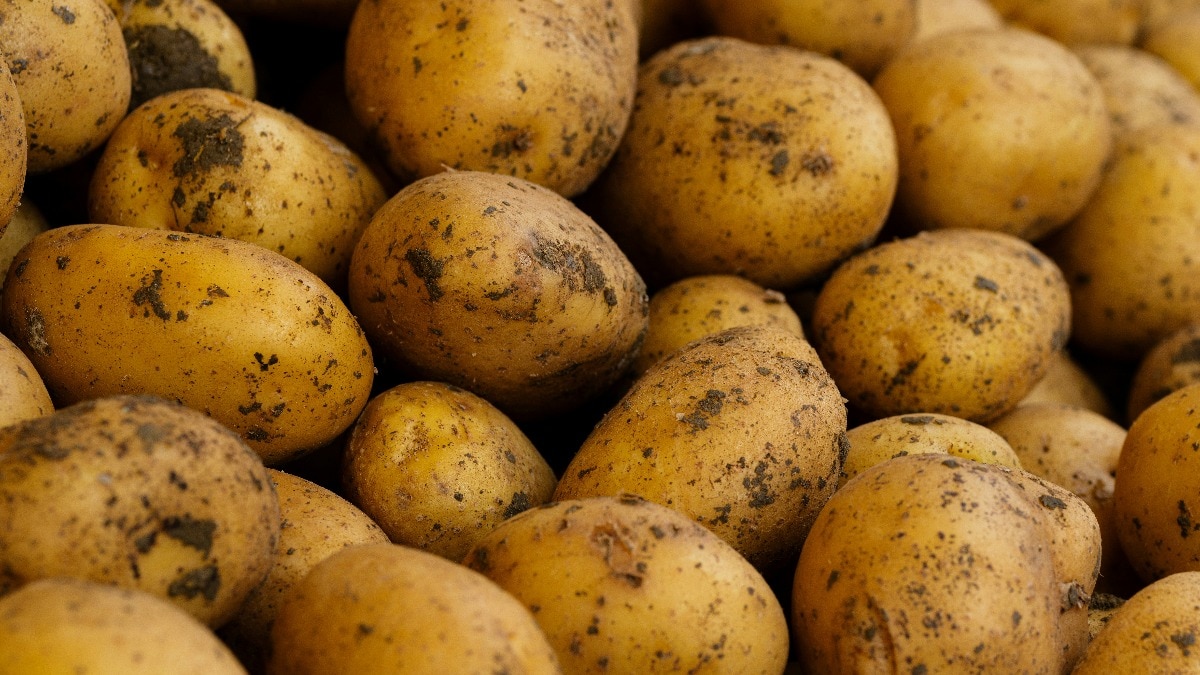
In 1845, a water mould turned Ireland's potato fields black. Within a few years, a million people were dead. More than 180 years later, the same disease still rots potato crops across the world. On October 23, 2026, farmers in Rwanda got an answer, and it came from a cold room in Lima, Peru.Rwanda released two potato varieties that resist late blight, the disease that once starved Ireland. Inside them work three genes borrowed from those wild Peruvian relatives.India, the world's second-largest potato producer, can only watch.Dr Simon Heck, Director General of the International Potato Center (CIP), told India Today Digital in an exclusive interview that Indian farmers cannot grow it yet. "In India at the moment, the policy doesn't allow it to be commercialised. So, it's fairly at the research stage," he said on the sidelines of the Kisan Tak Bharat Agriculture Conference in New Delhi. WHAT IS LATE BLIGHT, AND WHY DOES IT STILL MATTER?Late blight is caused by Phytophthora infestans, a water mould that behaves like a fungus. It turns leaves into black, rotting patches and can wipe out a field within days. Between 1845 and 1852, a lineage of this pathogen destroyed Ireland's potato crop and triggered a famine that killed about a million people. Scientists confirmed this by decoding the DNA of preserved 19th-century leaves, according to a study published in eLife.More than 170 years later, it remains the world's most damaging potato disease, and India is not spared. According to CIP, late blight can cut yields by 13 to 60 per cent, and by up to 75 per cent when left unchecked. In the European Union alone, it costs more than 1 billion euros a year in control measures and crop damage, according to a study published in Potato Research. Wild potatoes stored for decades in a Peruvian gene bank now protect Rwanda's farms from late blight, the disease behind the Irish famine. India, the world's second-largest potato grower, can't grow them yet. Here's why. (Representative image: Unsplash) Farmers fight back with fungicides, spraying again and again through the season. Heck said this "can take up to 40 per cent of production costs."The pathogen is also cunning. It can overcome a single resistance gene, which is why breeders have long struggled to keep it at bay.HOW WAS THE NEW POTATO BUILT?The answer lay in the gene bank. CIP scientists took three resistance genes from wild potato species native to the Andes and stacked them inside potatoes that farmers already love. Two of the genes come from Solanum bulbocastanum and one from Solanum venturii.With three genes standing guard at once, the pathogen finds it far harder to break through. In field trials in Uganda, the triple-gene potatoes showed complete resistance to local blight strains, according to a study published in Plant Biotechnology Journal. India is the world's second-largest potato producer, growing about 60 million tonnes a year. (Representative image: Unsplash) Heck called it a world first. "It's the first time in the world," he said. "We are not producing new varieties. Local varieties become more robust, more resilient."The journey took five to eight years, and much of that time went not into the laboratory but into regulatory approvals, he added.For Heck, the potato is also a lesson in why gene banks matter. "People often wonder why we bother keeping those old varieties that are not of any interest commercially," he said. "But we saw that they may hold the key for future challenges."WHY CAN'T INDIAN FARMERS GROW IT?The reason lies in how India classifies the science.In March 2022, the Union environment ministry exempted certain genome-edited plants from India's strict rules on genetically modified (GM) organisms. In these plants, scientists tweak the plant's own genes without adding new DNA, using techniques known as SDN-1 and SDN-2. In May 2025, India released two genome-edited rice varieties under this route.Inserting a whole gene is a different matter. That technique, known as SDN-3, is still regulated as genetic modification, even when the gene comes from a potato's own wild cousin. The Rwandan potato, built by adding three genes, falls on this side of the line.India's path for GM food crops has been blocked for years. Bt cotton, a non-food crop, remains the only GM crop grown commercially. Bt brinjal has been under a moratorium since 2010. In July 2024, the Supreme Court delivered a split verdict on GM mustard and directed the Centre to frame a national policy on GM crops. Late blight is the single-biggest disease threat to global potato production. (Representative Photo: Unsplash) India's own attempt shows the gap. Scientists at the ICAR-Central Potato Research Institute developed a GM potato carrying the RB gene. This gene was first isolated from Solanum bulbocastanum and gives broad resistance to late blight, according to a study published in PNAS (Proceedings of the National Academy of Sciences). They crossed it with the popular variety Kufri Jyoti. In 2023, the regulator allowed only confined field trials.Heck was careful not to criticise. "We know that India has a different position in policy terms, and we don't so much want to comment on that," he said, noting that Europe is even more conservative.But he warned that hesitation has a price. Indian scientists, he said, should master the technology now, "so that once the policy evolves, they are ready. Otherwise, they are falling behind."WHAT COMES NEXT?India grows about 60 million tonnes of potatoes a year, and Heck expects that figure could double by 2050. CIP is building its South Asia Regional Center in Agra, which he expects to be inaugurated early next year.For now, the wild potatoes of Peru have travelled from a gene bank in Lima to the hills of Rwanda. Whether they reach the fields of Uttar Pradesh and West Bengal depends not on science, but on India's choices.- Ends
A potato that beats the blight is ready. Why Indian farmers can't grow it yet
Full Article
Original Source
Read the full article at Indiatoday →KhanList aggregates and links to publicly available news content. We do not host full articles from third-party sources. Always verify important information with original sources.