
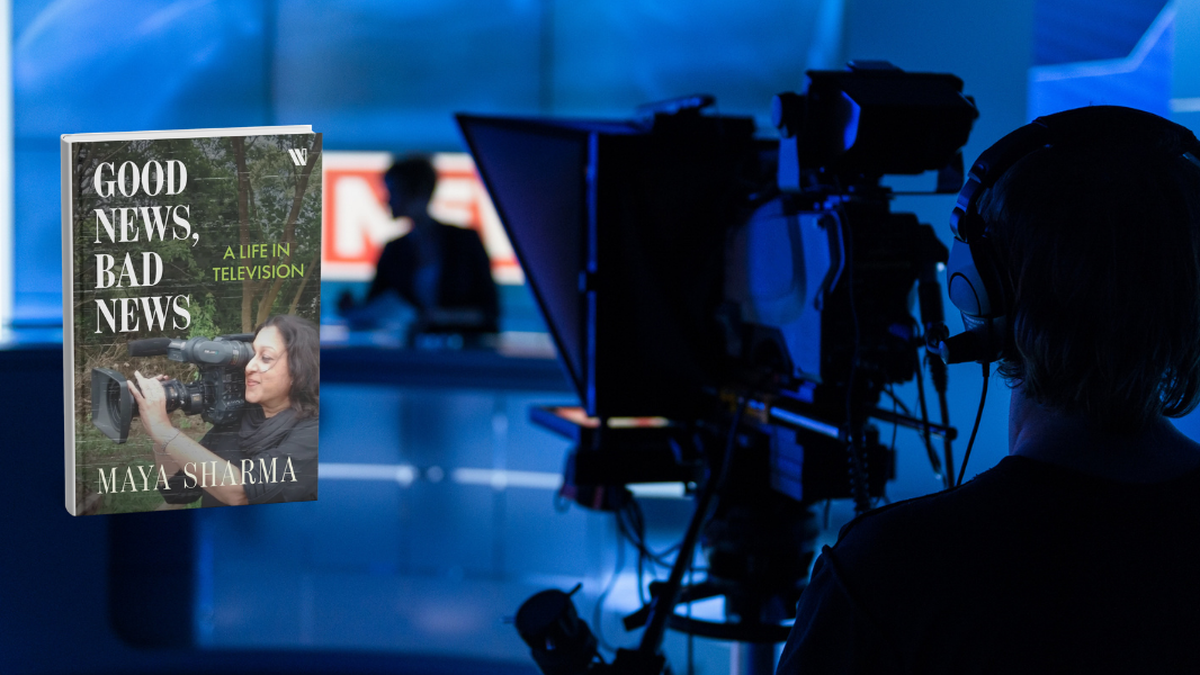
It is but inevitable that the reader would approach veteran television newsperson Maya Sharma’s memoir with some expectation. The author does not disappoint: her recollections flow gently, in the manner she employed on the small screen, speaking directly to the viewer, as she does to the reader here, in a warm, chatty tone.That conversational tone stays intact all through, as she starts unspooling her personal growth story, juxtaposing it with the evolution of television broadcasting. She tracks her 1980s journey starting with the State-owned Doordarshan, then at the private channel NDTV newly set up by Dr. Prannoy Roy and Radhika Roy, and concludes with a succinct summing up of the buyout of NDTV by the Adani Group and its political fallout. While Sharma makes no effort to conceal her respect and affection for the Roys, she documents the changes wrought in the country by private channels in a frank but fair fashion.A winding pathIt wasn’t a straight path to television. After her Mass Communications course, Sharma did stints at Wipro, Times of India, BPL, and Doordarshan before winning a Fulbright Fellowship at Syracuse University in New York state. She was then part of the Bangalore team at DD who got approval for a weekly news magazine called Insight, before moving to NDTV, which, she states, changed the face of TV news in India with its professional approach to production and its liberal editorial stance.Sharma, who has 30 years of work experience, makes it clear that she belongs to the old school of journalism, where the reporter was not the story; stories were well-researched and well-written before they aired, backed by facts rather than surmise or agenda. It was a time when news was announced, not broken, and professionalism ruled the roost.The book is a wide canvas that includes covert sexism in the workplace; the gradual sidelining of regional news in favour of Delhi-based coverage; how Sharma, having become a familiar face, gained access to most politicians in Karnataka; and the government’s eventual decision to stop advertising with NDTV and giving interviews to the channel, thus squeezing it.The language is free of frills, and she infuses the narrative with doses of sarcasm and wit. The irony is unmissable when Sharma states that Doordarshan was never a place where reporters spoke truth to power, they were expected to faithfully highlight the activities of the authorities of the day in a positive light. The reader cannot help but reflect wryly on how it has all come full circle in the present.Sharma’s book may be a personal memoir interspersed with opinions from her peers and former colleagues at NDTV, but it is undoubtedly a vital addition to the documentation of India’s media history. What I found remarkable was the absence of any bitterness; she rues the demise of a more solid substantial kind of television newscasting but is quick to say that maybe the New India wants the kind of channels that have proliferated now. There is a genuine strain of goodwill all through the account; this then, is a polite memoir/media critique. Good News, Bad News: A Life in Television Maya SharmaWestland₹799The reviewer is an independent journalist, columnist, author and manuscript editor. Published - November 13, 2026 06:15 pm IST
A polite media critique | Review of Maya Sharma’s Good News, Bad News
Full Article
Original Source
Read the full article at Thehindu →KhanList aggregates and links to publicly available news content. We do not host full articles from third-party sources. Always verify important information with original sources.