
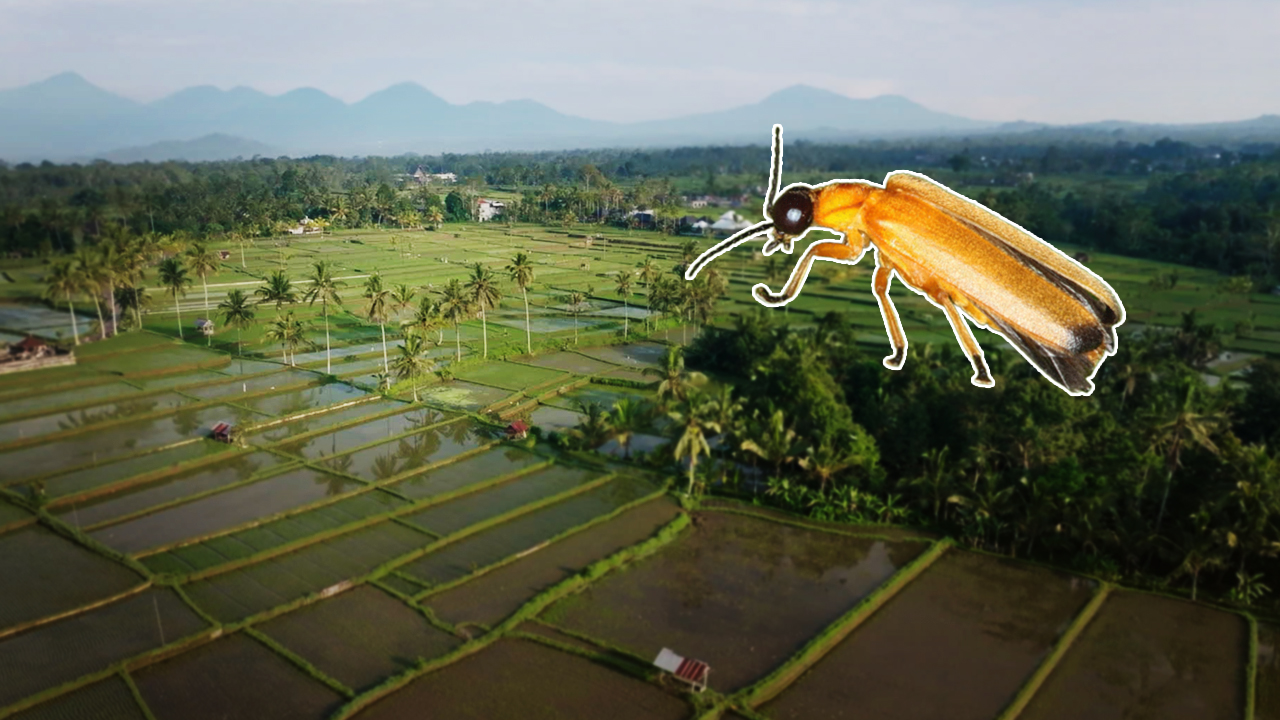
BALI — Indonesia. Wayan Wardika used to see “clouds of fireflies” as a child growing up among the rice fields of Bali, Indonesia. But 40 years later, he realized that the fireflies in his village had all but disappeared.Fireflies in Southeast Asia are vanishing due to habitat loss, light pollution, pesticide use, and climate change—and the same is happening in rapidly developing Bali. Which is a loss for us all, as fireflies are both ecologically and culturally significant.In 2020, Wayan decided to bring the fireflies back, by launching Indonesia’s only firefly conservation initiative called Bring Back the Light. He and his small team of scientists focuses on breeding fireflies to return to the wild. But through this work, Wayan has also gathered the importance of habitat protection – only by doing so will firefly numbers be able to grow sustainably. He is now focused on encouraging neighboring farmers to ditch the chemicals and go organic, in order to boost firefly numbers. Mongabay’s Video Team wants to cover questions and topics that matter to you. Are there any inspiring people, urgent issues, or local stories that you’d like us to cover? We want to hear from you. Be a part of our reporting process—get in touch with us here!Banner image: Firefly over the Bali landscape, collage. ©Rizky Maulana Yanuar TranscriptNotice: Transcripts are machine and human generated and lightly edited for accuracy. They may contain errors.These little fireflies have a big task. They’re being released back into the wild. A small act that can have a huge impact on the island of Bali and its people. Meet Wayan. He’s a big fan of fireflies. When I was little, we didn’t have electricity. I remember seeing clouds of fireflies. I normally collected the fireflies and used them as lights. But 40 years later, Wayan realized that the fireflies in his village had all but disappeared. These bugs glow in the dark to attract mates and to ward off predators. But as Bali continues to develop, they’re losing the night. Too much light it’s disturbing their communications. Villages and rice fields are taking over the forests and streams where they breed. And the chemical fertilizers and pesticides used by farmers degrade their habitat. At least four species in Southeast Asia are close to extinction, which is bad news. Fireflies pollinate local plants and crops. Some species even feed on snails that destroy rice plants, acting as natural pest control. So, I’m trying to bring back the population. In 2020, Wayan set up Bring Back the Light, Indonesia’s only firefly conservation program, on his family farm. Along with three other scientists, Cindy looks after the fireflies from egg to adult. Firefly eggs take just a few weeks to hatch into larva. The larva feed and grow for up to 2 years, then develop into pupae. These transform within a couple of weeks into an adult firefly, which feeds and mates for just 3 weeks before it dies. It’s painstaking work. Once the fireflies lay their eggs, the scientists first find and count them, look after the larva, nurture the pupae, and release the adults. Not much is known about fireflies and their breeding process in Indonesia. So, Wayan’s team is breaking new ground. They have released close to 20,000 larva and adults, and local firefly populations are gradually improving. It’s a slow increase. As we grow our knowledge, we able to contribute more into fireflies repopulation program. But, there’s one problem. Fireflies are highly sensitive to their environment. If the air, water, and soil aren’t healthy, they don’t survive. If we don’t see fireflies, there is something wrong with the ecosystem. So, 4 years ago, Wayan dreamt bigger. My goal now is not only to protect and save the fireflies, but also regenerate the ecosystem. And it all starts with cow poop. We are at the holy white cow conservation, where we collect the manure. Wayan treats this poop into compost. It’s an alternative to chemical fertilizers, one of the main threats to fireflies and their ecosystem. We used to choose cow dung to make fertilizer because it already has earthworm, millions of microorganism that lives and that’s where the plants need. Our main goal is actually to regenerate the soil so that the plants has all the minerals, the nutrition that they require. And that’s not all. So right now we are making eco enzyme. To replace synthetic pesticides, Wayan concocts a formula that deters pests while providing nutrients for crops and soil. It’s made from food waste. So we collect the rejected fruit from the local markets and then use them as a eco enzyme. This is our organic farm. This is where we show our crops. We must lead by example so we must grow our own farm when other farmers ready to follow, we don’t need to convince them. As soil quality improves, crops grow healthier and can sell for more. Profits go up. Eventually, both farmers and fireflies benefit. Wayan aims to convince the other 35 farmers in this area to go organic, thereby ensuring a pesticide-free zone for fireflies. But changing human behavior is now one of his biggest challenges. This transition is not easy, especially when we work with farmers. Wayan distributes his organic fertilizer and pesticides to farmers for free. He also pays the farmers back for any losses incurred during the transition away from chemicals. What I’m trying to do is to create a circular ecosystem where we provide all the materials that the farmers need for growing crops. Wayan funds this effort with revenue from firefly conservation tours and selling organic produce from his farm. The ecotourism is to support the project and then also to support the farmers. Four farmers are involved in the scheme right now. Pak Nyoman is one of them. First I was trying to touch their hearts. So now I’m reverse. I have to fill up the pockets, then we change the hearts. In the beginning it was my personal journey to see fireflies again. But Wayan’s mission has since rippled outwards to his community and to the natural world we live in. We human don’t live alone on this earth. We maintain the sustainability of nature, not just for our generation, but for our future generation. Not just for our kind, but also for the other biodiversity.
A plan to save Bali’s lost fireflies
Full Article
Original Source
Read the full article at News →KhanList aggregates and links to publicly available news content. We do not host full articles from third-party sources. Always verify important information with original sources.