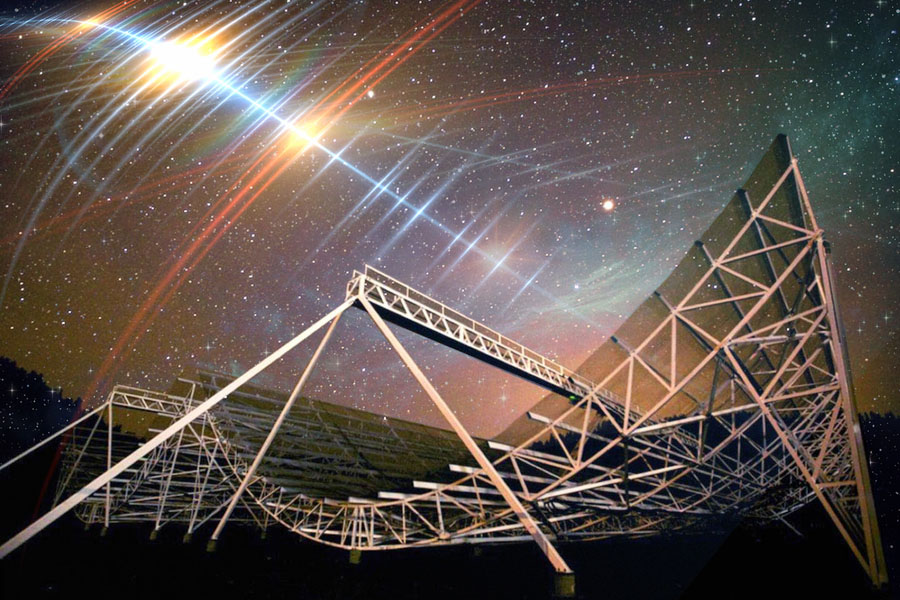
Brief but powerful flashes of radio waves are aiding astronomers’ quest to find and map cosmic gas. Look around and you’d be forgiven for thinking that we can account for most baryons, the “normal” particles such as the protons and neutrons that make up you, me, Earth, and the Sun. But the billions of Milky Way stars, trillions of planets, and extensive clouds of galactic gas — all of them don’t hold a candle to what’s outside our galaxy. Intergalactic gas is so sparse and hot that it’s hard to study. So much so that astronomers talk of the “missing baryon” problem: Observations have difficulty accounting for roughly half of the baryons that should be out there. Now, thanks to brief, once-mysterious flashes of radio waves, astronomers have a new way of observing the stuff between galaxies. Smeared Signals The Canadian Hydrogen Intensity Mapping Experiment (CHIME) has captured several thousand fast radio bursts, brief but powerful flashes of radio waves.Photo courtesy of CHIME, with background edited by MIT News When fast radio bursts (FRBs) first came on the astronomical scene in 2007, no one knew what they were. Now, we can be fairly confident that most originate in or around magnetars — spinning stellar corpses with magnetic fields so powerful, they’d strip a credit card from some 100,000 miles away. FRBs aren’t only interesting for what generates them, exotic as those sources may be. They’re also interesting for what they can do: Every millisecond-long flash of radio waves encodes the density of the sparse gas that the signal passed through on its way to Earth. Plasma delays the passage of lower-frequency radio waves more, smearing out the signal. So the higher an FRB’s dispersion measure, the denser the intervening gas. In other words, every time astronomers catch an FRB, they can map the amount of matter along a line of sight that extends from the explosive magnetar in some distant galaxy all the way to telescopes at Earth. Astronomers have been itching to use these signals to map the gas between galaxies since FRBs’ discovery two decades ago. Now, we’ve finally gotten to the point where FRB numbers are high enough to make that possible. The second iteration of the Canadian Hydrogen Intensity Mapping Experiment (CHIME) catalog contains thousands of FRBs — up from hundreds in the first iteration. Even before the new catalog has officially been published, team members are already putting it to use. What Lies Between This composite image shows Centaurus A, a nearby galaxy with a powerful outflow expelling gas into its surroundings. The composite combines light at visible wavelengths, submillimeter wavelengths (orange), X-rays (blue), and infrared (dark red). Magnetic field lines are overlaid. Visible: ESO's Wide Field Imager; Submillimeter: Max Planck Institute for Radio Astronomy / ESO / APEX / A.Weiss et al.; X-ray: NASA / Chandra / R. Kraft; Infrared: JPL-Caltech / J. Keene / SOFIA / L. Proudfit Haochen Wang (MIT) and colleagues mapped cosmic gas by comparing two maps: One measures the amount of gas along the line of sight to 2,873 FRBs in the new CHIME FRB catalog. Another charts the positions of nearly 6 million galaxies, detected as part of a legacy survey from the Dark Energy Spectroscopy Instrument, part of Kitt Peak Observatory in Arizona. “The second map is really five maps,” Wang explains. Each of those maps contains galaxies divided by distance, with the first map being galaxies closest to us, the next map being the next group farther out, etc. Comparing the two maps enabled the team to figure out where cosmic gas lies — and what the team found surprised them. “We have found evidence that ‘missing’ matter is distributed farther away from galaxies than most simulations predict,” Wang says. “That is surprising because gravity tends to ‘pull everything closer’ to galaxies.” Something must be counteracting that gravitational pull, flinging gas away from galaxies — “such as jets emitted from supermassive black holes and explosions from old dying stars,” he suggests. Those pushes might be more powerful than astronomers thought. While the results contradict simulations, they actually confirm hints astronomers had previously seen at X-ray wavelengths. Those observations, too, showed that the dark matter clouds suffusing galaxy groups are surprisingly empty of normal, baryonic matter — suggesting, again, that something has pushed those particles farther out. The FRB result is just as important for the promise it shows: This is the first time FRBs have been used to map the distribution of gas between galaxies in this way. The technique will only improve as various telescopes expand their searches for these enigmatic events.
A New Way to Map the Universe's Missing Matter
Full Article
Original Source
Read the full article at Skyandtelescope →KhanList aggregates and links to publicly available news content. We do not host full articles from third-party sources. Always verify important information with original sources.