
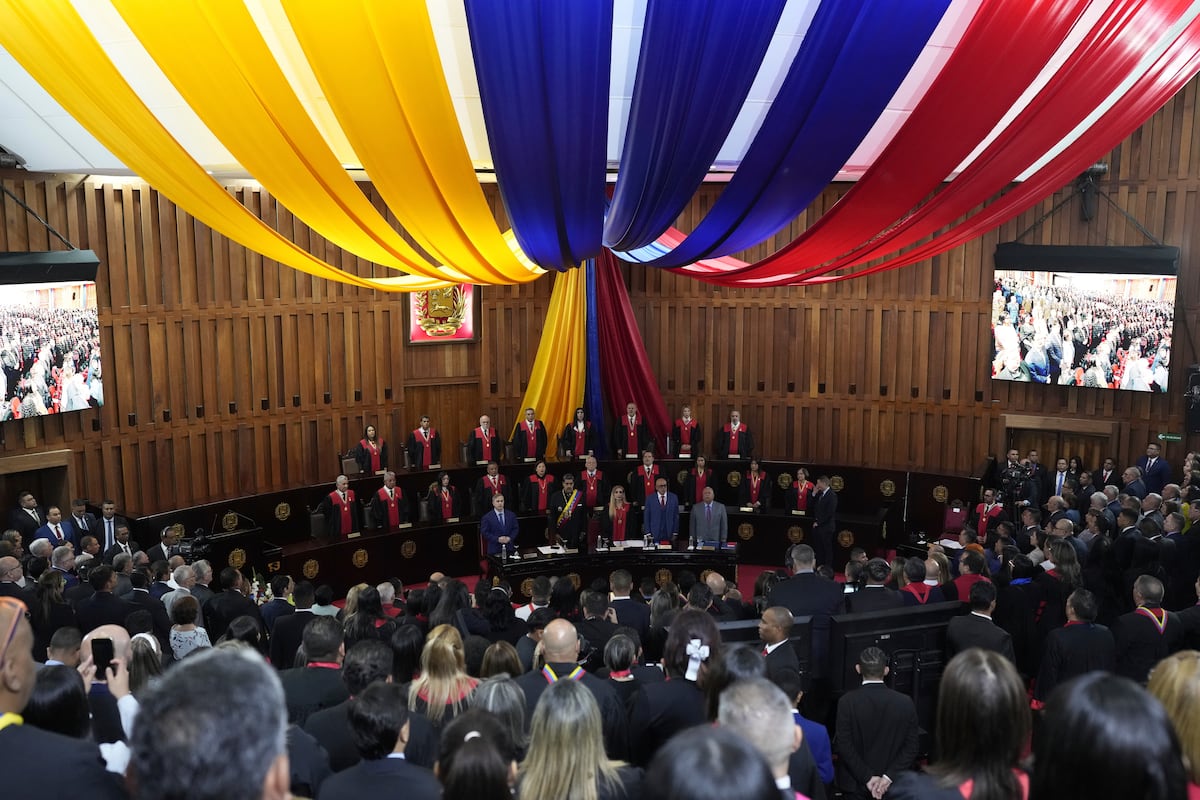
Washington has stepped on the accelerator to renew Venezuela’s Supreme Tribunal. It is its first major democratizing initiative in the country and the main task of the negotiation table between the 2015 National Assembly and the government of Delcy Rodríguez, which meets again this Wednesday. The goal is to have a new court by December, but beyond the outline the United States published last week, nothing is as yet known about the timetables, the profiles sought, the procedures to challenge appointments and how civil society will take part in a process crucial to a country that is supposedly moving toward a democratic transition.Venezuela’s new Supreme Tribunal will be chosen through an unprecedented process. The United States is driving Venezuela’s return to institutional rule through a procedure carried out outside the Venezuelan Constitution. The path has been built from the U.S. State Department, which is closely monitoring the talks at the negotiating table.This renewal process replaces the one Chavismo had launched months earlier in the National Assembly, chaired by Jorge Rodríguez, the same official who now leads the negotiations for the government side. That earlier procedure had evident flaws, such as changing the rules midstream. It was not clear how many magistrates would be chosen and the law was later amended to raise the number of seats on the Supreme Tribunal of Justice (TSJ) from 20 to 32 justices, which increased the number of vacancies. Before the June earthquakes more than 500 applications had been submitted for a single post. No decision has been announced on what will happen to credentials that had already been accepted.The State Department announced the negotiating round amid the emergency caused by the earthquakes, and its first agreement was to renew the Supreme Tribunal in full. Since then the design has been revealed in instalments. Last week, after meeting with Dinorah Figuera, the opposition’s representative in the dialogue, Washington reported that the negotiators had appointed a commission of seven jurists to verify applicants’ credentials. That advisory council will apply the first filter, but it is still unknown on what criteria, and from the list it approves the 32 new justices will be chosen.The other cog of the mechanism, the Nominations Committee, will finish being formed this week. To the 11 deputies who already sit on it, with a Chavista majority, 12 civil society members will be added, though their characteristics, the timetable and procedural details have not been specified. The scale by which candidates for Supreme Tribunal justice will be evaluated is also unknown. “The credentials verification commission opens an opportunity, but it must be governed by transparency,” warned lawyer Magaly Vásquez at a forum organized by the Andrés Bello Catholic University. “It is necessary to know clearly and in advance its powers and that, once the call and selection begin, the rules of the game are not changed.”Among jurists and human rights defenders concern is growing over the haste with which the parties want to close a process full of loose ends, and one that will also serve as a template for the next one: the appointment of a new National Electoral Council, which is on the negotiators’ agenda. What is at stake is a true political transition, and for that reason every step is being watched cautiously while confidence in the process cannot be taken for granted.At forums and meetings there is doubt that the opaque labyrinth of the judiciary can be transformed — a system that has become part of Chavismo’s repressive apparatus, where all judges are provisional, lack career stability and work under heavy pressure. Recent allegations by former magistrate Bárbara César Siero, who says she was coerced through the kidnapping of family members to sign rulings that disqualified opposition politicians (including the ruling against María Corina Machado), have exposed the courts’ lack of independence and the scale of the challenge this reform entails. Even deputy Pablo Pérez, acting vice president of the Nominations Committee, acknowledged this a few days ago: “Aside from the problem of partisan quotas that have been used in the powers, we also have judicial tribes.”Human rights defenders have also issued warnings. “There will not be change or a political transition if minimum democratic standards for oversight are not met. Citizens do not have clear information about the process,” said activist Debora Van Berkel of the NGO Ideas for Democracy at a meeting of rights advocates on Tuesday.The dilemma, various sectors say, is how citizens can scrutinize a process that the United States controls so closely. “The renewal of the judiciary is part of the political and institutional reordering, but we need it so that public powers are genuinely independent and useful to citizens,” said Óscar Murillo, director of Provea, who also emphasized the context in which it is taking place: “Venezuela is in an increasingly factual situation, it is outside the Constitution. And we are here because we want to return to the Constitution. There is a second element, which is the great influence of a key actor, the United States, which can say it is satisfied with the deadlines being set, which are not necessarily those of the people.”Sign up for our weekly newsletter to get more English-language news coverage from EL PAÍS USA Edition
A new Supreme Tribunal for Venezuela, rushed and without clear rules
Full Article
Original Source
Read the full article at English →KhanList aggregates and links to publicly available news content. We do not host full articles from third-party sources. Always verify important information with original sources.