
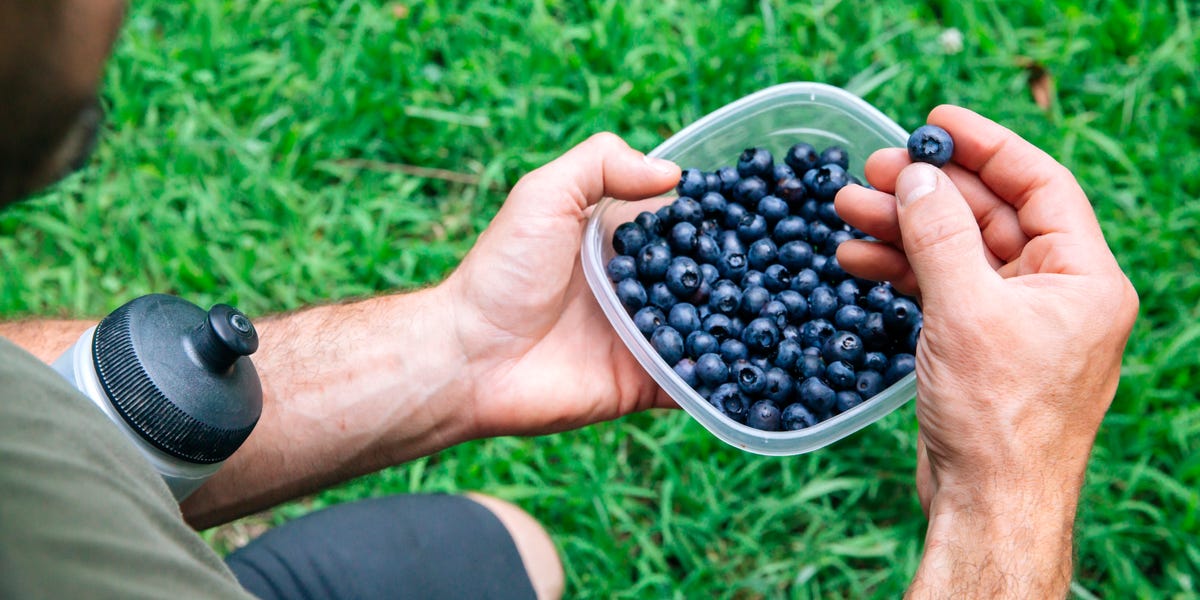
“Berry-doping” was certainly not on my 2026 bingo card … but there’s evidence it may deserve a square in 2027. In a small study* published in the International Journal of Sport Nutrition and Exercise Metabolism, researchers found that blueberries provided a modest performance aid for running.The study involved nine trail runners, two time trials, a battery of pre- and post-race physiological tests, and quite a few blueberries. And the results were pretty clear: Participants saw overall improvements in their running performance and several physiological measures—including resting heart rate and perceived tiredness—when they followed a blueberry-loading protocol in the week immediately before a race.As a blueberry-loving runner, I eagerly accepted these findings—but not without a little skepticism. Could simply eating blueberries really make you faster? And even if it could, it would have to be a truckload of them, right? I decided to test the research myself.For more than a week, I tried berry-doping on my own to see if I’d experience similar results. To match the study’s methods exactly, I’d have to down a lot of fruit … but it’d be worth it for a berry-fueled PR.What the Researchers FoundResearchers asked nine participants who each ran an average of at least 25 miles per week to complete two 22.2-kilometer (or 13.8-mile) time trials, separated by a 21-day washout period during which participants continued their normal training. Before each trial, participants supplemented for one week with either freeze-dried highbush blueberry powder or a placebo powder. Runners consumed three 25-gram packets per day.Each packet of blueberry powder contained the equivalent of 142 grams of fresh blueberries, meaning each runner consumed a daily dose of about three cups of berries, according to researchers’ calculations. Neither the participants nor the researchers knew who consumed which powder prior to each race. (The placebo powder matched the blueberry powder in calories, carbohydrates, taste, and appearance—but not nutrient content.)For each time trial, runners completed a three-loop trail race as fast as they could. In addition to tracking finish times, researchers monitored runners’ heart rates and muscle soreness, performed tests to measure cardiovascular, muscle, and lung functions, and collected ratings of perceived exertion after each race loop.After both time trials, researchers compared each runner’s blueberry trial with that same runner’s placebo trial. They found that the runners’ blueberry-supplemented race times were more than seven minutes faster, with an average finish time of 2:37:05 compared with 2:44:30. That’s an overall improvement of 4.2 percent—about the same boost you might expect from a pair of super shoes.Researchers also found that runners didn’t work measurably harder, even though they completed the time trial faster. Runners’ average and maximum heart rates, as well as their ratings of perceived exertion, were comparable in both groups. Plus, they saw lower resting heart rates and reported less tiredness when following the blueberry supplementation protocol.That said, berries didn’t move the needle on every metric. Researchers found no significant effect on muscle soreness or strength, blood pressure, pulmonary inflammation, cortisol levels, or upper-respiratory symptoms.“It’s possible that the blueberry supplementation reduced the oxidative stress and inflammation that could have occurred during the trail race, thus reducing exercise-induced muscle damage,” explains Luisa Giles, PhD, the study’s lead author and associate professor of kinesiology at the University of the Fraser Valley in Canada. “The supplementation also could have affected nitric oxide availability, which may have helped increase blood flow to runners’ muscles.” Together, those effects may have helped runners maintain muscle function throughout the race, allowing them to run faster.So Could Eating Blueberries Improve My Running? While my own experiment wasn’t nearly as rigorous, it matched the daily blueberry equivalent that the study participants followed. Three cups per day may sound like a lot, but with the right approach, I found it easier than expected to hit my daily berry quota.But since I already consume the Mayo Clinic’s recommended daily amount of fiber for women my age (25 to 28 grams), I wanted to make sure adding high-fiber berries too quickly didn’t lead to any midrun bathroom emergencies.For two days, I ate one cup of frozen wild blueberries, then increased to two cups for another two days, and finally ramped up to the three-cup goal—and kept my intake there for a full week. I prepared myself for some digestive weirdness, but gratefully, I didn’t experience any. I credit that to spreading out my blueberries across the day and ensuring that the largest amount I consumed at once (two cups in my smoothie) occurred after I’d already finished my run for the day.Across the seven days of berry-loading, I didn’t see any significant variations in my resting heart rate or in the average paces of my runs. However, I did have one run on Day 5 that felt spectacular—I’d attribute that to the slightly cooler September weather, but it’s still been touching 80 degrees in eastern Pennsylvania these days, and the humidity certainly hasn’t quit.Of course, I knew I was housing three cups of blueberries daily. So when I felt less tired immediately after my long run, I suspected it could partially be my subconscious rooting for the berries.That said, one finding was beyond question: Blueberries surpass every other fruit I’ve thrown into my postrun smoothies—and I’ve been blending them up on a daily basis for years. Out of habit, I usually relied on frozen strawberries. But I found blueberries make for a smoother blend (fewer seeds stick in your teeth) and a sweeter taste profile (a not-quite-ripe strawberry has some tang). This discovery alone made me more eager to get in my postrun fuel instead of waiting until I was ravenous.The drawback? Price. I used frozen wild blueberries for my experiment, which are significantly cheaper than fresh berries. Still, the 27-cup total from my grocery store came in at a little more than $25. (If I went the fresh-not-frozen route, it would have cost more than $70.) I’m pretty generous with my smoothie budget, because I know that’s the only way I’m getting in my postrun nutrition consistently—but I won’t assume other runners feel the same.Benefits of BlueberriesWhy do researchers believe runners experienced the performance improvements they did? As Giles noted above, the blueberries’ polyphenols—naturally occurring plant compounds—may have helped protect runners’ muscles against exercise-induced damage.Polyphenols have been shown to reduce inflammation and oxidative stress, write Giles and Jason Brandenburg, PhD, the study’s coauthor and an associate professor of kinesiology at the University of the Fraser Valley. Preloading with the polyphenol-rich blueberry supplement may have helped blunt some of the damaging effects that occur during prolonged, high-intensity exercise. (In a sense, the polyphenols acted like sunscreen does when it protects your skin from a burn.) And as any runner knows, your muscles don’t function as efficiently when they’re damaged, sore, or inflamed.As a result, researchers theorize that better-preserved muscle function may improve endurance performance. For the study participants, that translated to 4.2 percent faster finish times—along with other favorable findings, including lower resting heart rates and less perceived tiredness.But is berry-doping the next frontier in running performance? The evidence is compelling, but my own real-world experiment yielded less convincing results. Either way, that doesn’t detract from everything blueberries already have going for them: a solid dose of fiber, powerful antioxidants, and the ability to elevate your next postrun smoothie.*The United States Highbush Blueberry Council provided funding for this research. Morgan is a gear editor who has been with Runner’s World since 2017. She started as an intern ghostwriting The Warmup, a bygone version of the daily RW newsletter. Now, she tests and reviews anything you might find on runners’ feet-from crew socks and compression boots to carbon-plated super shoes. A lifelong runner and shoe geek, Morgan has been chasing the perfect pair of kicks since she joined her grade school cross-country team. Since then, she ran as a Division I walk-on for the cross-country and track & field teams at the University of Delaware, where she studied English and Biology. She has one full marathon under her belt, and has raced more halfs and 5Ks than she can count.
A New Study Says Blueberries Can Improve Running Performance—but You Need to Eat a Lot of Them. Here’s What I Learned When I Tried It Myself
Full Article
Original Source
Read the full article at Runnersworld →KhanList aggregates and links to publicly available news content. We do not host full articles from third-party sources. Always verify important information with original sources.