
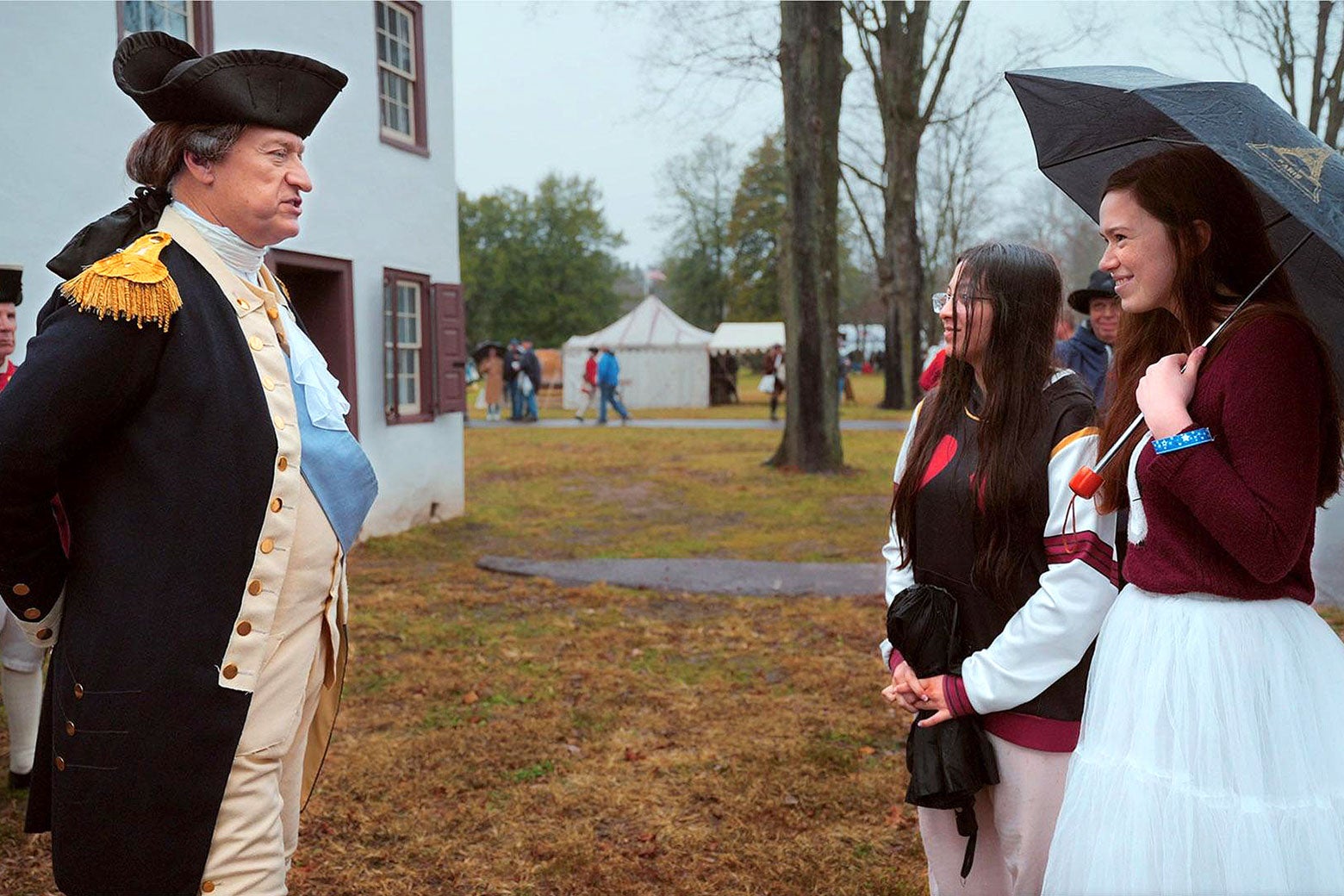
Television Bucks County, USA examines our political divisions and finds very fine people on both sides. By Enter your email to receive alerts for this author. Sign in or create an account to better manage your email preferences. Unsubscribe from email alerts Are you sure you want to unsubscribe from email alerts for Sam Adams? Sept 21, 20262:46 PM American Public Television Sign up for the Slatest to get the most insightful analysis, criticism, and advice out there, delivered to your inbox daily. Philadelphia’s collar counties are some of the most sought-after real estate in American politics, the swingingest part of a critical swing state. And Bucks County, which sprawls northward along the New Jersey border, is the most evenly divided of them all. In 2024, the county cast more than 400,000 votes for president; Donald Trump won by fewer than 300. So it was a shock even to some locals when the Bucks County school board took a massive turn to the right in 2021, with a newly radicalized Republican majority pulling books from school libraries and banning pride flags and other symbols of support from the classroom. It must have seemed like the perfect spot for Barry Levinson and Robert May to set a five-episode docuseries on the political polarization of America, centered on the friendship between two high school girls whose parents hold vastly different political views. Bucks County, USA generated controversy even before it aired, when a scheduled screening at Bucks County Community College was abruptly canceled for unspecified safety concerns last week. But you wouldn’t know it from the giggly camaraderie between Evi Casey, an effervescent theater kid who favors tulle skirts and goes gaga for Hamilton, and Vanessa Martino, a bright STEM kid who speaks in bunched-up clusters. The two might seem like an odd pair even if it weren’t for the political divisions between their families. But the strength of their friendship serves as an implicit rebuke to the grown-ups around them: If the kids can look past their differences, why can’t you? With its first episode debuting on PBS a year and a half after the first two episodes premiered at Sundance, the series poses the same question to its intended audience of well-heeled centrists: Can’t we just handle our differences like adults? Evi and Vanessa’s parents, however, aren’t just run-of-the-mill voters. Vanessa’s father is Paul Martino, a wealthy venture capitalist who spent half a million dollars backing far-right candidates for the Bucks County school board in 2021. The unprecedented sum had the desired effect in Bucks County but also fanned the flames of similar movements across the country, as parents radicalized by pandemic school closures and exposure to their children’s virtual classrooms pushed back at the schools’ influence over their children’s lives. Things, as Bucks County, USA periodically reminds us, got ugly fast. The screen regularly fills with vitriolic comments taken from social media, and an audio collage near the beginning features unidentified voices listing all the things they’ve been called: Bigot. Pedophile. COVID denier.Anti-American. Nazi. Where Levinson and May get into trouble is in treating those epithets as equivalent, as if bigot and transphobe were merely unkind insults, out of bounds no matter how extreme the views of the people they’re describing. Donte King, the Black father of a young daughter, recalls the pain that flooded into his face when his daughter innocently repeated a racist joke she’d heard from a classmate, and Lily Freeman, a trans high school senior, relates the physical and mental abuse she’s suffered at school. But like the deaths that prompted the COVID closures in the first place, their injuries are minimized or simply denied by enraged conservatives who’ve only just cottoned on to what their kids are learning in school. Martino and his wife Aarati, an engineer at Google, say they moved to the prosperous suburb of Doylestown to avoid having to raise their kids in “crazy San Francisco.” The town’s carefully curated main street features prominently in the show’s early episodes as Evi and Vanessa browse for poetry books and walk past the marquee of the beloved local art house. (You can mark the passage of time by the changing of movie titles on the County Theater’s marquee.) But despite their distaste for San Francisco values, the Martinos brought with them the tech-culture principle that systems exist to be disrupted, and, at least in Paul’s case, a triumphalist mindset more common in a corporate CEO than a concerned parent. (Evi’s mom says she and Vanessa get along fine, but Paul’s another matter entirely.) He says it’s all about the children, of course. But though he sits for numerous interviews and the camera follows him to plenty of political events, we rarely see him with his own kids, and when they sit down for a family game night, their interactions feel awkward. Later in the series, Evi says that even when they go out for family dinners, her parents just end up talking about school board elections. “It’s really aggressive,” she says. For Bucks County, USA to work, the sides must be evenly matched, in rhetoric and in power. But as Kitty Semisch, a retired teacher who approaches the heated political environment as she might a rambunctious classroom, tells Martino, “I don’t have your money.” If the series has an adult analogue to Evi and Vanessa’s friendship, it’s the substantially spikier relationship between Kitty and Vonna DeArmond, who the show identifies as a third-grade teacher. (Her social media profiles list her as a fitness instructor and wellness coach.) The two sit down over cheese at the end of the second episode for a cordial tête-à-tête, but by the fifth, Vonda’s insisting there’s proof that Haitians ate pets in Ohio, and acting shocked when Kitty insists otherwise. One constant in the show is the frequency with which subjects who seem levelheaded and friendly abruptly turn conspiratorial when the subject shifts to a particular issue. (Even the member of Moms for Liberty comes off as someone you’d happily have over for dinner.) There are, to coin a phrase, problems on both sides. But the most extreme voices are represented only by anonymous comments, and without any context, Bucks County, USA asks the viewer to take it as read that harsh words are never justified, even when the safety of children and fundamental constitutional principles are at stake. The show eats its own tail when the final episode catches up to the Sundance premiere, and the heated audience comments after the screening leave the impression that the episodes have reopened old wounds rather than moved toward healing. (The post-screening discussion between the documentary’s subjects, some of whom had never met before, goes even worse.) In practical terms, it’s true that Bucks County’s residents have to learn how to live together, and the series ends on a strained note of hope. But it’s mired in the fatal fallacy that the center lies an even distance from each extreme, because an asymmetrical shift in the nation’s political culture would throw off its ultimate lesson: Everybody just needs to calm down. Levinson and May can’t get their heads around the idea that some things are worth yelling about. Education Politics TV Documentaries Pennsylvania
A New PBS Documentary Offers a Gentle Message to Our Polarized Times. I Hated It.
Full Article
Original Source
Read the full article at Slate →KhanList aggregates and links to publicly available news content. We do not host full articles from third-party sources. Always verify important information with original sources.