
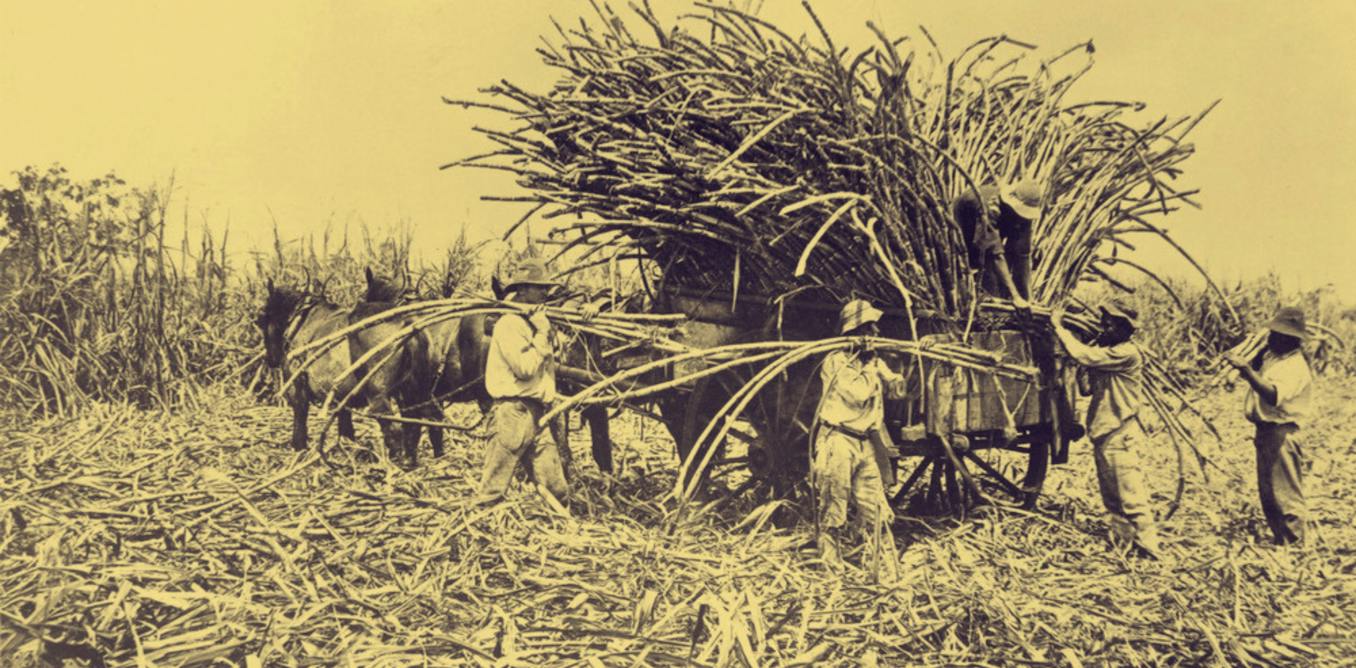
In the second half of the 19th century, colonial agriculture and pastoralism in Queensland were hungry for labour, and people of the South Pacific supplied much of it. Ryan Butta is not the first author to write the history of their maltreatment, but Blackbirding is a readable reminder of a shameful source of Queensland’s prosperity – he calls it “slavery” – that will make it known to new audiences. Review: Blackbirding: A Reckoning with the Australian Slave Trade – Ryan Butta (Affirm Press) Butta’s “slave trade” story is richly descriptive because the inflow, service and, in some cases, return of these people fascinated and outraged contemporary observers. Indeed, Queenslanders’ exposés, inquiries and regulatory efforts are as much the book’s subject as the “blackbirding” itself. Early ventures Butta, a freelance researcher and writer, begins his account with the trade’s forerunner, entrepreneur Benjamin Boyd, who in 1847 attempted to bring Pacific Island labour to New South Wales to fill the gap left by Britain’s decision to cease convict transportation. Boyd met resistance, including from Sydney’s Atlas newspaper, which predicted “pastures filled not with European Christians but with cannibals fresh from their last disgusting banquet”. Benjamin Boyd (1796-1851). State Library of New South Wales, Public domain, via Wikimedia Commons To thwart Boyd, the New South Wales Legislative Council amended the Masters and Servants Act to make it impossible for him to enforce employment contracts signed by “any native of any savage or uncivilised tribe, inhabiting any Island or Country in the Pacific Ocean”. Boyd departed for California in 1849. Butta writes that little is known of those Boyd “at best lured, and at worst and most likely kidnapped” to work in NSW. In the 1850s and 1860s, other Sydney-based entrepreneurs recruited Pacific Island men and took them to Natal in South Africa, Réunion and Peru. These short-lived ventures exposed the difficulty, for regulators, of assigning culpability. Did blame rest with the recruiting agent? The local chiefs who sold captured boys and women for muskets and calico? The ship’s captain? The employer who paid a recruitment and transport fee? The latter, Butta argues, was effectively the purchase of a person. The disruption of the global cotton industry by the American Civil War (1861-65) was an opportunity for British-born sandalwood trader and landowner Robert Towns to grow cotton in Queensland and import Asian workers to pick it. Towns had form. In 1854, a Select Committee on Asiatic Labour, chaired by Henry Parkes, had found evidence that Towns’ Chinese workers had been deceived and maltreated. Towns acquired land in the new colony of Queensland, which had separated from New South Wales in 1859. The colony’s first governor, George Bowen, attempted in the Coolie Labour Act 1862 to regulate what would otherwise be a “deluge” of “barbarians”. Towns supported the act because it enabled the regulated inflow and outflow of cheap labourers. In 1863, Towns turned to the Pacific as his source, encouraged by the apparent ease with which Peruvian ships were getting men from the islands. When Queensland Legislative Assembly member Theophilus Pugh demanded to know the terms of the recruits’ consent, Towns made public his written instructions to his recruiter Henry Ross Lewin, an illiterate. Citing press articles, the testament of “abolitionist” journalist Robert Short and the evidence of Captain George Palmer of the British Admiralty, Butta devotes many pages to Lewin’s practices, holding Towns responsible. Problems of regulation Queensland was obliged to enforce Britain’s anti-slavery laws. But its parliament included men made wealthy by access to cheap labour. By 1867, the Queensland government was being told that Europeans attempting business on some Pacific Islands were subject to revenge attacks provoked by kidnappings. Queensland’s Polynesian Labourers Act 1868, Butta argues, did not protect the islanders from kidnapping and slavery. The effect of the legislation’s “bonds, guarantees and sureties”, he writes, was to protect “the slavers from accusations of kidnapping and slavery”. Public agitation in Sydney gave rise to a petition critical of the act. The French government complained to Britain that blackbirding was negatively affecting their colonial subjects in the Pacific. With little confidence in the Queensland parliament’s select committee review of the act, Britain instructed the New South Wales government to conduct a royal commission in 1869. Dealing with the problem by regulation was not easy. The crucial transactions were taking place on the islands, far from a policing authority. One of Queensland’s experiments was to place a government agent on recruiting ships. The first appointed – John Meiklejohn, an ex-magistrate and sugarcane farmer from Maryborough – reported that the captain of the Jason, one of the recruiting ships, had drugged him and imprisoned him below decks when he questioned the recruiting practices of that voyage. Suffering, exploitation and death Butta’s third section takes the story from 1872 to 1892. He highlights another limit of Queensland law: “heathens” could not swear an oath, enabling courts to discount their testimonies. There were, however, conscientious Queensland public servants – such as Richard Bingham Sheridan of Maryborough – willing to report abuse of Pacific Islanders. A select committee discredited Sheridan in 1876, but Butta labels that another planter whitewash. From returning kin, Pacific Islanders were learning of bad experiences. As early as 1871, a ship’s captain reported their growing wariness of recruiters. Chiefs who brokered the trade asked a higher price, demanding Snider rifles. Communities that menaced resident Europeans were harshly punished by visits from British Admiralty. To appease critics armed with data about work conditions, the government revised the Pacific Labourers Act in 1880 and 1884, creating a Pacific Islanders Fund, managed by the government, to build hospitals. Butta’s story is a reminder of the importance of London – both press and government – in the “human rights” politics of the Australian colonies. The British government disallowed Queensland Premier Thomas McIlwraith’s attempt in 1883 to annex parts of New Guinea not under Dutch authority, partly because it saw in the land grab the colony’s subservience to the planter interest in what one adviser called “a modified form of Slave Trade”. South Sea Islander cane cutters on a sugar cane plantation in Queensland c.1900. State Library of Queensland, via Wikimedia Commons In 1884, McIlwraith’s successor as premier, Samuel Griffith, initiated a royal commission to examine eight recent recruiting voyages by six vessels. The shocked public was told that the regulatory measures enacted so far had not prevented suffering, exploitation and death. These findings established a mandate for the Griffith government to repatriate as many New Guineans as could be prised from the canegrowers’ grip. Then, in 1885, Griffith confronted the sugar industry (not least the Colonial Sugar Refining Company), legislating a plantation inspectorate and a termination (by December 31 1890) of the recruitment of Pacific Islanders. The industry responded by petitioning Queen Victoria – 12,000 signatures – to make North Queensland a separate colony. Britain’s refusal honoured the abolitionist tradition dear to imperial liberalism, but Butta points to the previous decades of what amounted to imperial and colonial tolerance. Further, he cites Short and Griffith to argue that liberal horror of Queensland’s slave trade included fear the white colonies of British Australia were being degraded by aliens. Some colonists thought Queensland’s prosperity had become too dependent on the sugar industry and that white workers were shirking the physical challenge of tropical settlement. When Griffith lifted the ban on recruiting in 1892, worried it would damage an industry that was too big to fail, criticism of Pacific labour recruitment was renewed, gaining strength from the discussion of federation. The other Australasian colonies had a stake in the fight to protect the racial purity of Queensland. “In the eyes of Queensland’s neighbours,” writes Butta, “a Federation that admitted black people was a Federation not worth having.” Australia’s first prime minister, Edmund Barton. State Library of New South Wales, Public domain, via Wikimedia Commons Advocates of federation feared that, even if members of the Pacific Island community were free and prospering – no longer “slaves” – they would be a problem, just as emancipated “Negroes” were a problem for the United States. Edmund Barton, before he became Australia’s first prime minister, assured a Sydney audience in 1892 that “they could always be got rid of if necessary”. In 1901, he introduced a bill in the new federal parliament to stop the importation of Pacific Islanders by March 31 1904 and for the deportation of Pacific Islanders after December 31 1906. When Queensland’s premier, Robert Philp, protested what the planters saw as a threat to their industry, Barton responded that because whites and blacks were not of equal intelligence, “the savage employed by the white man is […] more or less a slave even under agreement”. The manifest racial inequality of the US was Barton’s cautionary example. The Pacific labourers must go back to their islands, lest they remain in Australia as the oppressed equivalent of the emancipated Negro. For Butta, it is ironic “the beginning of the end of the Australian slave trade” was a law conceived in “overtly racist” terms. The ‘Kanaka Appeal’ In a 1902 “Kanaka Appeal”, many islanders pleaded to stay in Australia. They evoked themselves not as slaves, but as free communities, working, worshipping and attending school alongside white Australians. But as Butta comments, “they had no such freedom”. The reader needs to pause here to parse Butta’s use of “freedom”, which points to a dilemma of perspective that his book never resolves. I take him to mean the islanders were not free to stay in Australia. Yet, the authors of the Kanaka Appeal saw themselves as free. To name the coercive cruelty of the recruitment and employment of Pacific labour, Butta repeatedly uses the terms “slave” and “slave trade”. But he also writes that not every Pacific Islander that came to Australia was kidnapped or stolen or coerced or decoyed. Some men came willingly. Not all men were treated awfully on the boats […] no two Pacific Islanders had the same experience of being caught up in the Australian slave trade. This caveat, which places “experience” outside the frame, drains “slave” of sociological meaning. The term expresses Butta’s moral disgust, and many stories he tells make it easy for a reader to share that disgust. But this is our disgust, not their experience. As his favoured term of moral and legal condemnation, “slave” effectively renders Pacific Islander experience invisible, beyond our reckoning. Thus, Butta ignores a rich body of scholarship by historians, such as Deryck Scarr, Clive Moore, Peter Corris, Ralph Shlomowitz, Kay Saunders, Doug Munro and Patricia Mercer, which shows the Pacific labourers to be much more than victims of the traders and planters. Workers whose time had expired bargained for better conditions. Some bought land. Butta’s restricted choice of sources and scholarship has the effect of confining readers’ empathy to the white defenders and critics of the “slave trade”. He does not provide evidence of “slave” experience. Determined to illustrate “slavery”, he says little of the labourers’ recovery and resilience. He has little to say about the two generations of adaptation that preceded and made possible the Kanaka Appeal. By 1902, Butta writes, Some Pacific Islanders had been in Australia since the 1860s. Some were born here and had never known any other country or family. Some had escaped their bondage and made lives for themselves, owned property, started small businesses and raised families. The official figure for those exempted from deportation is 1,654; this included many couples, the demographic basis of today’s South Sea Islander community. Blackbirding concludes in the present, with two stories. First, Butta offers a vignette of the family history of former Prime Minister John Winston Howard. To curious readers, I say no more. Then Butta describes the recent Pacific Australia Labour Mobility (PALM) scheme and draws on the work of the Office of the Fair Work Ombudsman and the NSW anti-slavery commissioner to list PALM’s failures to protect labourers’ rights. He expresses his outrage by estimating that 41,000 people are “living in modern slavery in Australia”. But I wonder what they would say?
A new history of ‘blackbirding’ favours moral condemnation at the expense of complexity
Full Article
Original Source
Read the full article at Theconversation →KhanList aggregates and links to publicly available news content. We do not host full articles from third-party sources. Always verify important information with original sources.