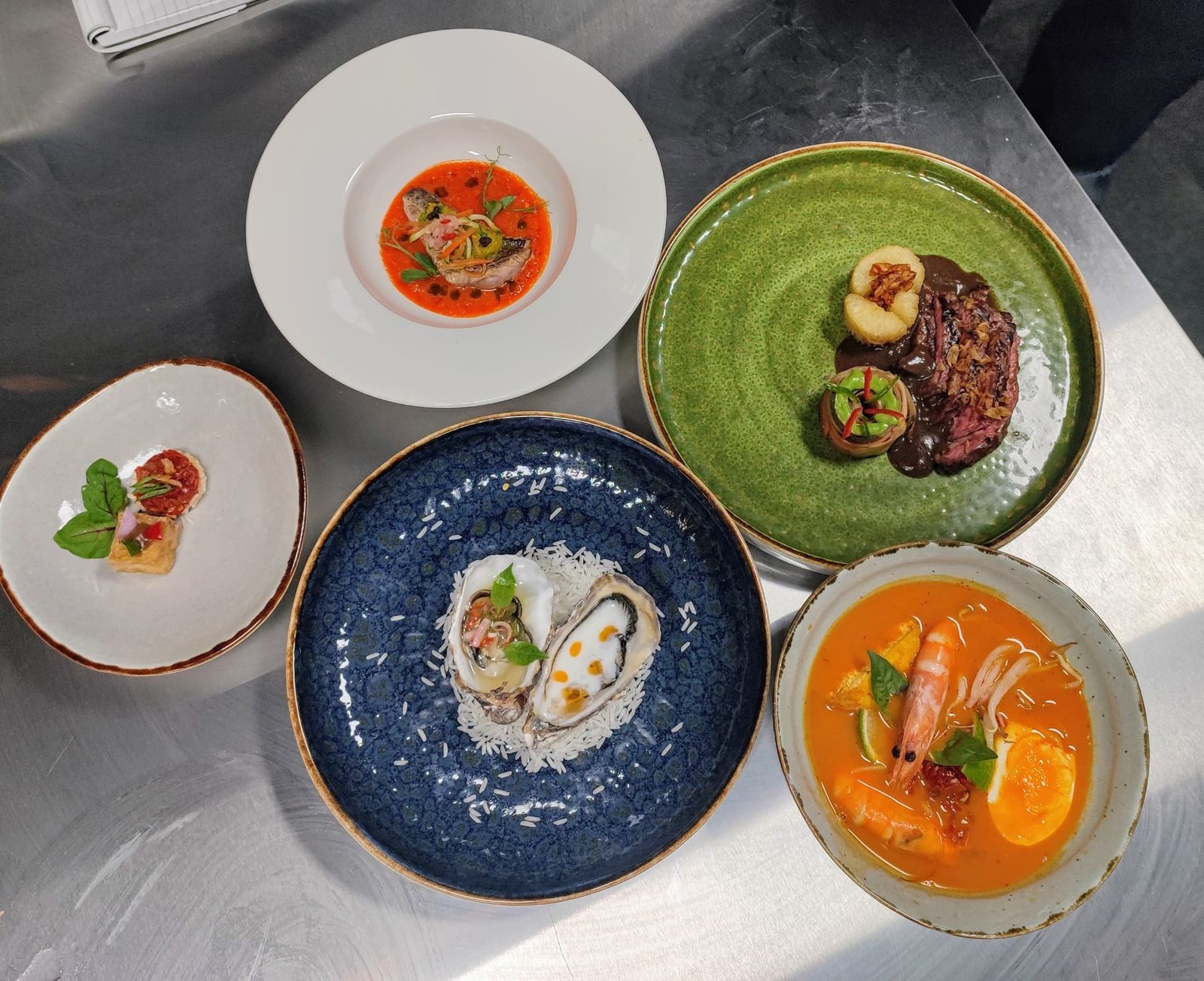
A New Generation of Chefs Reimagines Indonesian Cuisine in the Netherlands to Tell the Stories of Its Origins The shift reflects a larger cultural moment, with chefs asking whether the cuisine should remain tied to colonial nostalgia or evolve into a reflection of modern Indonesian identity At Nona Manis, dining guests can enjoy a prix-fixe menu that may include any of these dishes: ikan pindang patin (braised fish), steak semur (steak with kecap manis sauce), laksa (seafood curry soup), oyster sambal matah and oyster gulai Aceh (oyster on the half shell with Balinese sambal and Aceh curry). Edward Roesdi In the Dutch town of Oegstgeest just outside Leiden, soft lighting glows against warm wood and avocado green walls in Nona Manis’ intimate dining room. The evening’s meal unfolds as an intimate prix-fixe menu. One by one, the dishes announce their arrival with the fragrance of aromatics like lemongrass and lime leaves, and earthy spices like coriander and cinnamon wafting from plates that are as carefully composed as they are colorful. They arrive with fine dining precision, offering an intimate journey across Indonesia: delicate otak-otak, grilled banana leaf-wrapped fish cake from Palembang; kerang sambal matah, raw oysters with Balinese chile relish; followed by smoky ikan woku belanga, Minahasa-style fish scented with lemon basil from North Sulawesi; and terong cabe hijau, tender eggplant stuffed with tempeh in a rich and creamy coconut lodeh sauce. Wines are paired with each course, and chef Eduard Roesdi often emerges to explain the ingredients and their origins. The absence of rijsttafel—a communal spread of rice accompanied by dozens of small, shareable Indonesian dishes such as rendang, sate, gado-gado and sambals—isn’t an omission. It’s the point: a deliberate shift from the colonial-era Dutch invention in favor of a contemporary Indonesian cuisine that celebrates the diversity of the archipelago, one region and one ingredient at a time. Husband and wife team Eduard Roesdi and Renu Lubis opened Nona Manis in 2023. Reza Roesdi The colonial origins of Indo-Dutch cuisine Even though rijsttafel (meaning “rice table” in Dutch) has long been associated with Indonesian restaurants in the Netherlands, it is a distinctly Dutch colonial cuisine. The Dutch East Indies—now Indonesia—was under Dutch rule for over 300 years. The Dutch East India Company was founded to capitalize on the spice trade generated from the islands. Two centuries later, in 1799, the company folded, and the Netherlands formally colonized the archipelago. Presented with pomp and circumstance by servants, rijsttafel was a way for the Dutch to showcase their vast wealth and the empire’s reach. After Indonesia declared independence in 1945, the practice was largely rejected in the country as an unwanted reminder of colonial oppression. In the Netherlands, however, the trajectory of rijsttafel was vastly different. Post-decolonization, revolutionary militias in Indonesia targeted Europeans and Eurasians. As a result, hundreds of thousands of Dutch citizens and people of mixed Dutch-Indonesian descent were repatriated or fled to the Netherlands. Many opened small food shops (tokos) and Indonesian restaurants. While Indo-Dutch (those of mixed heritage) families continued to serve the original, spicy version of Indonesian or Indo-Dutch food at gatherings, restaurants kept the rijsttafel tradition alive in a different way. They started serving a scaled-down version where diners could enjoy a communal spread of rice accompanied by dozens of small, shareable dishes. According to Tom Hoogervorst, a culinary historian at the Royal Netherlands Institute of Southeast Asian and Caribbean Studies in Leiden, cuisines often change in diaspora. And the disparity can be more evident in restaurants. Quick fact: How Indonesia fought for its independence During World War II, the Japanese invaded the Dutch East Indies. From 1942 to 1945, they controlled the archipelago. When Japan surrendered in 1945, revolutionary leaders declared Indonesia's independence, but the fight between the Netherlands and Indonesia raged on for four years. In 1949, the Dutch and Indonesians reached an agreement, and the Republic of Indonesia was formally recognized. To attract and keep customers, restaurants had to adapt flavors to Dutch preferences, not just because of sourcing difficulties but also because some herbs and spices might be considered too intense for local palates. In addition, Dutch people tend to eat more side dishes and less rice, a preference dating back to the colonial period. “The rijsttafel itself is a product of Indonesian ingredients and dishes being adapted to suit European tastes,” says Hoogervorst. Over successive generations of Dutch families, dining at Indonesian restaurants and having rijsttafel became a tradition for celebrating birthdays, anniversaries and other special occasions. “It gradually took on a new meaning and became an important part of Dutch culinary heritage and of the cultural identity of many Indo-European families,” says culinary heritage expert Helena Smit, founder and director of Eating Habits, a foundation exploring the shared food cultures of the Netherlands and Indonesia. Rijsttafel is so deeply integrated into Dutch culture that it was added to the Netherlands’ National Inventory of Intangible Cultural Heritage (the Kenniscentrum Immaterieel Erfgoed Nederland) in 2022. A cultural practice must first be inscribed to this national inventory before the government can nominate it for UNESCO’s World Heritage List. According to its website, “Indies cooking and the Indies rijsttafel tradition have their origins in the former Dutch East Indies. Consequently, this intangible heritage forms part of the socio-cultural community rooted in the former Dutch East Indies, which continued to exist after decolonization and has managed to develop.” But rijsttafel’s prevalence in the Netherlands is problematic in that many people believe it represents Indonesian cuisine in its entirety. “It represents only one part of a much larger and more diverse culinary landscape,” explains Smit. “Indonesia has an incredibly diverse regional food culture. … That diversity deserves much greater visibility.” Not surprisingly, a new generation of chefs with Indonesian and Indo-Dutch roots are challenging that legacy and moving beyond the spectacle of the rice table. The shift reflects a larger cultural moment, and chefs are asking whether the cuisine should remain tied to colonial nostalgia or evolve into a reflection of modern Indonesian identity and diaspora creativity. Roesdi of Nona Manis and his wife, Renu Lubis, have made up their minds. “Our [tasting menu] concept is a conscious choice,” says Lubis. “We wanted to move beyond the colonial image of Indonesian food and introduce our guests to the richness and regional diversity of Indonesia’s culinary traditions.” Meet the new generation Roesdi and Lubis are no strangers to the food business. They have run Toko Iboe Tjilik in Leiden since 1999. Together, Dutch-born Roesdi and Indonesia-born Lubis were inspired to create a restaurant that presents Indonesian cuisine on its own terms. In 2023, they opened Nona Manis. “We wanted to present Indonesian food in a more refined and contemporary way while staying true to its rich traditions and flavors,” says Lubis. For Roesdi, Nona Manis also provides the opportunity to express his creativity as a chef and explore new ways of showcasing Indonesian food. By choosing a fine dining concept with a set menu, they can take their guests on a culinary journey through Indonesia. “It also gives us the opportunity to present traditional flavors with more refinement and creativity, while always respecting their origins,” says Lubis. The move away from rijsttafel was deliberate. “Rijsttafel is not Indonesian,” says Lubis. “It is part of the Dutch colonial history and does not reflect the way people eat in Indonesia.” She also laments that rijsttafels in the Netherlands almost always come with the same selection of dishes. “Indonesia’s culinary heritage is so much richer and more diverse than that,” she says. Running the restaurant hasn’t been easy. There was always a risk that their concept wouldn’t succeed, that customers wouldn’t come, says Lubis. “We wondered whether people would embrace a restaurant that offered a different perspective on Indonesian cuisine, but we both truly believed in the vision behind Nona Manis,” she says. That vision has paid off. “Our guests have been open to discovering Indonesian cuisine in a new way,” says Lubis. “That gives us confidence that there is room for this concept and encourages us to keep telling the story of Indonesia through our food.” Chef and co-owner of Kokkie Londo Ipul Hadi welcomes dining guests to his tropical-themed restaurant wearing traditional Javanese kain (cloth). Raymond Draijer Hadi rotates his nasi campur (mixed rice) plates, and their names, daily. This assortment—Sego Balik Ndeso (rice back to the village)—comprises dishes like ayam bakar pedas manis (grilled sweet and spicy chicken), urap (mixed vegetables and herbs) and sup ayam jamur kuping (chicken soup with wood ear mushrooms). Raymond Draijer Ipul Hadi has also been buoyed by support for Kokkie Londo, a warung (a roadside stall) that he and life and business partner Raymond Draijer opened in 2018, first in Bennebroek, outside of Amsterdam. It is now a small restaurant in Haarlem. “Kokkie Londo began with a desire to bring real, home-cooked Javanese food à la kampung [a traditional Indonesian village] to Haarlem,” says Hadi. “The kind of comfort food we actually eat at home, made with love and intention.” Hadi says that Kokkie Londo’s nasi campur (mixed rice) concept, a dish that is popular throughout Indonesia, isn’t very different from rijsttafel. “Nasi campur is essentially a beautifully curated, mini rijsttafel served exactly how it’s meant to be enjoyed—harmoniously balanced on a single plate.” At Kokkie Londo, each meal comprises rice and an assortment of vegetables, meats, plant-based proteins and sambals. Sound familiar? The nasi campur includes 11 items arranged on a plate. Hadi is inspired by dishes from his kampung in Malang, East Java, as well as the vibrant, aromatic flavors of Bali and Lombok. The menu changes daily and draws on these diverse flavors to keep the meals exciting. “We are serving the living, breathing reality of Indonesian cuisine today,” he says. Hadi says he is proud that their concept represents an about-turn from the overwhelming abundance of rijsttafel, and embraces zero-waste, high-quality and traditional ways that he says are important to diners. “It allows us to honor the food much better … and to have respect for the ingredients,” he says. Servé Dierdorp, a French-trained chef, is also concerned about the sustainability of ingredients, but in a slightly different way. Dierdorp and his business partner, Jack Wolsten, created their first Koki Putih pop-up in Amsterdam in November 2025, aiming to prioritize Indonesian techniques and combine them with local, seasonal products. This fig leaf lemper (Indonesian rice roll) is filled with oyster mushrooms baked in a local green bumbu (Indonesian-inspired spice mix, made with lemon balm, pickled cauliflower, ramsons, walnut, coriander seed and spring onion). Lisa Kroeske Take lemper, a chicken-stuffed coconut rice dumpling traditionally wrapped in banana leaf. Banana leaves have to be imported to the Netherlands and are expensive, so Dierdorp came up with an alternative: “The fig leaf has a similar flavor profile to coconut,” he says, “so we use fig leaves as a more sustainable and local substitute.” The goal at Koki Putih is to serve Indo-Dutch dishes in a way that brings them back to their Indonesian roots. Dierdorp acknowledges that not all ingredients can be replaced with local substitutes, and he tries to use traditional preparation methods. “That means hours spent grinding bumbu [spice pastes] and sambal in the mortar,” he says, laughing. “Occasionally, we blend Western techniques to highlight Indonesian classics, such as our atjar tjampoer [pickled vegetables] sorbet or rendang pie [beef curry pie].” Dierdorp, who is third-generation Indo-Dutch, is no stranger to Indonesian flavors. His grandmother, who arrived from Jakarta in 1955, served him “the real-deal spicy Indonesian food” when he was 10. The food was so spicy he ended up being sick for three days. “I couldn’t handle the heat, but I loved the food so much I couldn’t stop eating it, and it didn’t stop me from eating it ever since.” From then on, the food at other Indonesian restaurants in the Netherlands couldn’t compare. For Dierdorp, this experience has served him well. Blending east and west in the kitchen comes naturally to the chef. “What inspires me most is history, culture, my taste memories and the stories behind them,” he says. The Koki Putih menu rotates, but it usually comprises five courses. Some of Dierdorp’s favorites include rawon (beef stew flavored with kluwek, a black nut). It’s a dish rarely seen in the Netherlands, but one that resonates with his grandfather’s roots in Surabaya. “I reimagined the dish by preparing a traditional rawon, but adding beef and bone marrow meatballs,” Dierdorp says. He has also served ikan goreng with sambal tomat (fried fish with tomato sambal), a dish his mother used to make. “After visiting Jakarta and discovering this dish as a Peranakan specialty in Glodok [Jakarta’s Chinatown], it all made sense, knowing my grandmother was born in Jakarta,” he says. Reinvention isn’t erasure Some diners have been surprised by how spicy Koki Putih’s sambals are and the complexity of its vegetarian dishes. “For us, this confirms that we don’t compromise on traditional flavors or cultural authenticity,” says Dierdorp. “But we compose dishes to create a balance that everyone can enjoy.” For this reason, Koki Putih’s concept has sometimes been labeled Indonesian instead of Dutch-Indonesian. “That is partially true, because the Dutch-Indonesian cuisine is part Indonesian, but I also think the rijsttafel doesn’t define Dutch-Indonesian heritage. The dishes and the stories related to them do,” says Dierdorp. “We define ourselves as a Dutch-Indonesian concept that does not serve rijsttafel.” Rather than rejecting tradition, chefs like Dierdorp are expanding what “Indonesian cuisine” looks like. Dierdorp is glad to see more Indonesian restaurants opening in Amsterdam and beyond. “But this makes it even more important to keep Dutch-Indonesian culture alive as well,” he says. He thinks that rijsttafel just needs a disclaimer. “As a third-generation Indo, I feel it’s important to share the stories behind the dishes, even the painful ones,” he says. “We should not be afraid to confront and discuss the colonial past of our ancestors, even if it brings up feelings of shame.” Chef Servé Dierdorp makes kue serimuka, a sticky rice cake with a top of pandan flan, served with stroberi (strawberry) sate and bunga telang (butterfly pea flower) ice cream. Servé Dierdorp Culinary heritage expert Smit sees rijsttafel as “Indo-European culinary heritage.” Just because it emerged during the Dutch period doesn’t make it less valuable, nor does it mean it should be abandoned, she says. “It simply allows us to appreciate it with a fuller understanding of its history.” Rijsttafel is an important part of Dutch history, and few would deny that it deserves its place. “But we do think it is time to also make room for the real diversity of Indonesian cuisine: the regional traditions, ingredients and stories that go far beyond the dishes that have become associated with rijsttafel,” says Lubis. Hoogervorst says there are many reasons why Europeanized culinary traditions like rijsttafel are becoming less popular. “Dutch tastes have become more cosmopolitan,” he says. “It’s more about changing tastes than about people rejecting certain dishes because of their colonial associations.” These shifts also reflect broader developments: increased migration, easier access to information through social media, stronger connections with Indonesia, and a growing willingness to discuss history and cultural identity more openly. This progress has created space for conversations that simply weren’t taking place 20 years ago. “I don’t see this as replacing Indo-European cuisine,” says Smit. “Rather than replacing what already exists, these initiatives enrich the conversation and create room for multiple stories to exist alongside one another.” Diaspora cuisines—including Indo-Dutch—aren’t a carbon copy of the original. They are living traditions shaped by migration, economics, available ingredients and identity. Hoogersvorst explains that food in the diaspora can change quite easily, but it can also change back. He cites Indian food in the United Kingdom as an example. People used to have to drive to London to find basic ingredients. But those ingredients are now available almost everywhere, including online. “As the Indonesian Embassy has become more involved in food diplomacy, many ingredients that were once difficult to obtain have suddenly become widely available,” Hoogersvorst says. “As a result, some of the differences between diaspora and Indonesian cooking are beginning to narrow.” No one can dictate where a cuisine should be heading, Hoogervorst says. “But those who feel they should have a say in the future of Indonesian cuisine might want to actively promote Indonesian products, cooks and dishes so that they become as widely recognized as Chinese, Indian, Italian and French cuisine,” he adds. “That way, we all win.” A meal ends, the journey continues A meal at Nona Manis is not simply 20 dishes competing for attention. It is a thoughtful series of carefully prepared regional specialties. Diners are encouraged to slow down. To taste. To learn. To reconsider what Indonesian cuisine has been—and what it can become. Rijsttafel will almost certainly remain part of Dutch culinary life. But for a new generation of chefs, the future of Indonesian cooking in the Netherlands isn’t about preserving a colonial tableau. It’s about reclaiming authorship over a cuisine that has always evolved with migration, memory and time. The next chapter of Indonesian food in Europe will be written with a deeper understanding of whose stories those dishes are meant to tell. You Might Also Like Planning Your Next Trip? Explore great travel deals A Note to our Readers Smithsonian magazine participates in affiliate link advertising programs. If you purchase an item through these links, we receive a commission. More about: Business Colonialism Cooking Cultural Heritage Cultural Preservation Food Food History Netherlands South Asia
A New Generation of Chefs Reimagines Indonesian Cuisine in the Netherlands to Tell the Stories of Its Origins
Full Article
Original Source
Read the full article at Smithsonianmag →KhanList aggregates and links to publicly available news content. We do not host full articles from third-party sources. Always verify important information with original sources.