
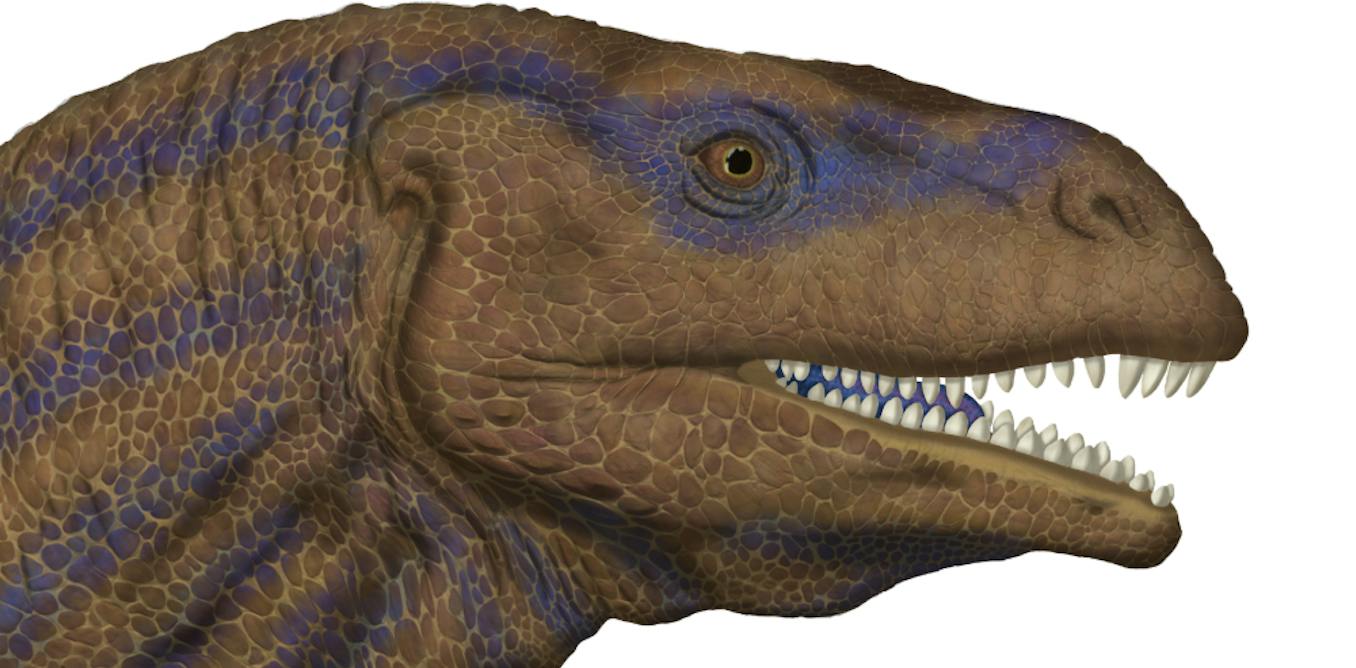
When we think of dinosaurs, some of the first animals that come to mind are sauropods: long-necked giants such as Brachiosaurus and Diplodocus. These huge four-legged herbivores from 150 million years ago were among the largest land animals to have ever existed, reaching lengths of up to 40 metres and weights of 80 tonnes. That’s about the size of 40 African elephants. They didn’t start big. It took millions of years for sauropod ancestors to evolve gigantic body sizes. South Africa tells an important part of this early evolutionary story. The country’s fossil-rich rocks preserve evidence of sauropodomorphs, the group of animals containing the ancestors of sauropods. These fossils are helping scientists to understand how evolution produced giants. Now, a dinosaur from the Late Triassic period (210 million years ago) is adding another key piece to this evolutionary puzzle. Its name is Nyana rooiwalensis. I’m part of a team of vertebrate palaeontologists who specialise in dinosaur anatomy, palaeobiology (ancient life and environments) and systematics (how species are related to each other). We’ve described the dinosaur for the first time in a recent paper. Atashni Moopen at the fossil site of Nyana rooiwalensis. Jonah Choiniere We found the fossils of Nyana rooiwalensis in the lower reaches of southern Africa’s Elliot Formation. This is a rock sequence composed of ancient muds and sands deposited by flooding rivers some 215 million to 185 million years ago. Finding pieces of the skull that fit together. Jonah Choiniere What makes Nyana rooiwalensis remarkable is its exceptionally well-preserved, near-complete skull. It is the first dinosaur skull of this quality to be recovered from the Late Triassic. The fossil includes several key anatomical structures, including the braincase, palate, and bones associated with the tongue, throat and eye. This preservation gives scientists an opportunity to investigate aspects of early sauropodomorph anatomy that are difficult to study from incomplete fossil material. For example, we can see more about how the skull proportions change with age. A surprisingly young dinosaur When ancient rivers overflowed their banks and created the Elliot Formation, they buried the skeletons of dinosaurs that had died, preserving them as fossils. Erosion sometimes brings them to the surface today. Scientists have studied these fossils for more than 150 years, but until recently their best specimens were from the younger rocks. Before the discovery of Nyana, the lower, Triassic parts of the rock series had only yielded fragmentary skull material from another dinosaur species called Kholumolumo. One of the most intriguing aspects of Nyana rooiwalensis is that, despite its large estimated body mass of roughly 400 kilogrammes, the individual was still very young when it died. Side view of the skull of Nyana rooiwalensis. Atashni Moopen Studying thin sections of fossil bones under a microscope (an approach known as osteohistology) reveals the structure of bone tissue. This gives scientists insights into an animal’s growth history. In Nyana, the bone tissue preserves at most two lines of seasonal growth and several other features indicative of an early life stage. This suggests that Nyana had already reached a substantial body size while still relatively young. The beginnings of dinosaur gigantism? The growth patterns observed in Nyana rooiwalensis may offer clues about how sauropodomorph dinosaurs eventually evolved into some of the largest land animals in Earth’s history. The combination of a relatively large body size and an early life stage supports the idea that rapid growth was already an important feature in the early evolution of sauropodomorphs. Nyana was nowhere near the size of the enormous sauropods that appeared later, but its fossilised bones provide evidence that growth strategies associated with gigantism were emerging early in their evolutionary history. What’s in the name View of the Qhemegha landscape. Jonah Choiniere Nyana rooiwalensis was found outside the rural village of Qhemegha, Eastern Cape province, near the Lesotho border. The fossil was affectionately nicknamed “Big Baby” and this inspired the name. The name Nyana means “son” or a reference to a child in isiXhosa, and “small” in Sesotho, the two major languages spoken today in the area. We chose this because of the dinosaur’s age and relative size. The specific name rooiwalensis is in reference to Rooiwal, the local area where the fossil site is located. Dinosaur science education in Qhemegha. South Africa’s prehistoric story The discovery of Nyana rooiwalensis is important for more than the description of a new dinosaur species. Its exceptionally preserved skull expands our understanding of early sauropodomorph anatomy. And its associated skeletal remains and microscopic bone structure provide valuable information about body size, growth and development. It also highlights the importance of South Africa’s fossil record in reconstructing the early evolutionary history of dinosaurs. Every new discovery provides another opportunity to investigate how these animals lived, grew and diversified over millions of years.
A new fossil from South Africa offers clues to how giant plant-eating dinosaurs evolved
Full Article
Original Source
Read the full article at Theconversation →KhanList aggregates and links to publicly available news content. We do not host full articles from third-party sources. Always verify important information with original sources.