
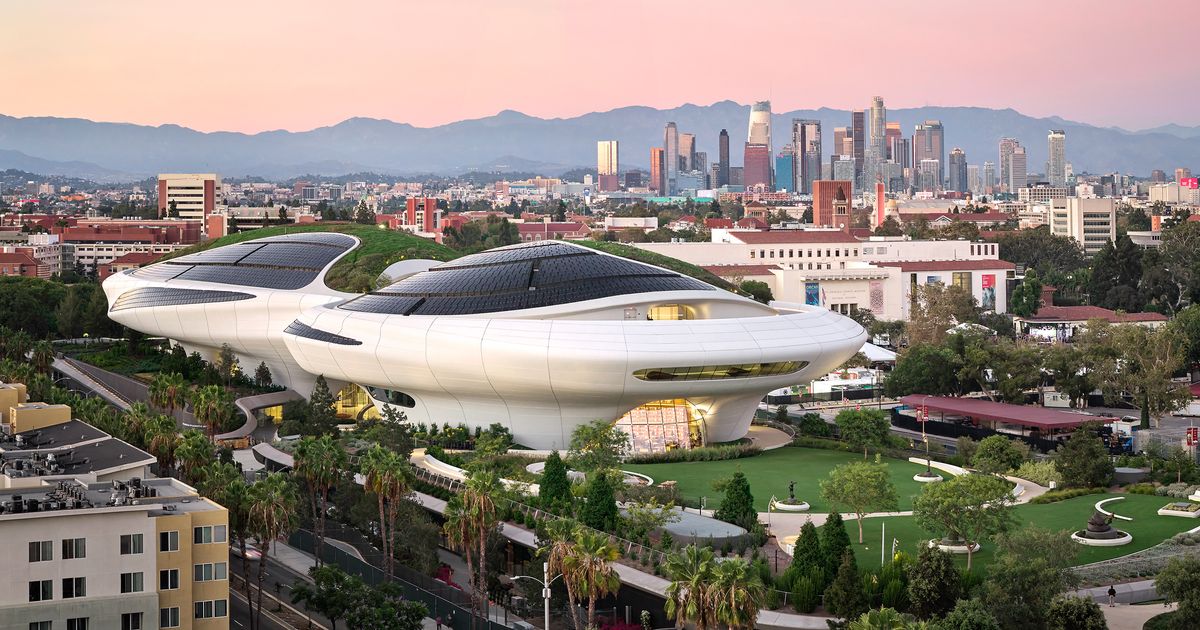
A New Era of Blobitecture in Los Angeles The new Lucas Museum and LACMA’s David Geffen Galleries are much more than spectacular objects in a landscape Photo: Hufton+Crow Within the span of five months, Los Angeles has opened two enormous floating amoebas: one brooding and brutalist, the other ivory and intergalactic. The David Geffen Galleries at the Los Angeles County Museum of Art, designed by Peter Zumthor, opened in April — a sprawling, serpentine concrete mass looming 30 feet above Wilshire Boulevard on seven bulky inhabited pavilions. Less than half a year later, the Lucas Museum of Narrative Art, designed by Ma Yansong of MAD Architects, is about to open in Exposition Park; it’s a sinuous spaceship that pinches, swells, bridges a plaza, and touches down into a lush, 11-acre park with circuitous gardens, paths, and event spaces by Studio-MLA. Together, these meandering megastructures form the most dramatic contribution to the city’s cultural landscape in more than a decade. Yet their twin arrivals remind us of a familiar specter from the not-so-distant past: The blob, that hated symbol of globalist excess, might be back. LACMA’s new David Geffen Galleries building winds through the museum grounds and bridges across Wilshire Boulevard. Photo: Iwan Baan The full Lucas Museum site includes a sprawling landscape designed by Studio-MLA. Photo: Hufton+Crow/Please contact Iwan Baan before usage Wait a minute — didn’t the novelty of using powerful modeling software to make crazy new forms fade away years ago? Hadn’t a building type that initially looked like liberation from the limits of analog architecture hardened into a predictable placeless formula? And haven’t we been burned enough by the institution-crushing costs and maintenance headaches required to keep an idiosyncratic museum running, not to mention the (mostly false) promise that just a single good one could revive a city? Apparently not. We never stopped loving a good alien landing. The blob continues to satisfy our attraction to organic shapes and spectacle and looks incredible on our Instagram feeds. The difference now, or at least the hope, is that it can graduate from its position as a shallow status symbol and earn its keep. If the blobs of the ’90s and early 2000s were exclamation points — Frank Gehry’s torquing Guggenheim Bilbao, Future Systems’ cratered Selfridges in Birmingham, and Peter Cook and Colin Fournier’s blue, nozzle-studded Kunsthaus Graz — these blobs offer prepositions: over, across, between. They have, in theory, shifted from billboard to terrain: less “look at me,” more “hang out with me.” Sinuous covered plazas within the Lucas Museum site. Photo: Hufton+Crow The Lucas Museum at night. Photo: Hufton+Crow LACMA and Lucas, while vastly different buildings, perform that task in similar ways. Hoisting their winding forms above the ground allows them to give space back to the city, sometimes in unexpected ways. LACMA has plazas and paths all around — some more shaded and pleasant than others — that carve out pockets to sit, socialize, circulate, and explore outdoor art while forging new connections to the La Brea Tar Pits and Hancock Park. Lucas’s elevated mothership shapes and shades a sinuous public court below, bringing the space to life with its twisting, gridded form and mesmerizing oculus. The museums’ fluid outlines confound the traditional hierarchies that can create spatial and cultural winners and losers: There’s no obvious front or back, no dominant façade, and no ranking signaling which kinds of art are more valuable than others. These forms allow for myriad unique journeys that are clearly designed to invite participation and meandering. And they strangely suit their context — their twists and turns are in step with contexts that are themselves ever shifting. A view toward the Lucas Museum from the landscaped grounds. Photo: Hufton+Crow Unobstructed by high buildings, as would be the case in places like New York, their levitating forms also define the experience from above as much as from below. At LACMA, panoramic expanses of glass make the city, the Tar Pits, the Hollywood Hills, and, most uniquely, Wilshire Boulevard itself dynamic, continuous companions to the art. At Lucas, the connection to the outside is episodic: Glass portals and wide terraces transport you around the site — and to the city beyond — until you’re pulled back into the museum’s artificial world. A plaza full of people at a block party at LACMA. Photo: Museum Associates/LACMA These ideas are not unique to L.A. In fact, Lucas and LACMA are members of an encouraging new crop of museums — blobs or otherwise — designed as landscapes themselves rather than just containers in a landscape. You can see this at Philadelphia’s Calder Gardens, where Herzog & de Meuron and Piet Oudolf have created winding paths that climb through dense meadows and groves over submerged galleries, and at Crystal Bridges in Bentonville, Arkansas, where Moshe Safdie has strung galleries across ponds and through ravines. Tod Williams and Billie Tsien’s Obama Presidential Center in Chicago is wrapped by a campus of green-engulfed buildings, rolling meadows, and sunken courtyards, while at the Amos Rex Museum in Helsinki, JKMM Architects buried galleries beneath Lasipalatsi Square, allowing their domed ceilings and skylights to swell into an undulating public playground above. It’s been true for a while that museums can no longer justify ambitious building projects and claim public land and money simply because they have precious objects on display. Fighting for resources and competing with screens, they’re attempting to shed their cloaks of elitism and privilege, offering new ways to belong. Many do this with programming; not all can or want to do this through the architecture itself. At LACMA, that test of the museum as a public and civic space has already begun. Beneath the galleries, people are sitting at tables and chairs scattered across the plazas. They may never enter LACMA itself. The spaces are being used more, and more casually, than I expected. I thought one distant corner, close to the tar pits, might become a dead zone, but on my last visit, it was crowded with families eating snacks, couples slurping smoothies, and the occasional art student sketching. The same negotiation will soon begin at Lucas, which officially opens to the public on September 22. Its park and sheltered spaces will inevitably attract uses its designers and administrators did not anticipate. (OMA’s Casa de Musica in Porto becoming a de facto skate park comes to mind.) An art parade in June 2026 fully occupies the landscape around LACMA. Photo: Museum Associates/LACMA The lawns around LACMA filled with picnickers. Photo: Suliane Favennec/REA/Redux Still, these institutions are already showing the limitations of what private institutions are willing to risk for the public realm. At LACMA, a green-spiked security fence hems the commons, while a pricey admission fee and a costly Erewhon café undermine its populist aspirations. At Lucas, much of the park meets the city behind fences, and its rooftop gardens and balconies are generally open only for special events or for diners at its upscale restaurant. Despite these limitations, there is promise in these floating amoebas. Los Angeles has plenty of icons and too few civic centers, or the kinds of places where vastly different groups of people can casually share space and relax for a moment. Getting there will require the museums to think outside of the needs of traditional museum visitors and donors. They will not become truly public places simply because their buildings provide shade and their landscapes look inviting. The public has to be present to fully realize the potential of these spaces, and for that to happen, the institutions will need to show a little flexibility and initiative. The blob is back, yes, but it is finally — hopefully — coming back down to Earth. Fencing that closes off LACMA to the pedestrians on Wilshire. Photo: Iwan Baan A New Era of Blobitecture in Los Angeles Your product is saved! You’ll receive emails when your saved products go on sale. Manage preferences.
A New Era of Blobitecture in Los Angeles
Full Article
Original Source
Read the full article at Curbed →KhanList aggregates and links to publicly available news content. We do not host full articles from third-party sources. Always verify important information with original sources.