
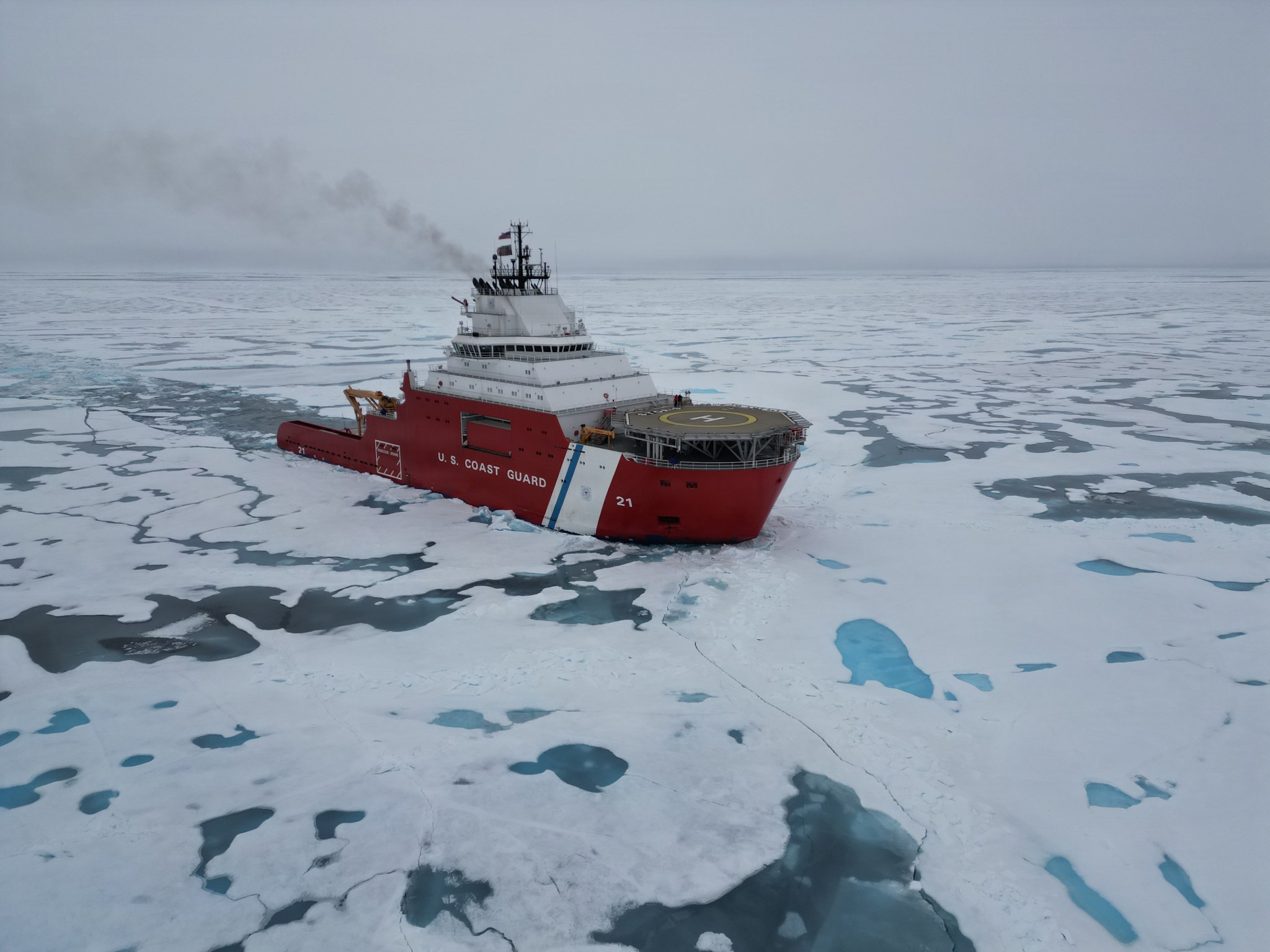
The U.S. Coast Guard’s first new icebreaker in nearly three decades returned from a maiden voyage to the Arctic this month, having demonstrated a spectrum of military operations that open up future possibilities for the service in the increasingly dynamic region. The U.S. Coast Guard Cutter Storis, commissioned in August 2025, spent 133 days underway around the Arctic Ocean and Alaska, performing some missions — including law enforcement and live-fire gunnery — that haven’t been executed in the region in decades. In an interview with Military Times on Monday, the captain of the Storis, Capt. Corey Kerns, said experiments while underway, along with the built-in capabilities of the ship, create new options for Coast Guard operations in the Arctic. Kerns, who took command of the ship before its commissioning, said staff from the Coast Guard Research and Development Center and the Pentagon’s Defense Innovation Unit were onboard during the deployment to test aerial drones, including models made by Textron and Skyfront. The experimental flights were intended to assess how well the platforms withstood the harsh cold of the high Arctic, he said, but they also demonstrated practical uses for drones in the challenging task of ice navigation. For icebreaking, “a good aerial drone could be helpful,” Kerns said. “Piloting is something we still do from our bridges, but we’re seeing that technology used in ways to make it much more efficient to pass through the ice.” The unmanned aerial vehicles helped the ship to maintain its intended station because “they can see out better and farther,” he said. “It was pretty interesting for the crew to see it, learn how we would be able to use and interact with a more capable drone. We did deploy with some of our own drones … less capable versions, and they didn’t do as well in the Arctic. So it was good to see that we’re working on a solution that is more robust given the environmental concerns.” But the Storis, a retrofitted commercial icebreaking ship formerly known as Aiviq, contains other “new capabilities we didn’t expect,” Kerns said, citing the ship’s container storage spaces that open possibilities for different deployable payloads or expeditionary gear sets. He also noted the multiple cranes built into the Storis add logistics and maneuvering capabilities. “Now we’ll work with the partners to be like, ‘What’s on your dream sheet? What would you love for us to be able to do up there?’” he said. “And I think we’ll be able to execute some of that. I think that was the biggest lesson learned: There’s more to it; we left a little bit on the plate, as it were.” Mock refueling shows potential One potentially game-changing additional mission could be a refueling capability that could service U.S. Navy vessels in the Arctic, Kerns said. “The ship was designed to support an oil rig in the Arctic, so she has a lot of what we would call expeditionary logistics capability,” he said. “We did some of that on this patrol, too, where I did a mock refuel of one of our national security cutters, and we’ve demonstrated that we could do that for the Navy if they needed a destroyer up there.” The Storis crew provides fuel to the U.S. Coast Guard Cutter Stratton in the Arctic Ocean on Oct. 6, 2026. The simulated fueling-at-sea exercise demonstrated the cutter’s ability to conduct refueling and replenishment operations in austere regions. (Petty Officer 1st Class Erica Libbing/U.S. Coast Guard) The ability to refuel a destroyer, made possible by the Storis’s large storage capacity and its native capability to pump the fuel up and into an oil rig, could potentially save the Navy up to a week-and-a-half of transit and time off-station to get to a shore-based refueling point, he said. “Once you’re in the Arctic, it is a long ways back to the closest location where you can refuel a vessel,” Kerns said. He stressed that refueling was likely not a mission the Storis could undertake on a regular basis, but suggested it could be a valuable fallback amid operational necessity. “If one of those vessels was up here and there was something else that was up here that required them to stay – it would be better for our national security if that capable vessel could stay in the area rather than travel a week-and-a-half to refuel. Storis can give them the gas and keep them on station so they can stay on mission,” he said. Law enforcement missions Storis’s five-month deployment also included the first law enforcement mission by a polar icebreaker in more than two decades, according to Coast Guard officials, who said the ship executed multiple fishing vessel inspections in the Bering Sea. The crew also teamed up with the National Oceanic and Atmospheric Administration Office of Law Enforcement for a joint boarding and fisheries plant inspection. Kerns said standing up a law enforcement mission required special training and the addition of a maritime law enforcement specialist – a chief petty officer first class – to prepare the crew. Petty Officer 1st Class Alex Fernandez, left, and Ensign Joshua Dees, right, conduct a live-fire gunnery exercise aboard the Storis on Sept. 18, 2026. This was the first live-fire gunnery exercise by a Coast Guard surface asset in the Arctic region in decades. (Ensign Maddox Holmes-Selby/U.S. Coast Guard) “Luckily, we had a chief, an E-7, on board who had a lot of boarding experience,” Kerns said. “We had to see how we would do it on board stores, which is not designed to be a law enforcement ship, but has some capable boats … Whenever we had the opportunity, some open water, we might run a law enforcement drill, preparing for later in the deployment when we knew we’d be focused on that. And it kind of all came together.” Challenges inherent to fixing the small boats when they broke due to age and disuse were among the hurdles the crew of the Storis had to overcome during the deployment. Others, Kerns said, included working around the layout of a ship not inherently designed for military use, which could get in the way of well-established Coast Guard and firefighting protocol. Command and control A potentially more serious issue was the lack of built-in military command-and-control communications equipment, which he said presented itself as an issue during a shorter underway the Storis had embarked on last summer. The ship, he said, had been operating near some Chinese research vessels, and leaders realized they didn’t have a direct and secure way to communicate in case of crisis or escalation. “When you’re operating that close, and geopolitics are tied in, you don’t want to make a mistake,” Kerns said. “But I also didn’t have the ability to communicate directly with my superior officers back in Juneau or Alameda (California).” When the Storis departed on its full deployment, he said, it was with improved military communications. But, he added, additional work needed to be done to enhance its command-and-control suite. U.S. Coast Guard Cutter Storis participates in a combined sail in the Bering Sea, Alaska, on July 21, 2026. (Petty Officer 3rd Class Class Cameron Snell/U.S. Coast Guard) During the Arctic deployment, the Storis spent some 300 hours monitoring the four Chinese research vessels in the region, which did not register their planned activity with the United States, as other nations around Alaska’s Exclusive Economic Zone do. “That’s going to be a growing mission set. I think you’re starting to see more and more, and I would expect at some point that you’ll see maybe even more military move up into that beyond just Coast Guard,” Kerns said. “So it’s a new competition space for us, and we’re just at the start of it.” The proven ability of the Storis to complete an Arctic deployment frees up the Coast Guard’s aging medium icebreaker Healy to focus on scientific research missions, Kerns said, and removes the burden of military presence and monitoring operations. The Healy had been set to deploy to the Arctic this fall, but it suffered a mechanical problem and had to be towed back to its homeport in Seattle. The mishap came two years after the Healy was forced to cancel a 2024 deployment due to an electrical fire onboard. For the Coast Guard, which is set to get the first of three purpose-built icebreakers around 2033, having a more capable icebreaking ship represents a mission paradigm shift for the service, Kerns said. “It’s important for icebreaker sailors who aren’t used to that to explain that, ‘Hey, in the future, the future of icebreaking isn’t icebreaking in and of itself,” he said. “You’re a multi-mission ship … We owe that to our civilian leadership. We have all these capabilities. We should be able to execute those capabilities anywhere in the world that they desire.”
‘A new competition space’: US Coast Guard takes icebreaker on maiden voyage to the Arctic
Full Article
Original Source
Read the full article at Militarytimes →KhanList aggregates and links to publicly available news content. We do not host full articles from third-party sources. Always verify important information with original sources.