
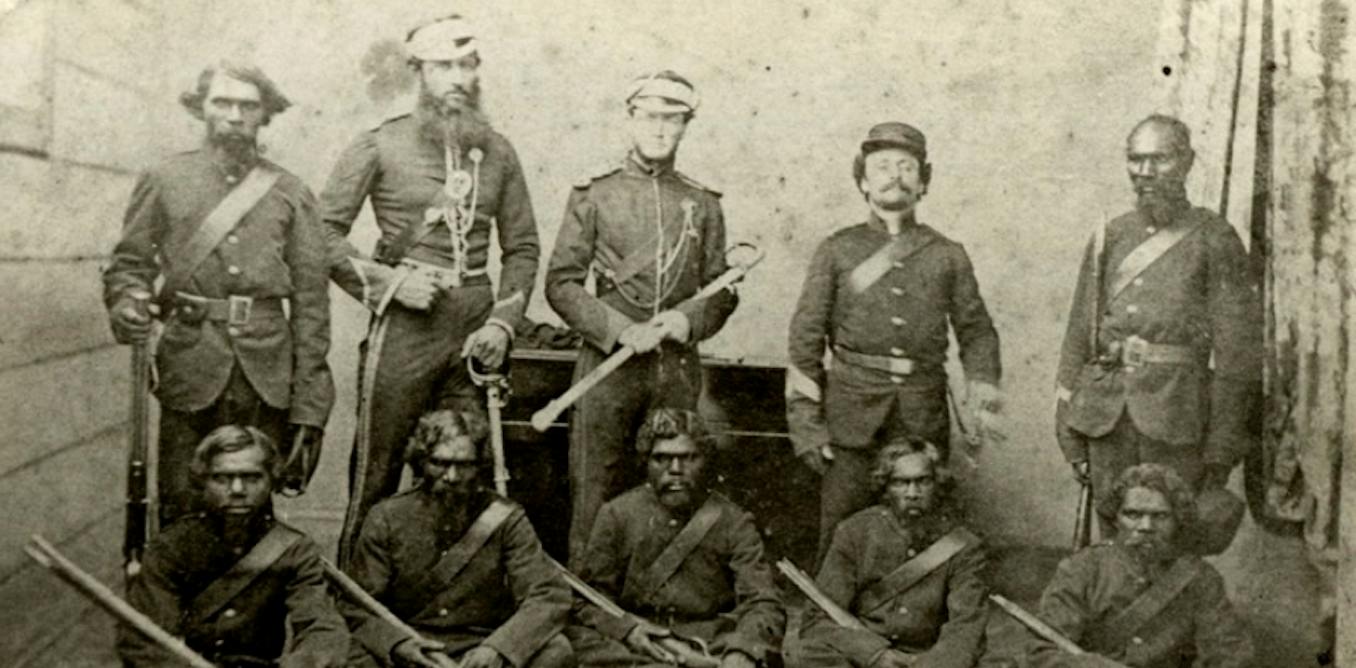
First Nations people please be advised this article speaks of racially discriminating moments in history, including the distress and death of First Nations people, and uses potentially distressing terminology. Buried is an ambitious and intriguing investigation into frontier conflict and the Queensland Native Mounted Police, by three academic writers. It meshes the techniques of archaeology with methodologies of history and, to a lesser extent, anthropology, a process the authors call “historical archaeology”. Buried: Archaeology, frontier conflict and the Queensland Native Mounted Police – Heather Burke, Lynley A. Wallace and Bryce Barker (Sydney University Press). The Queensland Native Mounted Police operated from 1849 (prior to Queensland’s separation from New South Wales) until 1929. It employed both white male officers and Aboriginal troopers and was involved in what appears to be colonial Australia’s most ruthless killing machine, resulting in the possible violent deaths of more than 40,000 traditional Aboriginal peoples across the vast colony of Queensland for roughly 80 years. Cross-disciplinary ways of reading the colonial past and racial conflict are not new. Yet it’s salutary to remember how, at the outset of this new scholarship in the 1960’s, established professional historians were often the most evasive and resistant to this approach. When, as a young History honours student back in 1965, I began researching colonial frontier struggle (including the Native Mounted Police), it was the concerted work of anthropologists (such as D.J. Mulvaney and Catherine and Ronald Berndt) who provided the best knowledge pathways towards authentic foundational stories. Another anthropologist, W. E. H. Stanner, used the 1986 ABC Boyer Lectures to discuss Australia’s “cult of forgetfulness, practiced on a national scale” when it came to race relations. Two years later, in 1970, the remarkable anthropologist/administrator, C. D. Rowley produced the historical, nation-wide, frontier study, The Destruction of Aboriginal Society – a 400-page work of deep research rarely mentioned today. Published historians of the frontier were not even on the scene at this point. Rowley presented almost 100 critical references to the Native Mounted Police in this work, concluding the force “offered the perfect niche for the sadist”. Surprisingly, Buried does not reference this central work, even though Rowley referred to a ground exploration at Bedourie in mid-1965 in far south-west Queensland, where eight Aboriginal skeletons and several .32 calibre cartridges were uncovered by an oil survey team. Buried, however, takes a different archaeological course. It does not examine Native Mounted Police field activities and there is only one page reference to monthly patrols, where collisions and “dispersals” frequently occurred, in a volume of over 300 pages. The authors, (whose work is aided by the research of three others), explain: “Importantly we did not set out to excavate massacre sites” due, apparently, to their elusive nature. Of course, dispersal sites do not easily announce themselves – that is to be expected. Yet, as recent archaeological work in Western Australia at massacre sites and a prison for Aborigines at both Forrest River and Rottnest Island has shown, such investigations at places of oppression and conflict are not impossible to excavate with some success. These were places where group killing had occurred and where buried bodies were discovered. ‘Pots and pans’ history? In Buried, however, archaeological methodology is applied only to the Queensland Native Mounted Police base camps themselves. Twenty-six camps were surveyed across four years (2016-2020) and eight were excavated. The outcome of thousands of kilometres travelled “by plane, four-wheel drive, quad bike and foot” — not to mention the hard and exacting labour of the digs themselves as well as the substantial funding expended overall, has uncovered a strange, at times disappointing and often mundane bounty. Of the many thousands of items secured from beneath the ground the most common pieces retrieved appear to be “[l]arge and small ornate gold buttons with government insignia” as well as crockery shards from dinner plates, serving dishes and egg cups. Laying to one side the optics involved in such retrievals, the uninitiated reader might be forgiven for wondering how this buried trove contributes very much to our expanding understanding of the purposes and most dubious behaviours of this force. After all, even before this investigation began in 2016, one might already have grasped that Native Mounted Police uniforms required buttons, and that officer-personnel and their families would have used crockery in food preparation and consumption. Herbert River Native Mounted Police Camp, circa 1870. Wikimedia Commons From a historical position, the omnivorous itemising of such fragments from the past, and the cataloguing and valuing of them simply based upon their antiquity is regarded as antiquarianism – a lower descriptive branch of historical endeavour, sometimes parodied as a pots and pans school of historical research. Thus, one might conclude that in employing strictly archaeological methodology, what the emphasis of this study gives us is the most detailed account of Native Mounted Police infrastructure to date. What it does not provide from its own devices is the archaeology of their practice – for buttons and crockery alone do not ask the hard questions. Significantly, the authors themselves also recognise this when they admit that “fragments of broken glass and ceramic” from the “detritus of domestic life” as well as the repetitive ordinariness of camp activities – the “core of domestic mundaneness” – merely act as a “camouflage” to “mask a unique colonial policing force […] a crucial government instrument for the subjugation of Queensland [sic] throughout the entire second half of the 19th century”. A possible solution to this problem might have been to include suspected “dispersal” sites alongside camp sites for excavation and interrogation. Locations and numbers The work makes a much more consequential contribution when it falls back upon traditional historical research methods to promote its findings. Here some of the revelations – particularly a range of impressive maps showing the locations and spread of Native Mounted Police barracks into every region of the colony – are superb. Furthermore, the state-wide research has radically revised the overall number of native police camps, first enumerated at 85 by historian Jonathan Richards. The authors of Buried virtually double that total to “176 possible camps” or 156 definite ones. At the same time, the archival research has increased the number of white officer-personnel from Richards’ accumulated figure of 269 to 447. Aboriginal trooper figures are also increased to around 1,027 and may go higher. Less is known of such troopers’ lives. As the study emphasises: There are no known accounts from any trooper about why they enlisted, how they were recruited, what their experience was like or what happened to them after they left. (One rare archival document, reproduced in the volume, Exclusion, Exploitation and Extermination but unmentioned in Buried is an extended account from an Aboriginal trooper named Georgy. It details tribulations and ill-treatment in the force, especially after his desertion due to the taking of “his Gin” by a white officer as well as his later arrest, accompanied by threats upon his life. As such accounts are extremely rare, this would have been worth following up.) The camps, according to the authors of Buried, lasted on average for around six and a half to seven years. Clearly, this was a far bigger and more destructive enterprise than we have realised. The book itself counts over 2,800 frontier conflict incidents from archival and documentary research, but such numbers would undoubtedly be much higher due to the contemporary conspiracy of silence that masked frontier violence as much as it encouraged it. Aboriginal voices are rarely heard in these archives of retrieval and would undoubtedly push mortality figures far higher, if known. Continued searching Buried uses the Lower Laura camp of Boralga, inland from Cooktown, as its prototype study, due to a larger bureaucratic and photographic imprint surviving there. The strictly archaeological findings show us the layout of the camp and the buried detritus – buttons, crockery and the occasional bullet cartridge. The historical research reveals lists of the white personnel of the camp but it does not reveal the Aboriginal or white staff in action in the field, patrolling this very violent Palmer River frontier. Curiously, given this region’s centrality to the overall account, a substantial and revealing documentary source has again been overlooked. This is the large collection of correspondence from the young schoolmaster at Laura, Millais Culpin, written to a group of friends in Britain between 1892 and 1897. Culpin is immersed in local race relations events while writing of visiting the local Native Police camps. His attitude to the Aborigines he meets is invariably contemptuous, even referring to a savage dog he was training to attack them. In 1892, the place, he writes, is “swarming with blacks”; but in 1896, after the killing of a pastoralist, Donald Mackenzie of Lakefield station, a “special train” from Cooktown “brought up a small army of black police […] the n…rs were tracked to a camp on the Normanby River, where a good many found a final resting place.” Others died from accidental consumption of arsenic mistaken for baking powder. As a result, the Native Police found: “…their track was marked by a dead body every mile or so…” After returning to London, Culpin and his wife revisited Laura briefly in 1913 and found only 13 Aborigines remained alive there. His wife wrote in her travel diary that they were “about the lowest type of the human species imaginable”. Such historical insights tend to tell us significantly more about the tragic, lethal outcomes on the frontier than structural layouts of camps and excavated fragments are capable of alone providing – although that knowledge in itself is clearly not entirely inconsequential. Undoubtedly, we need to keep searching in both the archives and under the ground to learn a lot more about both the form and the zeitgeist of these contentious days, remembering as we press on, that this past is not merely behind us, but right there under our feet.
A new book sheds light on the camps of colonial Australia’s ‘most ruthless killing machine’
Full Article
Original Source
Read the full article at Theconversation →KhanList aggregates and links to publicly available news content. We do not host full articles from third-party sources. Always verify important information with original sources.