
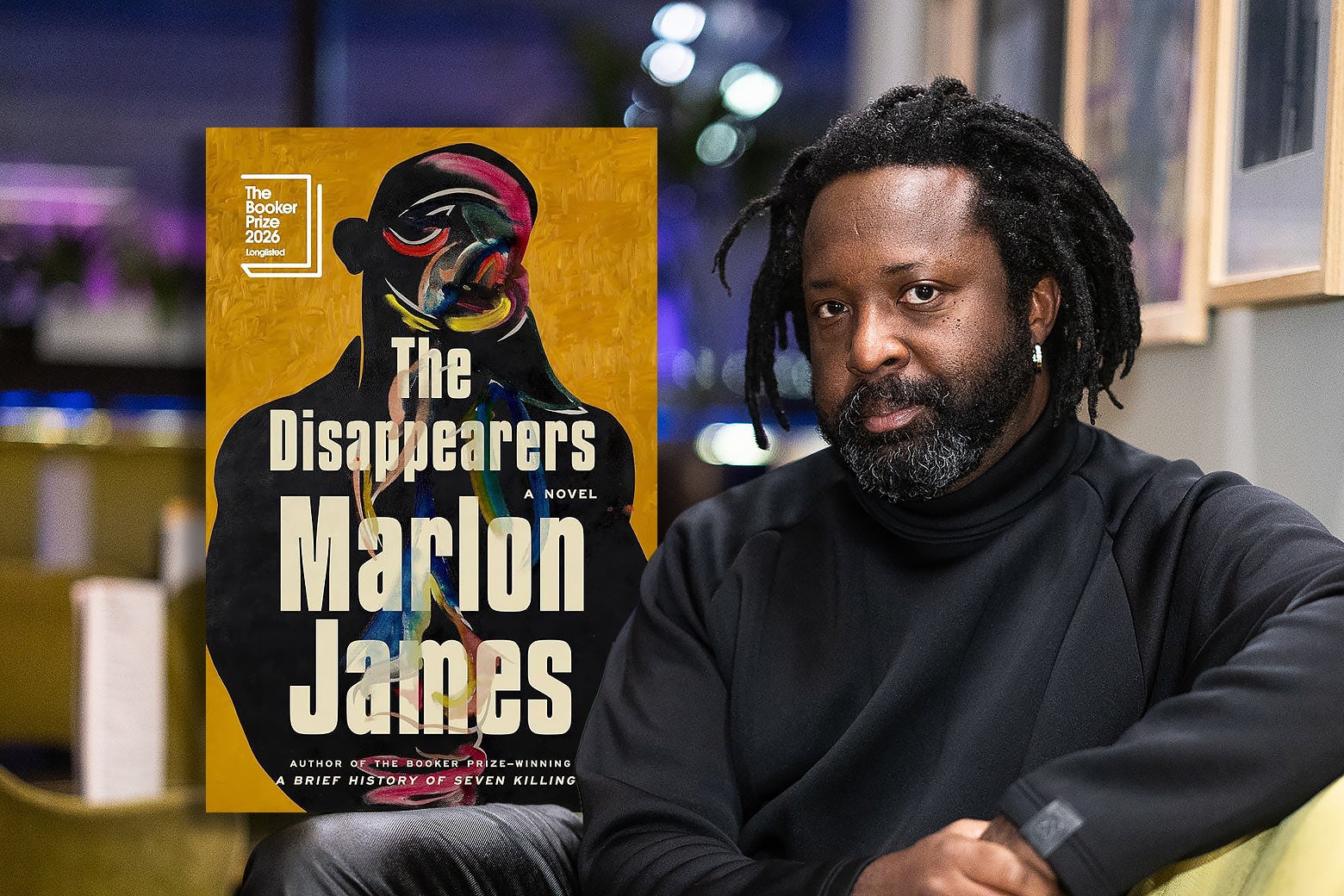
Books An Unforgettable New Novel Manages to Find Hope and Beauty in a Subject Many of Us Would Rather Forget By Enter your email to receive alerts for this author. Sign in or create an account to better manage your email preferences. Unsubscribe from email alerts Are you sure you want to unsubscribe from email alerts for Laura Miller? Sept 05, 202610:00 AM Photo illustration by Slate. Images via Tim P. Whitby/Getty Images for BFI and Penguin Random House. Sign up for the Slatest to get the most insightful analysis, criticism, and advice out there, delivered to your inbox daily. All of the action in Marlon James’ epic, immersive, and devasting new novel The Disappearers (already hailed in the New York Times as “the novel of the decade and possibly of the century thus far”) radiates out of a single, horrifically violent event. In 1988 a group of gay men of various ages and backgrounds gather in a house in Kingston, Jamaica, to rehearse a play about a men’s prison. The intention, explains their director—an Oxford-educated, occasional ascot-wearer named Havelock Titus—is to blow “open the whole fragile myth of Jamaican male sexuality and homophobia.” It’s a daring, rash, and possibly semi-suicidal project given how often that homophobia manifests itself in mob assaults that occasionally amount to lynchings, condoned and often assisted by the police. (Male same-sex sexual activity has been criminalized in Jamaica since the 19th century.) That’s exactly what happens one night to the players in The Disappearers, not all of whom will survive, and several of whom will emerge permanently maimed. Like all of James’ fiction, this novel is relentlessly explicit when it comes to both violence and sex, although the elevated bravura of his prose gives the brutality a Shakespearean grandeur. James’ previous masterpiece, A Brief History of Seven Killings, winner of the 2015 Booker Prize, is also set in Kingston and spotlights another act of violence, the attempted killing of Bob Marley. The Disappearers is less polyphonic than A Brief History and even more intense, focused on how homophobia warps and transmutes its characters. As James, a gay man himself, once put it, “Whether it was in a plane or a coffin, I knew I had to get out of Jamaica.” At the center of the story are two young men, Eddy Porteus and Jordan Brown. Eddy’s parents don’t yet know he’s gay, but to judge from his journal, which makes up the first of the novel’s five parts, he’s already had plenty of experience. Eddy is light-skinned enough to pass for white (his mother is “Flemish”) and therefore gets away with more than the darker-skinned Jordan can. Jordan, expelled from both school and his family—who have discovered he’s a “battyman”—lives in his car and supports himself with sex work. The poverty and vulnerability of Jordan’s situation wear him down, but the work doesn’t, necessarily. The Disappearers refers often to The Sexual Outlaw, John Rechy’s 1977 nonfiction account of three days in his life as a male hustler. Rechy’s book becomes a bible of sorts for the two men, a tribute to life in a secret world shaped by erotic desire and social stigma. Slate receives a commission when you purchase items using the links on this page. Thank you for your support. Eddy and Jordan aren’t friends, exactly, because, as more than one character points out, Jordan doesn’t really have friends. He is caustic and witty and reckless, the member of the troupe who can be counted on to speak the truth in the least gentle but often the most liberating fashion. Eddy, whom Jordan regards as a bit soft, serves as something of a reader surrogate, the kind of guy still naive enough to think the police might come to the aid of endangered homosexuals instead of just joining the ranks of their tormentors. Eddy, however, still has enough hope left to do the decent thing, like visit the 1988 attack’s survivors at the hospital, itself a dangerously self-incriminating act of compassion in a country where, as even Eddy acknowledges, “I’m a part of an us that people just want to beat to death. Everybody wants to kill us.” For his part, as Jordan will eventually confess to a most unexpected lover, “I want to kill the fucking world.” After a brief, blood-freezing passage narrated by the members of the gay-bashing mob, the rest of The Disappearers recounts the aftermath of the attack over the next two and a half decades. Two of the victims vanished after leaving the hospital, and Jordan and Eddy team up for a while to search for them, an effort one of the other survivors hilariously dismisses with “You two just watch too much Murder, She Wrote.” Pop culture—movies, TV, comics, and especially music—plays a vital role in the novel, whether it’s Eddy pining for but being too scared to purchase the new Prince album Lovesexy because it means stepping up to the record store counter with a photo of a naked man, or many characters’ insatiable celebrity crushes on everyone from late INXS front man Michael Hutchence to Olympic diver Greg Louganis. Jordan, in particular, seems to feel the death of Kurt Cobain most keenly, for, like many of the characters in The Disappearers, he is no stranger to self-destructive urges. As diverse as their tastes are, however, these men pay little attention to reggae. “All the boys who made my life hell in high school like Peter Tosh,” Eddy remarks, and central to the story is the singer of a popular gay-bashing anthem, “Batty Is Not Pussy” (a riff, presumably, on “Boom Bye Bye,” a song so virulently homophobic that its singer, Buju Banton, eventually disavowed it). The merciless pressure of all this ambient homophobia distorts every aspect of the characters’ lives. They obsess over which small gestures or expressions or movements have betrayed them to their enemies at school and on the streets, despite their best efforts to perform straightness. Their own families reject, beat, and disown them. At one point, Eddy witnesses all the bedding in his college dorm being dragged out and burned because, as one spectator explains to him, “that is how you stop it. The AIDS.” For readers in parts of the world where the imperative of the closet has faded, The Disappearers serves as a reminder of bad times—as well as of many other places where the times remain bad today. For Eddy, Jordan, and the rest of the gay characters in The Disappearers, fear and hatred come inextricably entangled with desire, since desire is the source of their excommunication. Not only do some of the men who persecute James’ characters harbor their own secret homoerotic longings, but the victims sometimes can’t help but desire them back. Violence and lust become so intermingled that they often can’t be distinguished at all. As Jordan’s desire for revenge festers and metastasizes until it takes over his life, it also becomes, perversely, his main source of companionship, until his story reaches a gothic crescendo. Dark as this sounds, The Disappearers isn’t without hope, and not everyone who reckons with its central injustice will be destroyed by it. How could a novel so crammed with the painful messiness of identity and rage and carnality ever reach a satisfying resolution? The masterstroke of The Disappearers is that James lands the finish, a feat of generosity, compassion, and, as with the rest of this unforgettable book, unconquerable bravado. Books Hate Crimes Slate Book Review LGBTQ+
A New Book Has Been Called “the Novel of the Decade, if Not the Century.” It Really Is That Good.
Full Article
Original Source
Read the full article at Slate →KhanList aggregates and links to publicly available news content. We do not host full articles from third-party sources. Always verify important information with original sources.