
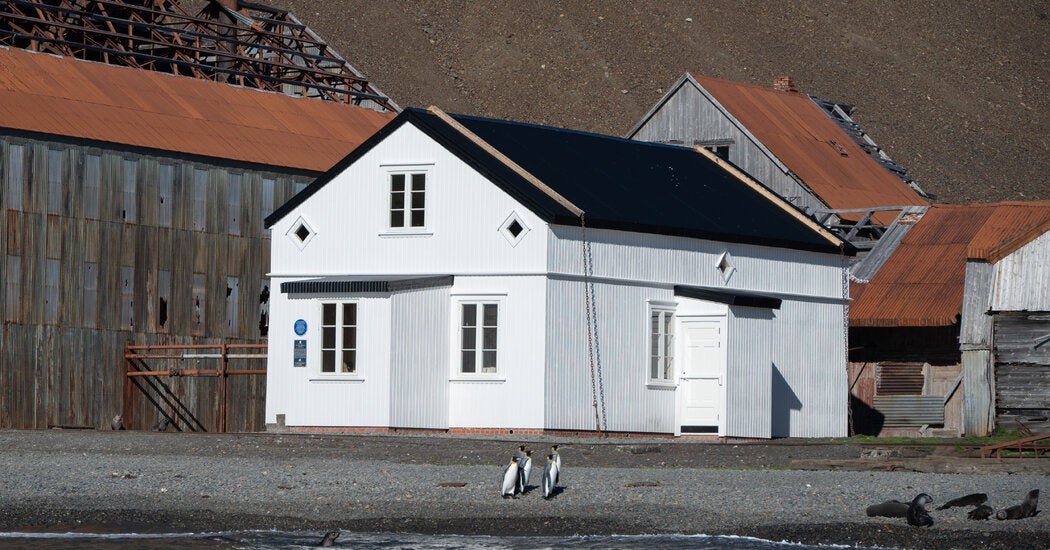
An abandoned station manager’s villa — the site of a historic effort to save the explorer’s marooned crew — has now been restored. Take a tour inside.Members of the South Georgia Heritage Trust restored the manager’s villa of the whaling town where the Antarctic explorer Ernest Shackleton found help for his stranded crew in 1916 and arranged their rescue.Credit...Video by South Georgia Heritage TrustA New, Bold Antarctic Rescue: Bringing Shackleton’s Outpost Back to LifeAn abandoned station manager’s villa — the site of a historic effort to save the explorer’s marooned crew — has now been restored. Take a tour inside.Members of the South Georgia Heritage Trust restored the manager’s villa of the whaling town where the Antarctic explorer Ernest Shackleton found help for his stranded crew in 1916 and arranged their rescue.Credit...Video by South Georgia Heritage TrustOnce a bustling whaling station, the Antarctic town of Stromness, South Georgia, has sat abandoned for more than half a century. Sixty-five harsh winters have passed since the whalers stationed there went home, reducing the empty buildings to dilapidated shacks seen from afar by passing cruise ship passengers. Seals and seabirds are the only regular inhabitants now.But recently, there has been a burst of activity at the station. Over the past year, about a dozen people have been on a mission to save the building that was once the station manager’s villa — and the orchestration site of an elaborate plan in 1916 to save the crew of one of the era’s foremost Antarctic explorers, Ernest Shackleton.In 1915, Shackleton and his crew were shipwrecked near a tiny landform known as Elephant Island. The nearest help was almost 800 miles away, in Stromness, so Shackleton boarded a lifeboat with his crew members Frank Worsley and Tom Crean to try and reach the way station for help. Shackleton documented the perilous trip in his autobiography, “South,” noting that the three were soaked with freezing water and starving by the time they crossed over the mountains to Stromness.ImageOne of Shackleton’s crew members with the expedition’s dogs on a foraging expedition after the crew’s ship, Endurance, was trapped in ice in 1916.Credit...Frank Hurley/Underwood & Underwood, via Library of CongressElephant Island, where the crew remained while Shackleton sought help; launching the James Caird, a small lifeboat to seek help, from Elephant Island on April 24, 1916.Credit...Frank Hurley/Underwood & Underwood, via Library of Congress“Shivering with cold, yet with hearts light and happy, we set off towards the whaling-station, now not more than a mile and a half distant,” Shackleton wrote of the final approach. “The difficulties of the journey lay behind us.”From the villa, they worked with local whalers to coordinate saving their marooned crew. Remarkably, there were no casualties in the 20 months the sailors spent stranded on the ice.Now, over a century later, the manager’s villa has been stabilized to stand up to another century of polar weather. And thanks to a digital model of the structure released on Monday, faraway visitors can view it through the ages, uncovering its history as the site of one of the most harrowing rescues in the early years of Antarctic exploration.Uncovering the Villa’s HistoryWhen the restoration crew — all contractors of the South Georgia Heritage Trust, a historical preservation nonprofit — arrived at the site of the villa, “the only thing we could really say about it was that it was still standing,” Dickie Hall, who led the project with his wife, Nini van de Merve, said of the building. “When we opened the front door, where there would have been a floor and a living room, all of that had rotted and collapsed into the basement.”The only way to get to South Georgia is by boat, so the restoration crew loaded up a container ship with every material they might need for the project, such as period-appropriate doors and windows, new floorboards and even a mini excavator. The supplies, sourced from Norway and the United Kingdom, were then sent via South America to South Georgia’s lone port. From there, the team carried the supplies across the 1,450 square mile island to the work site on Stromness.After removing the century-old crumbling bricks and rotting wood, the team rebuilt the structure from the foundation up over several weeks, discovering pieces of its history along the way.“When they were peeling back different layers, you saw more and more of the people that were there,” said Helen Balfour, an assistant curator at the South Georgia Museum.ImageWorkers stabilizing the villa.Credit...Dickie HallVideoThe villa’s digital twin, showing it as it might have looked when Shackleton set upon it in 1916; during its years of neglect; and recently restored.CreditCredit...South Georgia Heritage TrustEach artifact uncovered from the rubble was set aside and analyzed by museum staff on the island. The construction team found, for instance, rolls of unused linoleum and extra building materials from when the villa was built, as well as a felt hat and a single homemade ski pole, in a sealed portion of the attic. They also uncovered hair cream, toothpaste and razor blades from a drawer in an upstairs bathroom mentioned in Shackleton’s autobiography.Several of these items will join a collection of relics kept by the South Georgia Museum — one of the most remote museums in the world.ImageA villa bathtub, with a view.Credit...Art Lewry/South Georgia Heritage TrustThe Heroic Age of ExplorationThe ill-fated expedition that left Shackleton and his crew scrambling to South Georgia was the explorer’s third visit to Antarctica. Each of his journeys was captured in near-real time by publications including The New York Times, with Shackleton sending telegrams to the media detailing his triumphs and setbacks.One message to the British publication the Daily Chronicle even contained his plea for assistance: “When we left Elephant Island all was well, but urgent aid is necessary,” he wrote. Other messages sent via cable to The Times outlined his journeys’ proposed routes, delays, funders, equipment and crew, as well as the scientific goals that drove the explorer to the end of the earth.ImageErnest Shackleton, arriving in New York from the famed, doomed Antarctic expedition in 1917, on his way back to England.Credit...George Rinhart/Corbis via Getty ImagesLike other Antarctic explorers of his generation, Shackleton charted unknown areas, creating some of the first meteorological guides and maps of the region. Many of those maps are still used as historical data points to compare with new observations. And the manuscripts, photographs and other documents from these expeditions have since driven generations of others to explore the Antarctic.“There were a lot of whalers, even, who read his book,” said Ms. Balfour, whose grandfathers both worked in the Antarctic as whalers. “It inspired them to take the journey or to seek adventure in some way.”The trip on Endurance was one of the last expeditions of what is known as the heroic age of Antarctic exploration, which began in the 1890s and ended around the time Shackleton was making his final voyages to map the coastline of Antarctica. After this era, science in the area soon started looking more like what we see today: planes circling overhead to create aerial maps and large teams of researchers taking ice core samples and making observations about the water and air.Now, more than a century later, there are few surviving relics from the heroic age, driving researchers and polar history buffs to hang on to the pieces that remain.“It’s the greatest survival story in history,” said Barry Lipman, a self-proclaimed Shackleton-phile who funded the stabilization and digitization projects, adding that the villa is “one of the few things left that you can actually see, touch, feel of the Shackleton story.”A New Window Into the PastVideoA timelapse of workers restoring the villa.CreditCredit...South Georgia Heritage TrustThe stranded crew greeting the arrival of rescuers on Elephant Island; looking down on the Stromness Whaling Station, a view perhaps shared by Shackleton after he, Tom Crean and Frank Worsley hiked across South Georgia Island in search of help.Credit...Frank Hurley/Underwood & Underwood, via Library of Congress; Stephen BolcsoThis month, a team of historians attempted to recreate Shackleton’s journey, traveling from Elephant Island to the newly restored villa. But, like the explorers a century ago, they encountered problems: High winds, heavy snow and a bout of hypothermia interrupted the historians’ traverse.The re-enactment team are some of the few who will ever be able to see the villa in person. It is within an area that is off-limits because of asbestos. However, the polar-curious can now explore a digital model of the structure.After the restoration team had stabilized the villa and put on the final touches — a fresh coat of paint as well as new windows and doors — a new crew arrived to capture and then compile thousands of photos of every inch of the villa and fit them to a laser-scanned model of the building.The process was “laborious,” said Art Lewry, who created the model. “You’re also dealing with the wildlife because you’ve got seals wandering around, and they’re always very curious and bite-y.”The digital twin also presents the villa as it was 110 years ago. Using antiques photographed and scanned from museum collections, the digital structure is filled with what Shackleton, Worsley and Crean might have seen when they first arrived — right down to the tobacco tins and coffee set.“The villa is a really hard-to-get-to place, but an absolutely magical place,” Mr. Lewry said. “With things like this, we can take more people there virtually.”K. R. Callaway is a science reporter and a member of the 2026-27 Times Fellowship, a program for journalists early in their careers.Related ContentAdvertisementSKIP ADVERTISEMENT
A New, Bold Antarctic Rescue: Bringing Shackleton’s Outpost Back to Life
Full Article
Original Source
Read the full article at Nytimes →KhanList aggregates and links to publicly available news content. We do not host full articles from third-party sources. Always verify important information with original sources.