
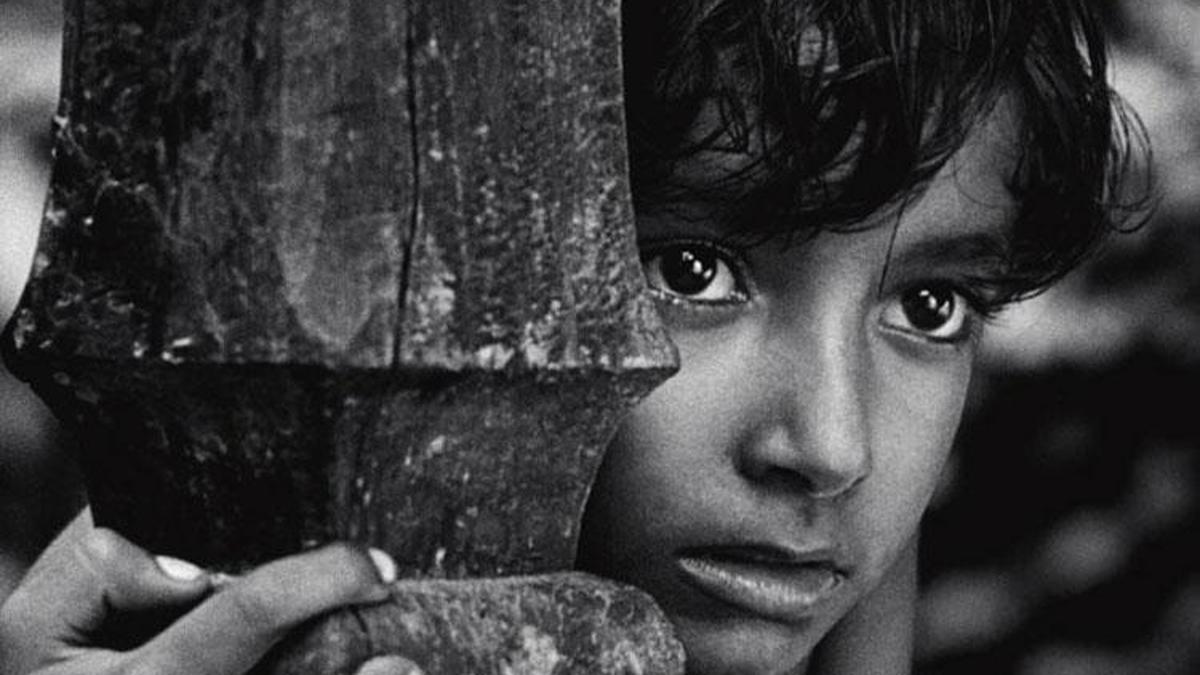
Pather Panchali (1955)Among the great pioneers of Indian Cinema, a man who was perhaps at the very forefront, especially internationally, is Satyajit Ray, whose filmmaking is marked by such immense detail. Hardly has a film captured the human condition in Indian cinema as well as Ray did in his very first film, ‘Pather Panchali’.Made less than 10 years after the country’s independence, ‘Pather Panchali’ is the first part of the ‘Apu Trilogy’, set in rural Bengal. Although the film captures the childhood of young Apu, Ray’s film is beyond just that. It is a complex film about a woman’s coming-of-age, and the living conditions of a family whose breadwinner remains perpetually absent. Growing up isn’t easy. For Apu, it certainly wasn’t. There is the deepest essence of childhood memory in this film. Pather Panchali. | Photo Credit: SIVA SARAVANAN S The most unforgettable moment in this film comes in the arrival of a steam engine train, which Apu and his sister Durga witness for the first time in their lives. It is a sequence where time seems to stand still; It is a sign of an India under shift. It is the birth of a new nation, and the country is still trying to find its feet.Ray captures the human condition in the truest of essence, through a tragedy of utmost magnitude, but at the same time, he reminds us: “We must live on.”Manthan (1976)Cinema has always had a major impact on the masses of the country, right from the time of its advent. ‘Manthan’, a film behind which lay the names of some of Indian cinema’s greatest contributors, is a defining film of Indian cinema history. A complex narrative about the politics of a village in the Kheda District of Gujarat, the film allowed for several Indians to come to realise the advent of the Milk Revolution that was started by Verghese Kurien through Amul, no less than three decades after the nation’s independence. Capturing a powerful image of young India pre-globalisation in one of the major moments of the nation’s post-independent agricultural history. Manthan’ is proof of cinema’s power in more ways than many. It takes several people to build a film, and ‘Manthan’ is a film made for the people, and funded by the people. Over 5,00,000 farmers paid ₹2 each, making this India’s first entirely crowdfunded film. ‘Manthan’ captures the milk revolution, the powerful spirit of feminism, and intricately deals with rural casteism, without becoming preachy. It is a landmark film in the New Wave of Indian Cinema.Jaane Bhi Do Yaaro (1983)Showing a developing India set in the urban landscape of Mumbai, director and writer Kundan Shah playfully crafts ‘Jaane Bhi Do Yaaro’ — one of the nation’s funniest films ever made, and the kind of evergreen comedy that has so many memorable moments that it becomes difficult to count them on one’s fingers. Jaane Bhi Do Yaaro. | Photo Credit: Wiki Commons That being said, hardly can one ever forget the climax sequence, where the film remembers never to take itself too seriously.Shot on a shoestring budget with long hours of shooting on the sets (including broken flyovers and under-construction buildings), the greatest triumph of this absurdist satire lies in its sharp critique of the nation. Kundan Shah’s charming direction takes this story forward in a way that one cannot ever see coming.Today we celebrate the 80th year of our country’s independence, where there has been inevitable progress that the nation has seen. Yet, there is something about this film that remains relevant. It is perhaps the themes that lie under the rubble of the broken flyovers of the story, and the metaphorical comparisons that are for you to make.Newton (2017)I remember being in my metric year when I insisted that my family take me to theatres to watch ‘Newton’. I ended up going alone to watch the film, and came back puzzled, but slightly more conscious. A few days later, I realised the film had awoken something within me; the balloon of a certain illusion seemed to have burst. From the very first scene, ‘Newton’ sets its tone. It never tries to bite off more than it can chew, and it is a film that says more without ever speaking too much. Rather, the film’s themes lie in the unsaid. The plot becomes a facade to facilitate a deeper quiet. The themes are like the silent forests of Chhattisgarh that fool us with the notion of danger.Honesty is a great trait, but one’s pride in their own honesty can often lead to a false sense of helpfulness. There is a quiet satire that is in tune with the seriousness of the film.Of course, there is a deeper sense of deviousness in certain decisions that some characters make in the film, but the film’s insistence is moving. There is not much attempt to tell us what is going on, as much as things happen, and the film ends with a hopeful note that feels bittersweet.India remains the largest growing democracy in the world, and the power of the people is evident in the act of voting. But beyond that, there is also a sense of responsibility that the film captures. Nutan Kumar, a.k.a ‘Newton’, fulfils his responsibility when he so easily could have abstained from risking his life. Yet, he realises the value of free and fair voting. It becomes a sense of identity, even. There is a spirit of India that glimmers very brightly in the film, and an essence that runs throughout the film.Through these films we can say that India has changed, and yet, there is a lot left to be done. Together, they show the story not just of progress, but of what people do with their newfound freedom. They do not leave us with the India that is today - but what it can be.(The writer is a freelance filmmaker, an avid enthusiast of the visual arts, and student at FTII Pune).
A nation on the big screen: The spirit of India through cinema
Full Article
Original Source
Read the full article at Thehindu →KhanList aggregates and links to publicly available news content. We do not host full articles from third-party sources. Always verify important information with original sources.