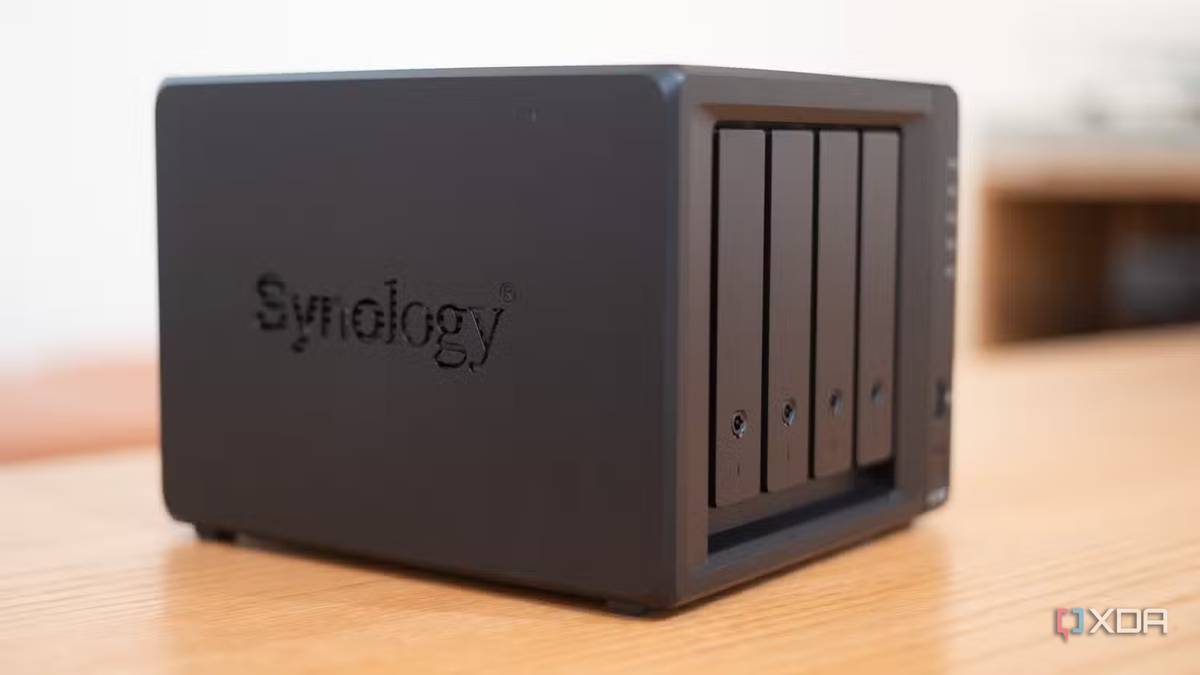
Published Jul 23, 2026, 10:00 AM EDT Abhinav pivoted from a career in banking to pursue his first love in writing. Even while working full-time, he continued contributing as an editor-at-large, a role he has held for more than 7 years. A lifelong tech enthusiast who has built three gaming and productivity powerhouse PCs since 2018, his passion for technology keeps him closely following the semiconductor industry, from NVIDIA and AMD to ARM. His MSc dissertation explored how artificial intelligence will reshape the future of work, reflecting his curiosity about the wider social impact of emerging technologies. It's mid-2026, and AI is everywhere. Your laptop probably shipped with an NPU, your browsers all have AI integration, and even your motherboard is "AI-overclocking-ready." Some of these integrations are situationally helpful, but most aren't commensurate with the premium they ask for in dollars. The latter is exactly what seems to be the case with Network-Attached Storage (NAS) devices. A brand-new class of "AI NAS" has arrived, led by crowdfunded flagships with neural processors, headline TOPS figures, and if that wasn't absurd enough, onboard chat assistants. These come at a price that is comfortably above established competitors with more drive bays. Having gone over the product spec sheets and early reviews, I was left with a single question, and that is, "who would actually benefit from these AI features?" The AI NAS is the fastest-growing pitch in storage NPUs have invaded yet another product category that never asked for them Anyone who has been in the market for a NAS is probably already familiar with the new incoming wave of AI NAS devices. Leading this wave is UGREEN's NASync iDX6011 Pro, which happens to be a crowdfunded six-bay NAS built around an Intel Core Ultra 7 255H, 64GB of RAM, and a marketing campaign that's centered on 96 TOPS of AI compute and an onboard assistant called Uliya, which handles semantic file search, photo recognition, and voice transcription. It does all of those things locally, so naturally, data privacy isn't one of my core gripes. Zettlab pitches its own "AI NAS" along identical lines, and QNAP sells the TS-AI642 with a dedicated NPU alongside its Core Ultra-equipped TVS-H workstation series. You'll see what the manufacturers are getting at. They want to deliver a Google Photos-style intelligence, minus the cloud, all running on the box that stores your data. The problem is that the processors inside most consumer NAS units that are widely beloved by the market, such as QNAP's TS-464, Synology's DS925+ and UGREEN's own DXP4800 Plus contain no NPU whatsoever, and the market leader Synology has not announced a single consumer unit with one. That, for now, makes it another tale of challenger brands hunting for a premium tier in a category where the incumbent sees no reason to follow. That itself throws the entire value proposition into question, so naturally, I began searching for an answer. The early reviews suggest that the premium buys you very little You could pay more, but do you have to? In a recent review of the iDX6011 Pro, TechPowerUp's review found that, despite the Core Ultra 7 sporting an NPU, the chip's neural engine was never observed in use while LLM features were at play, with the processor's standard cores doing the work instead, and Uliya's assistant itself failed with "no available models" errors that could not be resolved without reinstalling the entire OS itself. How-To Geek couldn't get Docker containers to communicate with the NPU either, found the native AI app too restrictive to load custom models, and admitted that the AI functionality simply didn't feature much in day-to-day use. As such, it becomes even more absurd to put a price against that. At an MSRP of $2,599, the iDX6011 Pro costs more than an eight-bay Synology DS1823XS+ at $2,050, which means that manufacturers shipping these are charging the AI premium that's worth approximately two drive bays. This is a classic case of over-promising and under-delivering, and, at least at this point, there doesn't seem to be any credible improvements in the user experience to sacrifice two drive bays for any of the features promised. Buy the NAS for storage, and put the AI where it belongs Your GPU already embarrasses every NPU in the world There are so many other, better ways to spend your money on a NAS that actually deliver a return on your investment, rather than spending top dollar on a feature set that's currently stuck in its beta phase. For example, you could prioritize 2.5GbE or 10GbE networking, because network throughput will bottleneck your NAS experience long before processing power ever becomes an issue. You could go for upgradable RAM, an iGPU if Plex or Jellyfin transcoding is something that matters to you, and perhaps above all, favor a vendor with a long-standing security commitment, since the box faces your network round the clock for at least a decade. If local AI is something that genuinely improves your user experience, there's always an option to run the model on a machine with an actual GPU and point them at the NAS over the network. A mid-range GPU will almost always outclass any NAS NPU by orders of magnitude, and your data really doesn't care about which box the inference happens on. If you go through the product specifications, you'll find that even UGREEN concedes this point by shipping the iDX6011 Pro with an OCuLink port for an external dedicated GPU. Manufacturers want AI everywhere, but do the products need it? An AI badge and a user's actual experience have rarely been further apart. Some of the products shipping with dedicated AI features exist solely to signal to markets and potential investors that a brand is sufficiently forward-thinking. A technology demo masquerading as a product is precisely where the first-adopter disadvantage lives, and it's something that has become increasingly common across the tech industry. It is important that consumers let the challengers subsidize their own AI experiments. For now, your NAS has one job, and doing it well still requires absolutely no neural silicon at all.
A NAS doesn't need an AI chip, and we need to stop pretending it does
Full Article
Original Source
Read the full article at Xda-developers →KhanList aggregates and links to publicly available news content. We do not host full articles from third-party sources. Always verify important information with original sources.