
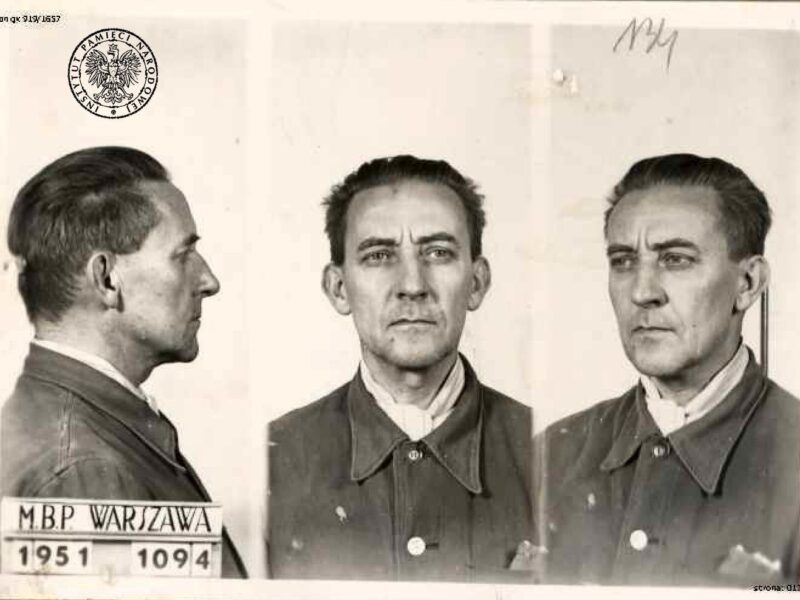
Kazimierz Moczarski wrote “Conversations With an Executioner: 255 Days Imprisoned with the Nazi Who Destroyed the Warsaw Ghetto,” after he lived to tell that tale. His Nazi prison inmate was SS Gruppenführer General Jürgen Stroop.Moczarski worked with the Home Army during World War II — one of many Polish underground groups who fought the Nazi occupation. He was decorated for his work in the Warsaw Uprising of 1944, which came a year after the Nazis, led by Stroop, “liquidated” Warsaw’s Jewish ghetto, killing at least 56,000 people in a few weeks during April and May 1943, and probably far more.Moczarski was arrested by the Soviet occupiers of Poland, on Aug. 11, 1945, three weeks and a day before World War II supposedly ended. He was charged with collaborating with a fascist organization — the Home Army — which did not collaborate with Nazis, but fought them.After repeated beatings and tortures, including 14 months in solitary confinement, on March 2, 1949, he was assigned a roommate: Stroop, the SS general who’d directed the liquidation of the Warsaw Ghetto.Stroop was hanged in 1952, after being tried as a war criminal twice, by the United States and Poland. Moczarski too was sentenced to death, by the Soviet Union, in 1952. His sentence was commuted to life imprisonment in 1953, but the Soviets did not inform him of this until 1955. He was freed the next year in an “amnesty.”His book recounts conversations with Stroop over the eight and a half months they spent as cellmates, together with a former Nazi police chief, Gustav Schielke.Moczarski worked on his book for the rest of his life. It was not published in book form until 1977, in a censored version, in Polish — two years after Moczarski died. The complete English translation, by Sean Gasper Bye, was published this year. (Steerforth Press, Lebanon, New Hampshire.)Overweening aspects of Stroop’s personality were his absolute assurance that he was right, about everything, whether he knew anything about it or not, and his fury whenever anyone dared to correct him. Oftentimes, this was Schielke, a Nazi himself, who merely corrected some of Stroop’s errors once in a while, which made Stroop livid.How dare this mere policeman not cringe before me?For Stroop, the highest virtue in life was obedience. And as one of the highest-ranking SS officers in Germany, all 79 million members of the Reich had to obey him. The only exceptions were Himmler and Hitler. And Stroop’s foremost virtue, as a good German, was to obey them.So when Himmler ordered him to destroy Warsaw’s Jewish Ghetto, kill all the people in it or deport them to concentrations camps, and reduce their homes to rubble, Stroop killed all the people he could find, deported the rest and reduced the buildings to rubble.Stroop looked down upon everyone, aside from Himmler and Hitler. Well, he outranked everyone else, didn’t he? So they owed him obedience, didn’t they? Naturally,he surrounded himself with toadies.Stroop claimed to have no regrets about anything — neither the orders he issued nor the orders he followed. When asked directly, before he was hanged, whether he had any regrets about ordering the deaths of 56,000 people in Warsaw, Stroop said no, he did not. They were Jews.After Nazis slid into power, it took them less than 90 days to ram enough laws and orders through the Reichstag to legalize everything they were about to do for the next decade and more.*Nazis hated anyone who was not just like them. Naturally, they isolated and targeted minority groups: any minority, so long as they could be named, singled out and presented as threats to the Reich.Jews, gypsies, the disabled, intellectuals, democrats, liberals, Catholics, immigrants — isolate them, declare them threats against our national purity**, bundle them off into camps.You don’t even need to deport them if you can just shoot them.At his trials, Stroop blamed other people for everything.“He was a real bastard at that trial [in Dachau],” Schielke said. Stroop blamed the other defendants he was tried with, “and that’s why so many of them got death sentences,” Moczarski wrote.He continued: “Stroop had no understanding of or feel for certain attitudes and practices of Polish society, for instance the issue of tolerance in general, and religious tolerance in particular. … ‘So you Catholics danced and had fun along with Protestants, Calvinists, Jews, Orthodox, Muslims? Your parents permitted that? Your friends, priests and teachers didn’t protest?’”So let’s sum Stroop up: He was absolutely certain he was right, all the time; he thought he was the expert on anything, whether he knew anything about it or not; he could not stand contradiction; he thought the highest virtue for everyone was to obey him; he looked down upon everyone but the few Fascists who were more powerful than him; he found minority populations easiest to attack, so he separated them from humanity in words, then attacked them; he thought that tolerance of others’ beliefs was weakness; he surrounded himself with toadies; and he felt no regret for the hundreds of thousands of people he had killed and harmed.Remind you of anyone in the news today?Am I saying that Donald Trump is a Nazi?No, but he’s got the characteristics of one.*Ralf Dahrendorf, “Society and Democracy in Germany.”**Whatever that is.Subscribe to our free newslettersOur weekly newsletter Closing Arguments offers the latest about ongoing trials, major litigation and rulings in courthouses around the U.S. and the world, while the monthly Under the Lights dishes the legal dirt from Hollywood, sports, Big Tech and the arts.Additional Reads
A most peculiar role model
Full Article
Original Source
Read the full article at Courthousenews →KhanList aggregates and links to publicly available news content. We do not host full articles from third-party sources. Always verify important information with original sources.