
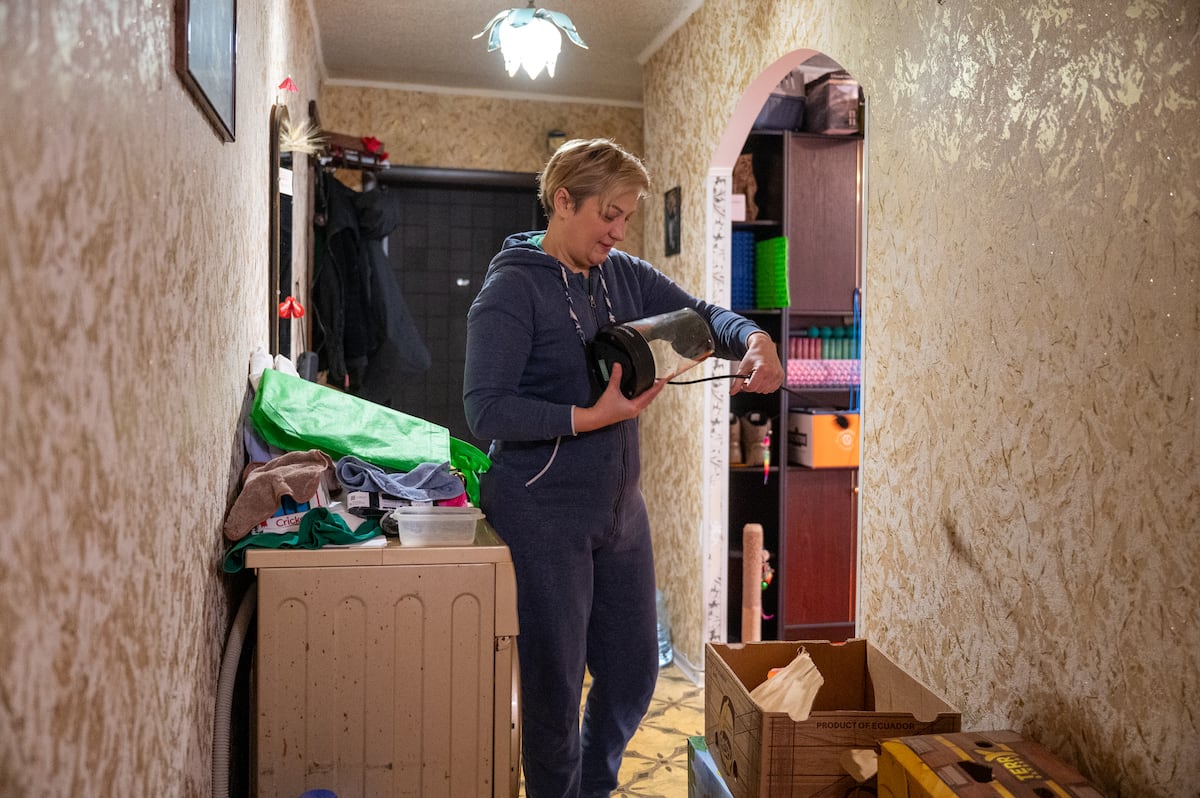
There is no drama, nostalgia or farewells. At 4.00 p.m. — the hour the curfew imposed in the city of Sloviansk in Ukraine’s Donetsk province takes effect — Irina Baladina gets ready, grabs her purse, a few bottles of water, and leaves the grocery store she has run for three years; its door is covered with wooden boards. Today is her last day. In the street she meets the four stray dogs that daily beg for food from the increasingly scarce shoppers and a few residents hurrying home as fast as she is.On the main avenue, carpeted with autumn’s yellow leaves, only two cars drive beneath the aerial nets set up to protect people from Russian drones. The market next to the grocery store is burned out. “A drone fell months ago,” the 50-year-old woman explains as she quickens her pace. Air-raid sirens went off in the city a few minutes earlier. “This is no time to be sad; the tears will come later,” she says as she walks.Days earlier, Baladina accepted that it was time to leave Sloviansk and Donbas, her native region in eastern Ukraine. Baladina was born in the small mining town of Bilozerka which, like much of the region, has been destroyed by the Russian army’s relentless attacks. Like many other Ukrainians from that area, she has been displaced several times since the Kremlin launched its full-scale invasion in February 2022, but she had never before left Donbas (composed of the Donetsk and Luhansk provinces, largely under Russian control).She moved from Bakhmut — where she had lived since 2020 — to Kostyantynivka and then to Sloviansk, which she thought was safer. Although the city has been a constant target since the start of the war and there were times when much of the population had to flee, life returned to a certain normality in 2023. But everything changed in August, when Russian attacks intensified.Moscow has turned the city’s infrastructure into a target, and residents see everyday life becoming impossible. According to data from Sloviansk’s military administration, 5,643 people have left since September 1. At the beginning of November there were 20,390 residents in the city, compared with over 105,000 recorded in January 2022.These population movements are part of a massive, chronic displacement that has affected the country for almost five years. According to data published in September by the International Organization for Migration (IOM), Ukraine — now with fewer than 30 million inhabitants — currently has about 3.48 million internally displaced people. In addition, nearly six million people have sought refuge abroad since 2022, according to UNHCR.It is hard to keep up with Baladina’s pace. She turns right into a small park between two rectangular apartment blocks typical of Soviet architecture. The anti-drone gunfire and explosions can be heard in the distance. “Today it’s quiet; there are much worse days,” she says. She enters the building and climbs five flights of stairs. The corridor’s glass panes are broken and boarded up, like many windows in Sloviansk.When she opens the door, Casper, the white cat she rescued from a dumpster in Kostyantynivka, waits for her by the entrance. The apartment does not look like the home of someone who will leave the next morning. Face creams sit on the hall table and clothes are strewn across the bed. “I’ll pack later. This isn’t the first time I’ve had to leave a place,” Baladina says before changing clothes and opening two packages of cold cuts she bought for dinner. It is already dark when she sits down to tell her story.A few weeks earlier, two 250-kilogram guided bombs hit a building on the other side of the avenue and destroyed it. “When I felt the first explosion I stayed very still, under the blanket, waiting for the next one,” she recalls. The second impact came soon after. The windows shattered; people screamed for help under the rubble. There were many wounded.“The next morning I called Sasha, my husband. He asked me why I was awake so early, and I lied: I told him that my nephew, who works in emergency services, had come over for breakfast with me,” she recalls. The man, whom she met when he was deployed with his brigade in Donbas, didn’t believe her story. “I’m coming to get you,” said Sasha (his last name is omitted because he is in the military), 58, who is now stationed in the Kharkiv region.At that point Baladina was not yet thinking of leaving, but the circumstances ultimately convinced her it was time. Since November 1, the curfew has forced her to spend much of the day at home. In addition, the water shortage meant she had to carry water drums up to the fifth floor of the building, where only a 90-year-old neighbor remains. “When you live under constant attacks, everything begins to feel normal. That’s why it’s so hard to decide to leave,” she admits.Sasha has just left Kharkiv. “I told him to drive carefully,” Baladina says. The road is difficult, especially at night. Cars are within reach of drones and everything becomes even more dangerous when entering Sloviansk, where it is common to see burned-out vehicles in the ditches. “I tell him that he didn’t just have to fight for Donbas, but also for a woman from Donbas,” she says, then bursts out laughing.Baladina speaks of Bilozerka, the mining town where she lived for most of her life and where coal dust covered everything. “People dressed in black so it wouldn’t show. Now I always wear colors,” she stresses. She visited the town for the last time in May 2025. “That day I went to my parents’ grave and I understood it would be the last time.” All her family members have left.In November 2022 she left Bakhmut, when the city was under constant attack. There was no power or water and the grocery store she ran had only a few nonperishable items left. Inside, she recalls, the shop looked like a bunker piled with sacks and wooden boards. Her brother had already gone to western Ukraine. “My responsibility was to stay until the end,” she says, explaining that her main concern was caring for the few employees who remained in the town. One day several soldiers arrived and told her the situation was critical; she had three minutes to pack.She put a few things in a plastic bag and left with them for Kostyantynivka, 17 miles away, thinking she would be able to return soon. She never did. She lived there for a couple of months but when the front began to approach and attacks became more frequent, she moved to Sloviansk, where she thought she could stay.Baladina says she has been surprised in recent months that the Sloviansk authorities, like those in Bakhmut in 2022, have continued to tend gardens, repair pipes, and fix the streets’ paving. “They try to keep life normal, but I’ve lived through all this before and I know that however much they do, the situation won’t be okay,” she says. Across from her building only a few windows are lit.Finally, at midnight, Sasha arrives and Baladina comes out to meet him. At 8.00 a.m. the next morning they are already up, smiling. “Inna [as he calls her], I can’t believe you didn’t at least pack the kitchen things,” he scolds. But by then Baladina’s attitude has already changed. She moves boxes and bundles clothes into garbage bags. “I arrived here with very few things; everything I had was left in Bakhmut and for a long time I didn’t feel like buying anything,” she recalls. Now, she says, she likes to have new things.“Can I take the new pillows?” she asks Sasha, who nods but reminds her it will be hard to fit everything in the car, including the refrigerator. “I know I’ll cry a lot in the coming months, but for now I have to think about leaving. I’ll get to Kyiv — we’ll be there for his leave — and then I’ll look for a place, possibly in Kharkiv, where I can rent a house,” she continues as she loads the bundles into the car.Baladina dreams that the front line will freeze and the war will end. Even so, she thinks it unlikely she will return to Sloviansk. “If I do, it will be to open my own business,” she says. Shortly after midnight on November 4, she wrote to this newspaper: “Already in Kyiv. Casper traveled on my lap the whole way.”Sign up for our weekly newsletter to get more English-language news coverage from EL PAÍS USA Edition
A morning to pack a life into a suitcase and leave the besieged Donbas region
Full Article
Original Source
Read the full article at English →KhanList aggregates and links to publicly available news content. We do not host full articles from third-party sources. Always verify important information with original sources.