
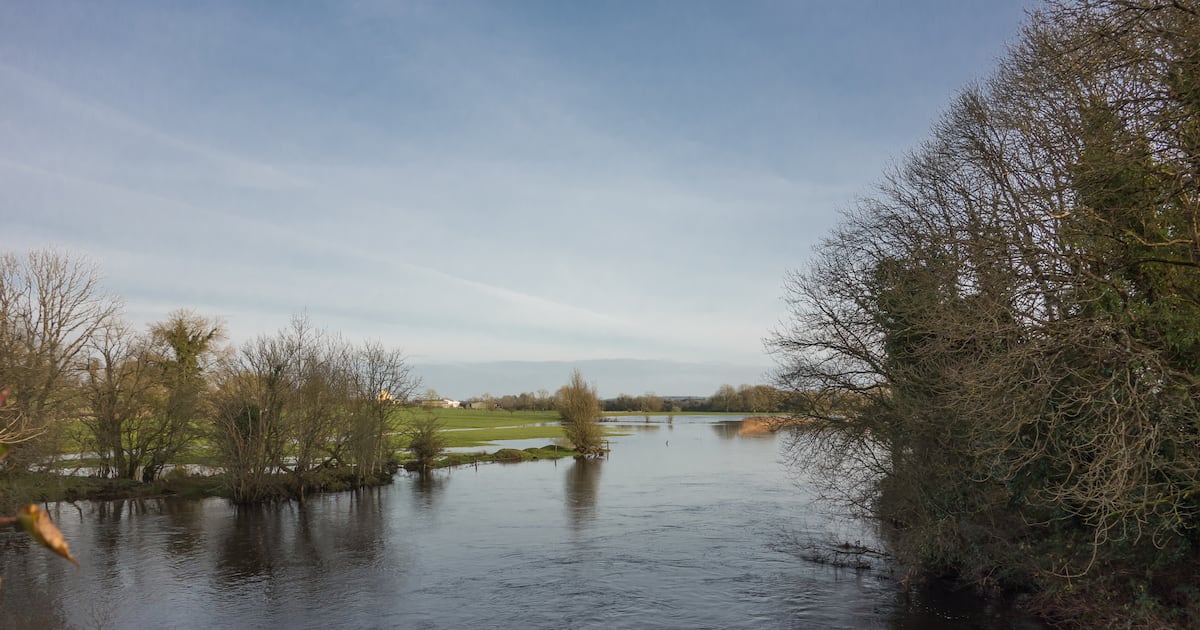
On days like these, with limited daylight, the full moon is doing the sun’s work. One early evening during the week, I walked the River Suck outside Castlerea in Roscommon, and the moon carried me along, lighting my way as it reflected off the river and the pools of water that had gathered in nearby fields. The Suck is a river of Roscommon, a county that largely sits on 350 million-year-old limestone riddled with cracks, cavities and channels. Water appears and rapidly disappears; it’s a county of swallow holes and sinkholes, turloughs that fill and vanish with the seasons, underground rivers, streams and springs where water slips out of view shortly after it surfaces. Water can move quickly through the rock, creating a system where river and groundwater are almost one.Roscommon is a long county, about 100km from north to south, and rivers gave the county much of its characteristic shape. The Suck rises just over the border in Mayo and runs for about 130km, passing through Lough O’Flynn, a 300-acre limestone lake outside Ballinlough. From there, it flows southeasterly through Castlerea before meeting the Shannon at a right angle. The Shannon forms its entire eastern boundary from Lough Allen down to Shannonbridge, a clear example of a river making a county line, while the Suck forms the south-western edge from Ballymoe to its confluence with the Shannon, narrowing the land between them into a wedge. Where the two rivers meet, Roscommon ends.I followed the river, walking on slippy ground covered in layers of burnt orange leaves. Much of what spring and summer offer is life-signalling and on show – scented flowers, birdsong, elaborate plumage, the hum of insects. In winter, attention moves from the foreground to background, to the elements. And yet, on the Suck, winter is peak season. The callows, the low meadows which run along much of the lower half of the river from Castlecoote to Shannonbridge, flood extensively on both banks from October until April, and that’s when the river’s winter birds arrive: whooper swans from Iceland, rare Greenland white-fronted geese which mainly gather in the middle reaches around Ballyforan, thousands of wigeon, and lapwing and golden plover. Winter on the Suck, at its fullest and loudest, means arrival. READ MOREBut the flocks are thinning. National Parks and Wildlife Service surveys put the goose flock at 124 in 2020, down from 293 in the late 1990s, a 58 per cent fall, similar to the decline in the whole Greenland white-fronted population since 1999. Between the early 2000s and 2010s, the lapwing flock fell from 3,906 to 1,638 and golden plover from 2,241 to 1,134, mirroring national declines. Only the whooper swan is on the rise, from 164 in the early 2000s to 234 in 2020. Many causes lie beyond the River Suck: geese breed poorly in Greenland, and wintering waders are declining across Ireland, pushed out by multiple pressures along their entire migration route.At the river’s edge, I spotted a white-clawed crayfish and watched it crawl along the stony bank. It looked as its Irish name describes it: an gliomach fionnuisce, the freshwater lobster, as it moved along before disappearing into the calcium-rich waters below. The Suck may still be one of the country’s strongholds for one of the world’s rarest pondweeds. Lanceolate pondweed is a sterile hybrid of two species, known only from Britain and Ireland, although its two British sites, Anglesey and Cambridgeshire, are thought to be lost. In 1895, the botanist Robert Lloyd Praeger collected the pondweed from the Clonbrock River, as the Bunowen is called where it passes through the Clonbrock estate near Ahascragh. In 1952, it was discovered again at Clonbrock, and in 1985 in the River Suck itself on a site along the Galway-Roscommon border. It prefers fast-flowing, limestone-rich water, stays green all winter and turns a russet colour in the sun. Whether it still exists in the Suck isn’t known. It’s a plant so rare that it can go unrecorded for years; in September 2021, it was discovered in the Camcor River and the Little Brosna. In 2024, Inland Fisheries Ireland (IFI) surveyed sites across the Suck catchment, sampling the main river channel at Cloondacarra, Donamon, Cloontrask and Ballyforan, and tributaries including the Bunowen, Shiven, Francis and Smaghraan. Trout were widespread, with some streams off the Francis and Shiven recording high density. Lamprey were found at five sites, but only one salmon was recorded.[ What Paris can teach Ireland about clean waterOpens in new window ]The results were disappointing. No site reached the legal target of “good” status, and 21 of the 50 were “poor” or “bad”. The deep-water sites at Ballyforan and Dunamon did worst, with none better than “poor”, which is a river in failure. The IFI points to a range of pressures as the probable cause – nutrient pollution, habitat changes and barriers to fish passage.I stood by the Suck, drizzle on my face, with the moonlight illuminating the bulging river, its fresh waters bound for the Shannon and out to the Atlantic Ocean.
A moonlit walk by the River Suck in Roscommon, where thinning flocks underline modern realities
Full Article
Original Source
Read the full article at Irishtimes →KhanList aggregates and links to publicly available news content. We do not host full articles from third-party sources. Always verify important information with original sources.