
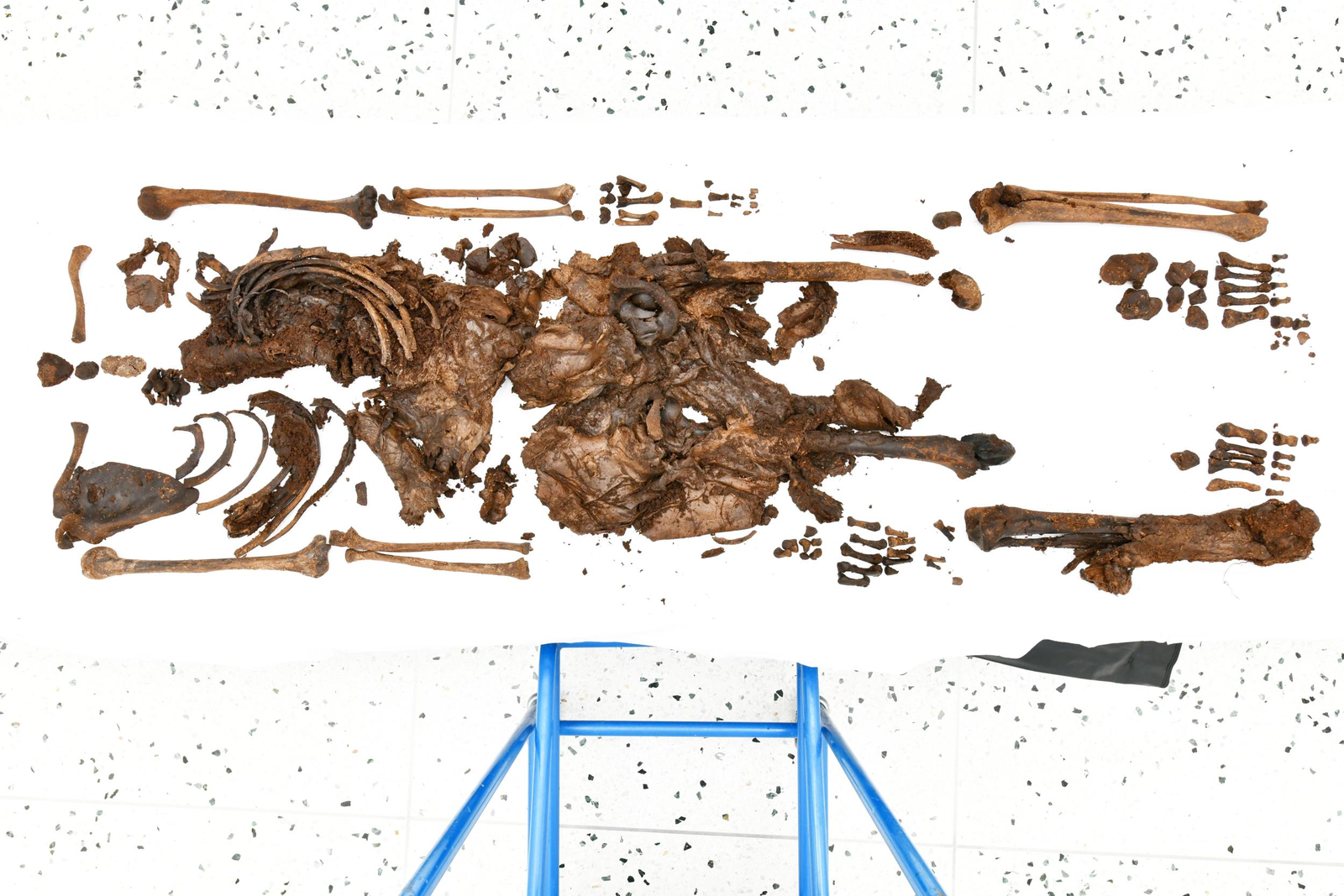
Archaeologists teamed up with a coroner to determine that the “Ballymacombs More Woman” was just 15 to 22 years old when she was beheaded in what seems to be an Iron Age ritual sacrifice November 18, 2026 3:36 p.m. The skeletal remains of the young woman who was beheaded more than 2,000 years ago Police Service of Northern Ireland After more than 2,000 years, authorities Northern Ireland are making major discoveries in gruesome cold case. A public inquest-style inquiry has determined the cause of death of an young woman from the Iron Age, whose body was recovered in a peat bog in 2023. A coroner’s investigation concluded that she was deliberately beheaded from behind with a bladed weapon. Hosted at the Ulster Museum in Belfast, the proceeding synthesized findings from an international research consortium led by National Museums NI (NMNI). Although not a formal legal inquest, the hearing applied contemporary investigative standards to examine the evidence behind a death more than 20 centuries ago. “Finds like this that are women are incredibly rare,” Hannah Crowdy, head of curatorial at NMNI, tells the BBC’s Eve Rosato. “She’s the first of her kind in Northern Ireland at all. This helps us piece together a part of history that is quite mysterious. To honor her, it’s important to tell her story and bring that to the fore.” The remains were unearthed in October 2023, when peat workers from Bulrush Horticulture uncovered human bones in Ballymacombs More outside Bellaghy in County Londonderry. Subsequent excavations recovered further skeletal remains and a woven artifact, though no skull was found. Researchers initially thought the body was male and dubbed the individual “Bellaghy Boy,” before forensic testing revealed the remains belonged to a young woman between 15 and 22 years old. She was subsequently renamed the Ballymacombs More Woman. Using micro-CT scanning, digital mapping, 3D imaging and targeted analyses of preserved bone, hair, skin, nails and the woven textile, researchers from nine institutions gathered clues about her diet, health and physical appearance. Cut marks on the woman’s neck appear to indicate that she was “intentionally decapitated in the bog,” Niamh Baker, NMNI’s curator of archaeology, tells the BBC. The reason for this decapitation is unknown. “It may be that she falls into a pattern of ritual and sacrifice that took place across northwest Europe in the Iron Age period,” Baker explains, adding that comparable Iron Age male remains found in the Republic of Ireland have been linked to leadership positions. “Was she a female sovereign?” Baker asks. “Or it may be that it was related to an agricultural or weather issue at the time.” “The purpose of the exercise is not to impose modern legal conclusions upon the distant past, but to provide a framework through which the available evidence could be assessed and the story of a previously unknown young woman could be told,” Joe McCrisken, the coroner who chaired the investigation, said at the inquest, the Guardian’s Rory Carroll reports. The Ballymacombs More Woman joins internationally famous bog bodies—including Denmark’s Tollund Man and Grauballe Man, as well as Ireland’s Clonycavan Man and Old Croghan Man—in offering rare insights into ancient societies.Residents of Bellaghy have embraced the young woman as one of their own, naming her Áine after an Irish goddess. “We feel that Áine is one of our own,” Séamus Mac an Fhirléighinn of the Bellaghy Historical Society tells the BBC. “This is her inquest, she needed her people, her family there with her to act on her behalf as advocates.” As the Ulster Museum prepares updates to its Early Peoples gallery, curators have decided not to display Ballymacombs More Woman’s physical remains, opting instead to evoke her life through mediums such as illustration and poetry, for example. “Ballymacombs More Woman was once a person, just like us,” Crowdy says in a statement. “While the circumstances of her life and death belong to the past, her discovery raises questions that remain relevant to the future, not least the presence and care of human remains in museum collections today.” You Might Also Like Get the latest stories in your inbox every weekday. More about: Archaeology Body Crime Death History Ireland Murder Northern Ireland Women's History
A Modern Forensic Investigation Reveals the Cause of Death of a 2,000-Year-Old Body Found in a Bog in Northern Ireland
Full Article
Original Source
Read the full article at Smithsonianmag →KhanList aggregates and links to publicly available news content. We do not host full articles from third-party sources. Always verify important information with original sources.