
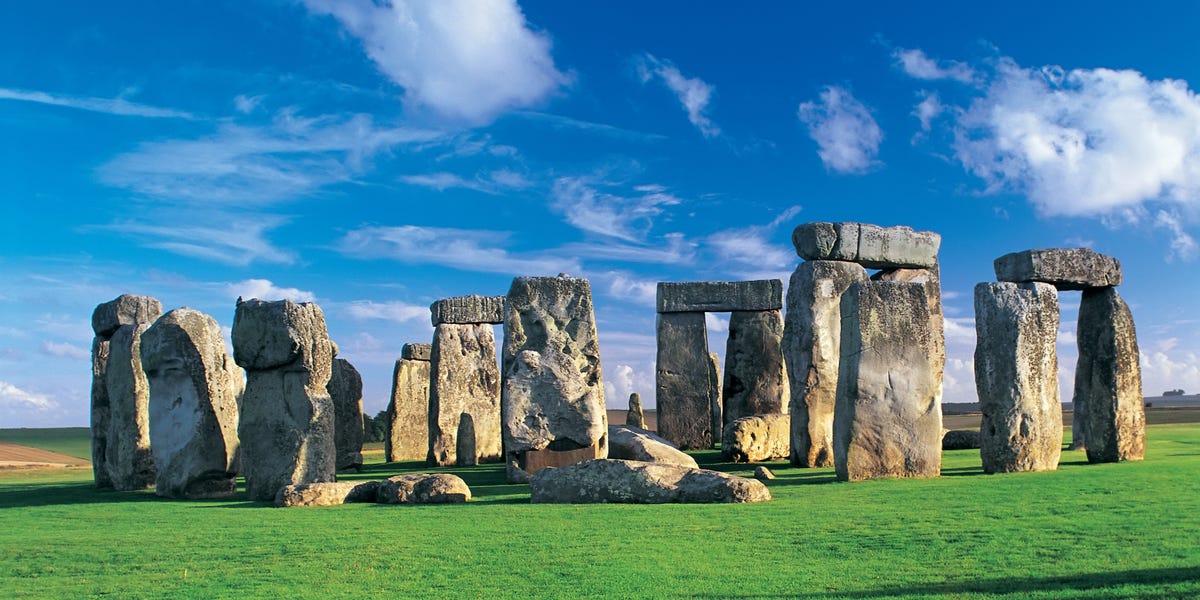
4 min readBefore anyone could set Stonehenge’s Altar Stone in place, someone had to get it to southern England. According to geological research, the six-tonne sandstone slab came from northeast Scotland—a journey of hundreds of miles with a cargo that couldn’t be replaced if it were lost.“My view is that the evidence strongly favours transport by Neolithic people, most plausibly involving a maritime journey,” Chris Kirkland, a professor of geology at Curtin University in Australia, tells Popular Mechanics. Kirkland helped trace the stone to Scotland in a 2024 study that overturned the long-held belief that it came from Wales. At the time, we looked at how a six-tonne slab might have traveled that far, possibly by sea. Since then, two studies—one of them Kirkland’s—have tested whether glaciers could have spared people some of the hauling. Kirkland’s reading is that they probably didn’t, which leaves archaeologists with a harder question than how the stone was moved. “Transporting a six-tonne stone across Britain would have demanded considerable organisation, cooperation and communication between distant communities,” he says. Were people coming together just to move this stone, or could they already count on help from communities far from home?The grains tell us where to lookThe Altar Stone is made of sand eroded from older rocks, and the mineral grains in that sand record where it came from. Researchers date some of the grains by measuring how much of their uranium has decayed into lead, then look for sandstone elsewhere with the same pattern of ages. “The mineral fingerprint points to northeast Scotland, specifically the Old Red Sandstone of the Orcadian Basin,” Kirkland says—roughly 700 kilometers (435 miles) from Stonehenge in a straight line, and farther by any real route. Later work narrowed the closest match to Caithness, around Sarclet, though the exact outcrop the slab was cut from hasn’t yet been found.The ice would still leave people with a jobTwo studies published this year tested whether glaciers could have done part of the work. In Communications Earth & Environment, Kirkland and Anthony Clarke examined mineral grains in modern stream sediments around Stonehenge and found no trace of the distant material that glacial delivery would have left behind. A separate study in the Journal of Quaternary Science modeled ice flow from Scotland and found that ice could at most have carried the stone toward Dogger Bank, now beneath the North Sea—not to Salisbury Plain.Kirkland cautions that a possible glacial path “is not evidence that the stone actually followed it.” Around the Caithness rocks that best match the Altar Stone, glaciers mostly carried material north and east, away from southern Britain. And even if ice had delivered the slab to Dogger Bank, it would have had to arrive in one piece, and people would then have had to retrieve it before rising seas submerged the area—with hundreds of kilometers still to go. Too much would have to go right, Kirkland says. He can’t rule out some help from ice, but he thinks people brought the stone from Scotland themselves.The cargo needed people who could work togetherKirkland favors a sea route because of what an overland one would involve: hauling six tonnes of stone along rivers and bogs over nearly the entire length of Britain. A sea route would bypass many of those barriers, though such a voyage carried risks of its own, and a combination—using boats for part of the trip, hauling overland for the rest—is possible. No archaeological evidence yet identifies the route or the vessels.Whatever the route, the harder problem is the people. Did a single group stay with the Altar Stone all the way to Stonehenge, or did it pass from one community to the next, each knowing where it was headed and why it mattered? If the journey stretched over generations, then its destination and its purpose had to be handed down along with the stone, Kirkland says. Archaeologists already have evidence of long-distance connections across Neolithic Britain; the Altar Stone would show what those connections could accomplish. Pinpointing the outcrop it came from would give them a starting point for reconstructing how.Some of the Altar Stone’s grains were already billions of years old when they settled into the sandstone, Kirkland says. That history is written in the rock. The far more recent story of the people who moved it is harder to recover. If they brought it from Scotland, they took on an enormous amount of work for something they could have left where it was. Finding out how they did it would be an achievement. Finding out why they thought it worth doing would tell us even more.Eric Spitznagel is a frequent contributor to magazines like Playboy, Esquire, and the New York Times, and was employed for over two decades by the Second City comedy theater, where Stephen Colbert was his Secret Santa _twice.
A Mineral Fingerprint Taken From Stonehenge Just Deepened the Mystery of Its Ancient Origins
Full Article
Original Source
Read the full article at Popularmechanics →KhanList aggregates and links to publicly available news content. We do not host full articles from third-party sources. Always verify important information with original sources.