
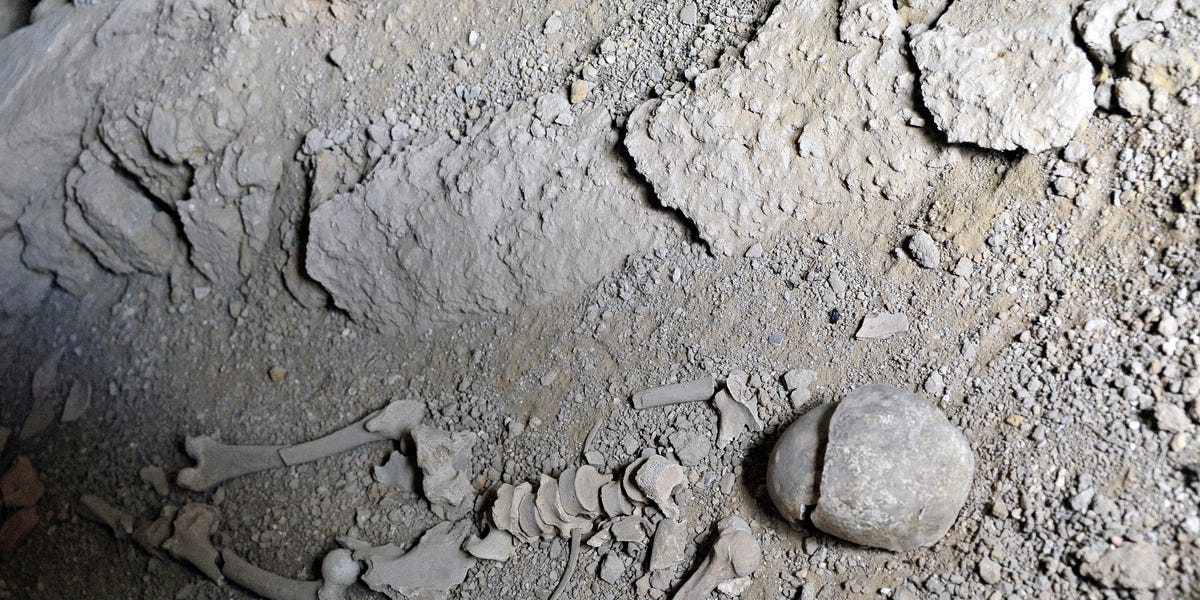
3 min readA metal fragment lodged in the skeleton of a 16th-century woman in Slovakia revealed that she was stabbed with a stiletto dagger, sparking investigation into whether she was murdered or mercifully killed.Researchers used 3D modeling and CT scans to recreate the exact stabbing scenario, determining the weapon’s trajectory, the force used, and even the approximate height of her attacker centuries after her death.Advanced forensic analysis of the 51-year-old woman’s remains demonstrated how modern technology can unlock hidden details from ancient burials, though her killer’s true motive remains a mystery.When you’re excavating an area that was once a cemetery, you expect to come across some bones—it comes with the territory. The former burial site on present-day Baštová Street in Bratislava, Slovakia, called a “parcan” for its placement between fortification walls in its day, offered up a fair share of interred remains for its excavators.Each of the 62 skeletons found at the site had, at one point, their own life and their own story to tell—but just one of these remains came with a little something extra; a tiny metal fragment that suggests this particular story may have been a tragedy, or possibly even a murder mystery.A recent study published in Digital Applications in Archaeology and Cultural Heritage shows that identifying the metal fragment was just the beginning. When scientists at the Laboratory of Physical Anthropology at the University of Prešov discovered the metal fragment located in one of the corpse’s thoracic vertebrae during macroscopic examination, they submitted the medieval skeleton for a modern day computed tomography (CT) scan.The fragment, measuring 12.2 mm in length, was determined to have been made from either iron or steel, and its “thin shape and the associated bone trauma,” including a perforation of the lower left sternum, led the researchers to conclude that the fragment had come from a weapon, specifically a stiletto dagger. A narrow blade, easy to conceal, the weapon was popular in the 16th and 17th centuries—the same era when these remains were interred.The study notes that a stiletto would be employed in a wide range of scenarios. Knights used it as a secondary weapon during combat, as the slender blade was “able to penetrate plate armour or fit into the slits in its joints.” Because the weapon is also “silent, highly penetrative, and leaves minimal bleeding,” it was used on the battlefield for mercy killings. Yet, they note, all those qualities also made the blade ideal for assassins and other criminals.So identifying the fragment only raised a new question. How did it end up lodged there for centuries? To answer that question, the researchers turned to the Medical Image and Data Resource Center’s database. Having identified the remains as a Caucasian woman of about 51, the team searched modern CT scans for a match. They selected one anonymous candidate (“Ethical approval was not required to access this anonymous, public dataset,” the study noted) and used that data to reconstruct the medieval woman’s thorax in a 3D model.They then recreated the stiletto in 3D to determine exactly how the weapon made its way into the victim and identified two scenarios that fit the evidence. In the first, the victim was stabbed twice: once through the sternum and once into the thoracic vertebra where the fragment lodged. In the second, a single thrust pierced both.Not only were the researchers able to game out those scenarios, but they were also able to determine the approximate speed of the stabbing (between roughly 2.2 to 38.6 mph), the energy expended during the stabbing (5.71 to 272.9 joules), and even the height of the stabber (somewhere between 5’5” and 5’10”).But what they couldn’t determine was the motive behind the killing. Since the body ultimately received a normal burial in the community, she wasn’t considered a criminal, which “suggests the stabbing was likely an act of passion or a mercy killing.” The researchers note that, starting in the 13th century, “Hungarian archpriests permitted burial in sacred places after payment of a silver mark for those who had been murdered or died by sword, poison, or similar means,” making it difficult to glean exactly how the victim was slain simply from the circumstances of the burial.Ultimately, the study was unable to determine a reason for the victim’s stabbing (absent some historical record, or a time machine, this is a question likely to always remain unanswered). But the research demonstrates how much more we can ascertain from centuries-old burial remains than was possible previously. Whether she was murdered or mercifully killed will remain a secret—but we know far more about her now than her bones alone once told us.Michale Natale is a News Editor for the Hearst Enthusiast Group. As a writer and researcher, he has produced written and audio-visual content for more than fifteen years, spanning historical periods from the dawn of early man to the Golden Age of Hollywood. His stories for the Enthusiast Group have involved coordinating with organizations like the National Parks Service and the Secret Service, and travelling to notable historical sites and archaeological digs, from excavations of America’ earliest colonies to the former homes of Edgar Allan Poe.
A Metal Shard in a Dead Woman’s Spine Just Exposed a 500-Year-Old Mystery
Full Article
Original Source
Read the full article at Popularmechanics →KhanList aggregates and links to publicly available news content. We do not host full articles from third-party sources. Always verify important information with original sources.