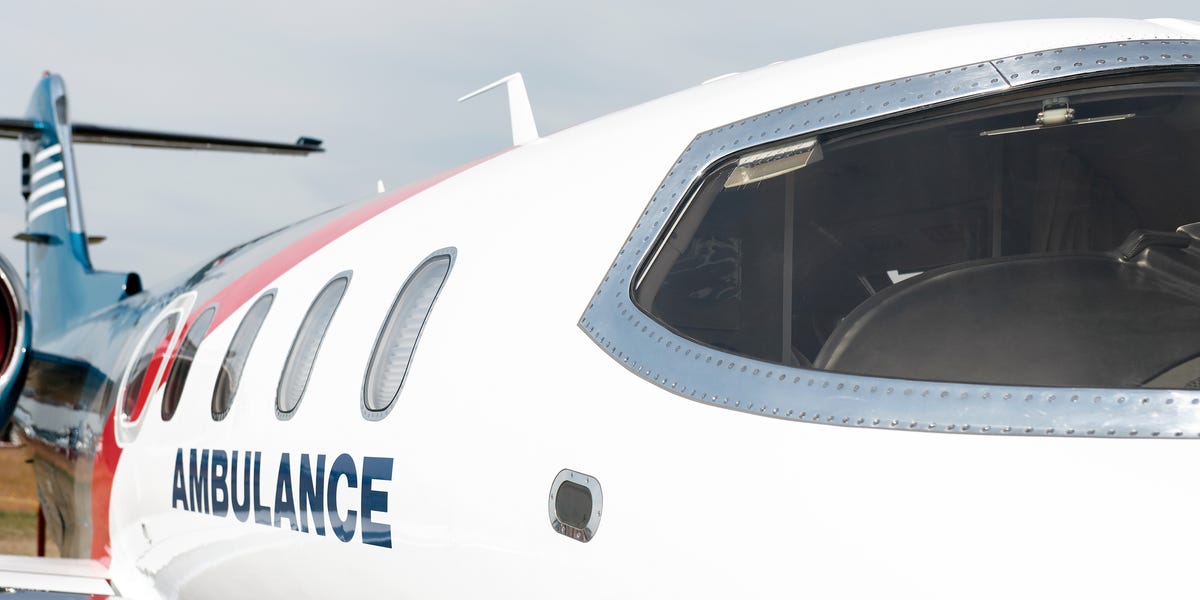
4 min readHere’s what you’ll learn when you read this story:A medevac plane was headed to pick up a patient in nearby Ruidoso, but lost GPS because of military jamming tests in the area.After guiding the two pilots to an elevation and distance where Ruidoso was in sight, air traffic control informed the military that the plane should be safe, and jamming resumed.Minutes after tests started again, the plane crashed into a mountain, leaving no survivors. For eighty years, the New Mexico desert has been where the U.S. government tests the things it would rather not talk about. The first atomic bomb, for instance, was detonated there in 1945, on a stretch of scrubland now inside White Sands Missile Range. Two years later, debris from a classified spy balloon turned up on a ranch outside Roswell and launched the most durable UFO story in American history.Those experiments were secrets. What happened on the night of May 14, 2026 was not.At 11:52 p.m., a Beechcraft King Air C90 medevac ambulance with two pilots and two nurses on board took off from Roswell Air Center and began flying to Sierra Blanca Regional Airport near Ruidoso, where a patient was waiting for transport to a hospital in Albuquerque. The King Air flew through the darkness of a moonless night with almost no visibility, and those on board had been briefed that White Sands Missile Range was conducting experiments that involved GPS interference. But the sheer scale of the disruption likely caught them off guard.Jamming exercises are announced in advance—the FAA warns pilots when they are scheduled and publishes the areas where GPS may become unreliable. But GPS signals arriving from satellites 12,000 miles overhead are extremely weak, and a ground transmitter powerful enough to defeat a drone does not stop neatly at a boundary on a chart.Although a federal aviation notice had warned that the nearby White Sands Missile Range was conducting GPS jamming exercises, the crew encountered a critical situation when their navigation systems went dark shortly after takeoff. About eight minutes after departing Roswell, pilot Keelan Clark and copilot Ali Kawsara—flying with flight nurses Sarah Clark and Jamie Novick—reported to air traffic control that they had lost their GPS signal. Forced to revert to older technology, the pilots requested heading vectors from controllers to manually navigate toward their destination. The jamming also meant the aircraft’s Automatic Dependent Surveillance-Broadcast (ADS-B) lost its primary source of location data, severely limiting air traffic control’s ability to track the plane’s precise position and altitude as it navigated the mountainous terrain. Though ADS-B usually sends updates every few seconds, that slowed drastically to once a minute, which is an obvious symptom of GPS glitching.The plane’s secondary tracking device, Spidertracks—which records position and velocity based on a different satellite network—showed an altitude about 600 feet higher than the sporadic ADS-B readings air traffic control was receiving. The conflicting data and lack of reliable instruments made it incredibly difficult for the crew to maintain their situational awareness in the dark.The pilots needed a heading—information on the direction the nose of the plane is pointing—and after providing that, the controller asked about the approach they intended to use for landing. Kawsara and Clark had originally planned to use a GPS-based approach upon arriving at Sierra Blanca Airport. However, due to the total loss of their GPS navigation capability, Clark requested to change to an Instrument Landing System (ILS) approach that relied on radio navigation instead. Recognizing the danger of navigating the rugged Capitan Mountains without GPS, the operation supervisor at air traffic control requested that the military temporarily pause their jamming operations.Unfortunately, the ILS signal was difficult to lock onto, and the plane flew off course. The military briefly paused the GPS interference, and the plane’s ADS-B signals soon returned to firing at their regular intervals. At approximately 12:08 a.m., the crew reported twice that they had Ruidoso in sight and requested a visual approach. Air traffic control received the message and officially cleared the aircraft for a visual approach to Sierra Blanca Regional Airport. Assuming the aircraft was now safe to land visually, ATC supervisors contacted the military to let them know they could resume their jamming exercises. The jamming restarted, and the plane’s ADS-B tracking plummeted once again.Minutes later, the King Air slammed into a mountain. There were no survivors.In its wake, the collision left a fire that spread so far and so fast that nearby communities were ordered to evacuate. The FAA and National Transportation Safety Board (NTSB) launched an investigation. Disturbingly, this is not the first time that planes have either gone down or been in imminent danger because of government GPS experiments. Back in 2021, an air traffic controller asked their manager to put through a request for jamming to stop to help an aircraft, but the request was denied. According to reports, FAA managers have told controllers that every time they order a “stop buzzer” to halt a GPS test, it costs the military between $5 million and $10 million. Reluctant to bleed money, tests often continue sending powerful electromagnetic radiation into the sky despite risks to civilian planes.“I don’t blame pilots for getting a little addicted to GPS,” Todd E. Humphreys, director of the Radionavigation Laboratory at the University of Texas at Austin, told the IEEE journal Spectrum. “When something works well 99.99 percent of the time, humans don’t do well in being vigilant for that 0.01 percent of the time that it doesn’t.”Elizabeth Rayne is a creature who writes. Her work has appeared in Popular Mechanics, Ars Technica, SYFY WIRE, Space.com, Live Science, Den of Geek, Forbidden Futures and Collective Tales. She lurks right outside New York City with her parrot, Lestat. When not writing, she can be found drawing, playing the piano or shapeshifting.
A Medevac Plane Crashed Into the Side of a Mountain—Minutes After the U.S. Military Flipped a Switch
Full Article
Original Source
Read the full article at Popularmechanics →KhanList aggregates and links to publicly available news content. We do not host full articles from third-party sources. Always verify important information with original sources.