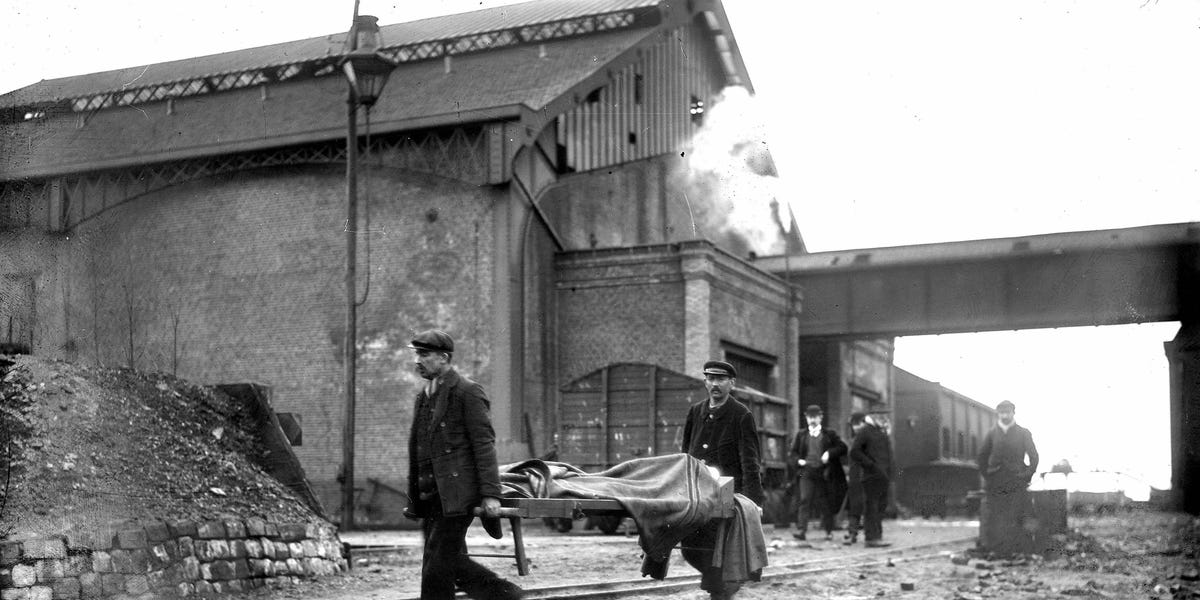
3 min readHere’s what you’ll learn when you read this story:A mine explosion in Courrières, France, in 1906 claimed the lives of 1,099 people, the largest mine disaster in Europe at the time.Flammable gas and a fire combined to create a devastating explosion and additional fires throughout the complex. Rescue missions were cut short, but survivors were still found weeks after the explosion. In March 1906, something was wrong beneath the hills of Pas-de-Calais in northern France. Workers descending into the Courrières coal mine reported a strange, acrid smell seeping through the tunnels—toxic gas, leaking through cracks in the rock. But the mine was vast, a labyrinth of shafts connecting at least four different towns, capable of hosting over 2,000 men and boys digging for coal at any one time. And so operations continued.Then came the fire.Deep in the Cecil Pit, roughly 900 feet below ground, coal dust ignited around 3 p.m. on March 9, 1906. It’s never been certain how it started—the leading theories include the mishandling of explosives used nearby or a miner’s naked-flame lamp sparking the accident—but miners couldn’t extinguish it. They attempted to seal the pit, hoping to suffocate the oxygen-hungry flames.It wasn’t enough. About 15 hours later, on the morning of March 10, the flammable gas that had been seeping through the walls mingled with the fire, and the mine erupted. The explosion was powerful enough to kill individuals on the surface and damage buildings above ground as debris shot out of the tunnel openings.Roughly 500 miners escaped the shafts in the immediate aftermath, many of whom were severely burned and injured from both the fires and the toxic air. But rescue attempts were perilous. All 40 men in one rescue party died when a shaft completely collapsed. The owners of the mine ordered shafts sealed shut to limit the growth of the raging fires, although some believed at the time this was done was to save precious money-making coal from burning. The casualty list grew and officially reached 1,099, with hundreds more seriously injured. It was the most devastating mining disaster in European history at the time. A mortuary was erected near the mine, and workers spent weeks recovering and trying to identify the dead.Then, nearly three weeks after the explosion, recovery crews received quite the surprise. They stumbled upon 13 miners “in a terribly emaciated condition,” in the words of a news report published at the time by the Northern Times of Carnarvon, Australia. The miners had survived for three weeks on oats, the bark of the mine’s timbers, and decomposing horse flesh. Once back above ground, they had to be slowly nursed back to health because their bodies were ravaged by the lack of food and toxic air. A Paris-based newspaper blamed the owners of the mine for many of the deaths, saying they were guilty of “negligence in not exploring the galleries where the 13 men were rescued.” Experts estimated that 150 entombed miners had lived for several days after the catastrophe.On April 1, crews discovered a live horse in a pit and determined that several miners had died just a day prior—agonizingly close to rescue.But the final unexpected marvel occurred on April 4. About 1,000 feet from the surface, crews discovered a lone miner alive and in surprisingly good health. The man, who was identified as Auguste Berthou in media reports, had survived for nearly a month in total darkness, living off coffee, brandy, water, and bread found on the bodies of his deceased coworkers. He staved off the cold by pulling clothing from the dead all around him. At his lowest, he had contemplated suicide with an axe, but couldn't locate one.Instead, he was found breathing. Twenty-six days after the earth had swallowed him, Berthou walked back into the light.Tim Newcomb is a journalist based in the Pacific Northwest. He covers stadiums, sneakers, gear, infrastructure, and more for a variety of publications, including Popular Mechanics. His favorite interviews have included sit-downs with Roger Federer in Switzerland, Kobe Bryant in Los Angeles, and Tinker Hatfield in Portland.
A Massive Coal Mine Fire Killed over 1,000 Workers. Weeks Later, 13 Men Emerged Alive.
Full Article
Original Source
Read the full article at Popularmechanics →KhanList aggregates and links to publicly available news content. We do not host full articles from third-party sources. Always verify important information with original sources.