
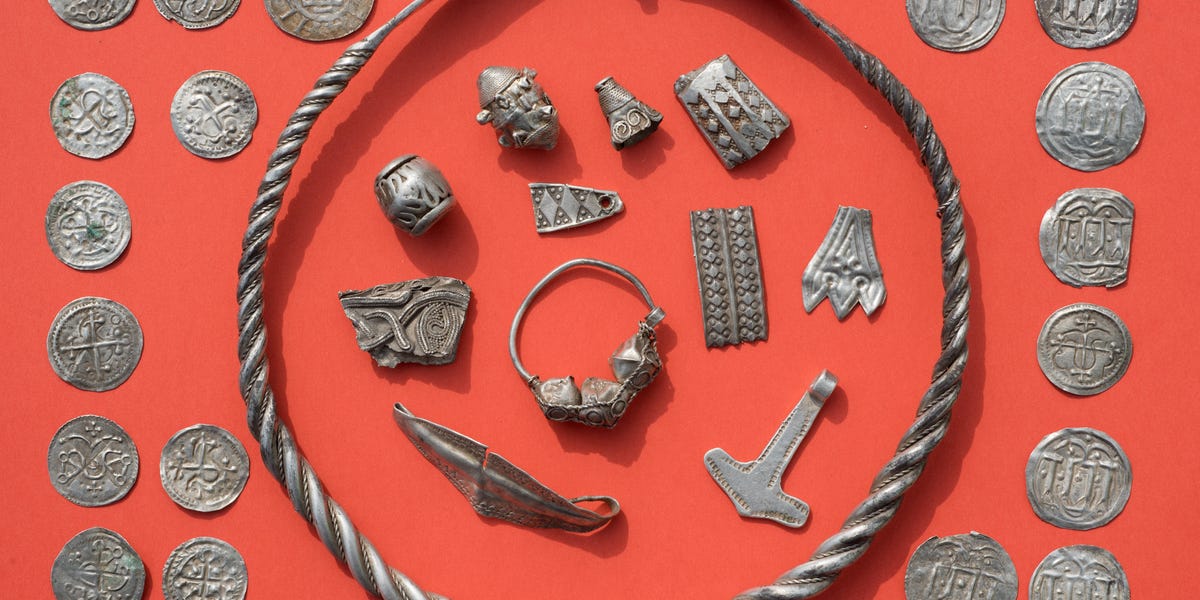
4 min readHere’s what you’ll learn when you read this story:A homeowner doing routine yard work uncovered the largest Viking Age silver hoard ever found in Denmark. The 40 pounds of silver includes ingots, jewelry, coins, and hacksilver. Just how the valuable 10th century hoard came to be there is still unknown. While working on a new patio for his house in Rebild, Denmark, a man discovered 40 pounds of 10th-century silver lying beneath the soil. What wound up being the country’s largest-ever Viking Age silver hoard contained a mix of 700 objects spilling out of a clay pot, including ingots, armbands, cut silver, 47 coins and coin fragments, and even a tiny silver pendant in the shape of Thor’s hammer.“It is like finding a Viking Age safe,” Torben Sarauw, head of cultural heritage and an archaeologist at the Museums of North Jutland, said in a translated statement.Roughly half the hoard’s items—about 320 objects weighing 14 pounds—remained inside the clay jug, while the rest had spilled into the ground around it. Combined, the contents of the hoard are almost three times as large as the previous record holder for the biggest Viking Age silver hoard in Denmark. Several of the silver ingots are stamped with crosses or Thor’s hammers, which means the hoard was created during a time when Norse paganism and Christianity coexisted, according to museum experts.The find only happened because of a private home-improvement project. “It was just supposed to be a couple of hours of hard gardening—clearing away stubborn grass, stones, and gravel for a new paved patio—but it turned out to be the biggest surprise of my life,” the anonymous homeowner said about the find. “After digging for half an hour, my garden fork struck something that made a strange sound. At first, I thought it was old iron, fencing wire, or pottery shards, but when I started digging with my hands, I suddenly found myself pulling one metal object after another out of the ground. After a short while of careful work, I realized they were pieces of jewelry, coins, and silver bars.”One of the silver bars has an extra clue as to the hoard’s origin: it’s inscribed with runes that form the word hutu, likely an owner’s mark.While the coins constitute just a fraction of the hoard’s overall weight—ingots, jewelry, and hacksilver make up the main haul—they help to date the find. Two Anglo-Saxon silver pennies were minted under King Edward the Elder, who reigned from 899 C.E. to 924 C.E., and silver Arab dirhams date to the 10th century. Dirhams were commonly cut into smaller pieces, as they were traded exclusively based on weight and silver quality, as seen in this hoard.The coins also prove the silver came from far and wide. “That is precisely what makes the find so fascinating,” Sarauw said. “The silver was hidden in Rebild, yet it points toward a much wider world. The coins reveal connections to the Islamic world in the east and England in the west, as well as a Viking Age in which people, goods, and valuables moved across vast distances.”The hoard contains an unusually large number of silver ingots, and experts noticed that they fall into distinct weight classes. It’s evidence that Vikings cut, divided, and melted their silver down to precise amounts as each transaction required. The hacksilver and even pieces of jewelry fall into distinct weight classes, too. “This is a find of great significance for our understanding of the Viking Age in Denmark,” Sarauw said. “Not only because of its size, but also because the hoard so clearly demonstrates how silver served as a form of wealth and a means of payment during the Viking Age. When we analyze the weight of the silver objects, the hoard reveals information about Viking Age economic practices.”The hoard was discovered in what’s now a modern residential neighborhood. Archaeologists can’t say whether the silver was buried there because it was once a Viking settlement, near a busy travel route, or simply a place where no one would think to look for a treasure. Because the area’s been so heavily developed, archaeologists may never know for sure.Rebild has a remarkable history of disgorging Viking Age hoards. In 1971, the 10th century Rebild Hoard, which featured silver ingots, jewelry fragments, and silver pieces wrapped in a hide, was found near where this recent discovery took place. And just two months ago, the Rold Hoard, also found near Rebild, featured six Viking Age gold arm rings, ornaments that were associated with high social status.“We are dealing with an area that consistently yields spectacular finds from the Viking Age,” Sarauw said. “The new silver hoard demonstrates that the Rebild region was not a peripheral backwater, but rather part of the extensive economic and cultural networks.” The hoard has been declared danefæ, meaning it will automatically become government property. The hoard will go to the National Museum of Denmark for assessment, with Nordjyske Museer hoping for permanent display at the Fyrkat Viking Museum alongside the Rold gold rings, which are linked to Harald Bluetooth’s unification of Denmark.Tim Newcomb is a journalist based in the Pacific Northwest. He covers stadiums, sneakers, gear, infrastructure, and more for a variety of publications, including Popular Mechanics. His favorite interviews have included sit-downs with Roger Federer in Switzerland, Kobe Bryant in Los Angeles, and Tinker Hatfield in Portland.
A Man Was Gardening in His Yard—and Unearthed a Massive Viking Silver Hoard
Full Article
Original Source
Read the full article at Popularmechanics →KhanList aggregates and links to publicly available news content. We do not host full articles from third-party sources. Always verify important information with original sources.