
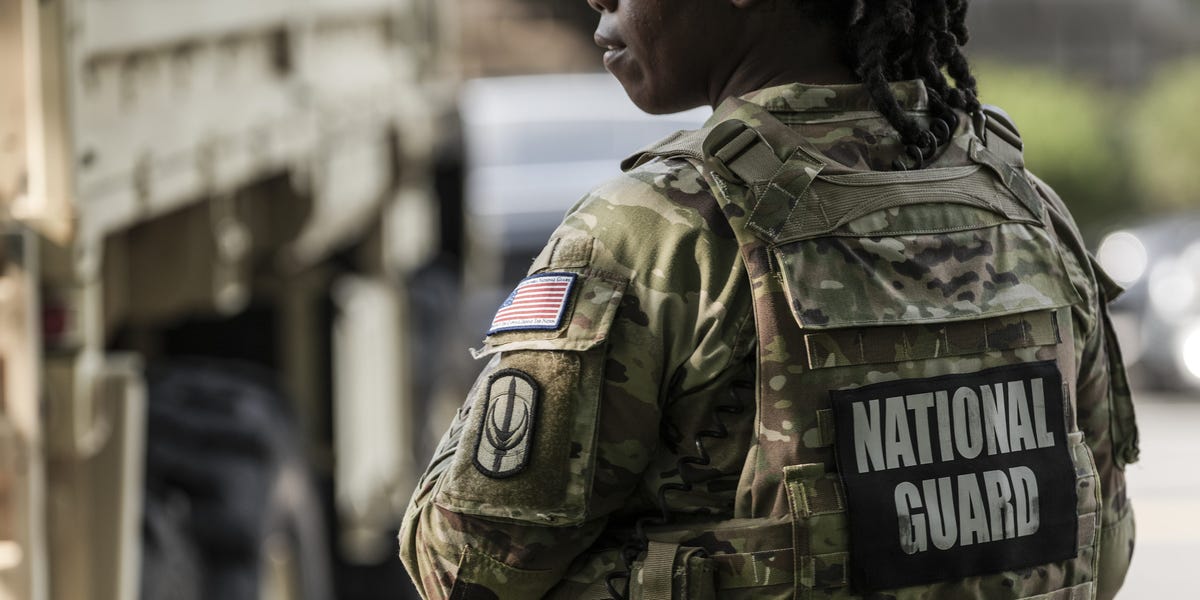
A major war could leave US states without enough National Guard troops for disasters and other emergencies, generals warn National Guard troops patrol along Constitution Avenue in Washington, DC, on August 15, 2026. Hasan Akbas/Anadolu via Getty Images A major war overseas could leave US governors without enough National Guard troops to respond to hurricanes, cyberattacks, and other emergencies at home, senior Army National Guard leaders warn.Several generals raised that concern at the Association of the United States Army's annual meeting in Washington last month, where they discussed how the Guard's more than 329,000 soldiers could face competing demands in a war against a major military power."Hurricanes will not take a break for great power war," said Lt. Gen. Jonathan Stubbs, director of the Army National Guard, according to an Army news release published Friday.The National Guard is different from the rest of the US military. Its forces respond to emergencies under the authority of state governors and also serve as a combat reserve for the military. In a major conflict, large numbers of Guard troops could be called to active duty, leaving governors with fewer personnel to respond to disasters or protect critical infrastructure.Army leaders described the dilemma as "simultaneity," warning that the military could face enormous demands for troops overseas just as threats to the homeland intensify.It's not uncommon to see the Guard facing competing demands.The wars in Iraq and Afghanistan made the National Guard a key part of US combat operations, with Guard troops accounting for about 20% of Army deployments and 11% of Air Force deployments between 2001 and 2015. A 2005 watchdog report warned that overseas deployments were straining the Guard's ability to respond to domestic emergencies.Today, thousands of Guardsmen are deployed to the US southern border, and there are thousands more in the nation's capital supporting an anti-crime initiative. This year, National Guard troops have also supported overseas combat operations, such as Operation Epic Fury against Iran, while also responding to domestic ice storms, hurricanes, and flash floods.A major war could stretch the Guard even further, forcing tough choices. Maj. Gen. Larry Muennich, Indiana's adjutant general, questioned what capabilities governors would have left to respond to domestic threats if their National Guard forces were mobilized for war. "What's left for the governor in a contested homeland?" he asked.Some states are already taking steps to address the potential shortfall.Maj. Gen. Bob Carruthers, commander of the Florida Army National Guard, said Florida had revived its State Guard, a separate, state-controlled volunteer force, in part to fill potential gaps left by federal mobilizations. The force, which Carruthers said has been "on the books" since World War II, can include up to 1,500 volunteers to respond to emergencies at home.Other generals suggested establishing a process to resolve competing demands for troops between state and federal authorities, improving civilian emergency response capabilities, and streamlining mobilizations, a notoriously burdensome administrative process, for certain home-defense missions.Maj. Gen. Brey Hopkins, the deputy commanding general of US Army Western Hemisphere Command's Reserve Component, warned that America's adversaries are closely watching how quickly it can mobilize for war and how it handles critical missions.If "you don't think they have a stopwatch on it," he said, "you got another thing coming." Read next Business Insider tells the innovative stories you want to know Business Insider tells the innovative stories you want to know Business Insider tells the innovative stories you want to know Business Insider tells the innovative stories you want to know Kelsey Baker is a military affairs reporter with Business Insider. She joined in 2025 and covers military personnel issues and how the military is overhauling how it prepares for future conflicts.Prior to joining BI, she worked at The Washington Post as a Military Veterans in Journalism Fellow covering human interest stories and international news and at The Chronicle of the Horse magazine covering horse sports. She holds a graduate degree in Journalism from Northwestern University, a degree in Diplomacy from Norwich University, and an undergraduate degree in History from the University of Denver. She previously served in the Marine Corps as a logistics officer, and later in the reserve.Contact her via email at kbaker@businessinsider.com, or via Signal at KelseyBaker75.75. Use a personal email address, a nonwork WiFi network, and a nonwork device; here's our guide to sharing information securely. War
A major war could leave US states without enough National Guard troops for disasters and other emergencies, generals warn
Full Article
Original Source
Read the full article at Businessinsider →KhanList aggregates and links to publicly available news content. We do not host full articles from third-party sources. Always verify important information with original sources.