
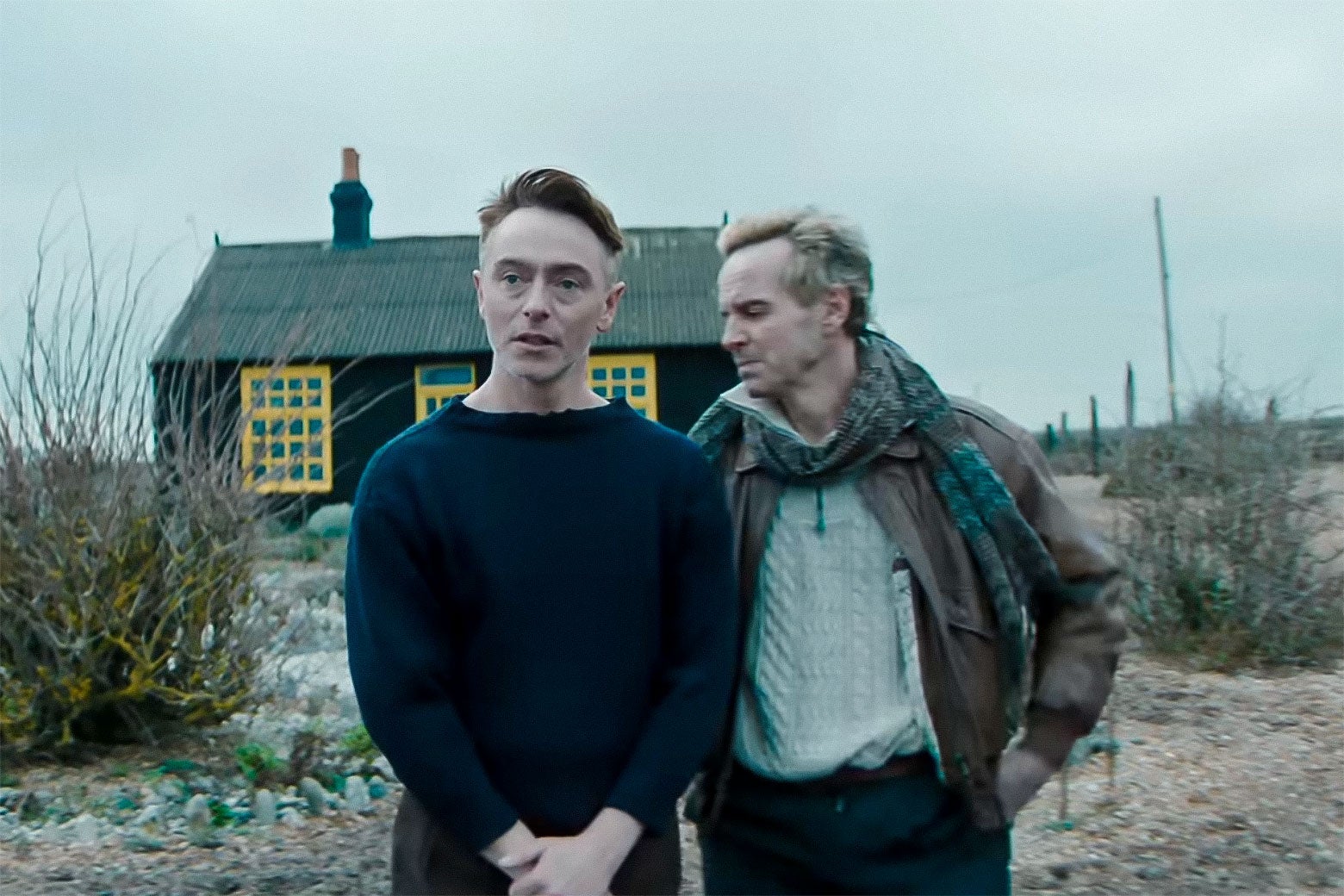
Movies The Oscar contender re-creates the feud between Ian Charleson and Derek Jarman—and changes its ending. By Enter your email to receive alerts for this author. Sign in or create an account to better manage your email preferences. Unsubscribe from email alerts Are you sure you want to unsubscribe from email alerts for Sam Adams? Nov 24, 20265:32 PM Focus Features Sign up for the Slatest to get the most insightful analysis, criticism, and advice out there, delivered to your inbox daily. In the summer of 1992, I went to see a movie called Edward II. I didn’t know Christopher Marlowe’s play, but although the actors wore period costumes and spoke in Jacobean verse, it was clear this wasn’t a straightforward adaptation, if only because when the British monarch bows to pressure to send his male lover into exile, Annie Lennox turns up to sing a Cole Porter song. But in truth, I don’t remember much about that first viewing, because one particular moment burns so brightly in my memory it has eclipsed everything else. At one point, the leader of a group of noblemen hoping to overthrow the king’s rule arranges to have Edward’s lover tortured, and citizens gather to protest his treatment. Their rebellion is met not by soldiers with swords but modern-day policemen with clubs and riot shields, and the protesters are not medieval villagers but members of the gay-rights group OutRage!, carrying signs that read “Queer is cool” and “Gay desire is not a crime.” It was as if they’d stormed their way into the film itself, occupying classical drama the way they might a government official’s office, refusing to leave until they’d changed the course of history, or at least the ending of the play. I remember feeling the way I did when a celestial being crashed through the ceiling of Prior Walter’s bedroom halfway through Tony Kushner’s Angels in America: Wait, you can do that? I felt a similar, if less intense, sense of shock when Derek Jarman, the director of Edward II, turned up a few minutes into Elsinore, which chronicles the Scottish actor Ian Charleson’s battle to play the lead in Hamlet while he is dying of AIDS. Jarman is one of the most important figures in the history of both LBGTQ+ and British cinema, but even in 2002, his frequent collaborator and muse Tilda Swinton worried that his influence was beginning to disappear. The movie is, in some ways, an elevated tearjerker (it certainly made me weep), and Andrew Scott’s performance as the wryly determined Charleson has made him a major Best Actor contender. But Jarman’s presence adds an essential dimension that turns a highly effective melodrama into a debate about the nature of political activism, and whether it’s possible for time to heal all wounds. Ian Charleson Nigel Wright/Daily Mirror/MirrorpixGetty Images Charleson had risen to fame playing the Christian missionary and Olympic gold medalist Eric Liddell in the Oscar-winning 1981 movie Chariots of Fire, but he made his film debut three years earlier in Jarman’s Jubilee, a raucous dystopian fantasia in which Charleson played a leather-clad street tough who is involved in a sexual relationship with his own brother. Jarman, who proudly claimed to have made the first film approved for general U.K. release to feature an erect penis (the filmmaker said he screened Sebastiane for the ratings board in the wrong aspect ratio so that the controversial member was just out of frame), styled 1978’s Jubilee as a deliberate affront to British gentility. (The title is a snarky reference to the same royal festivities that inspired the Sex Pistols’ “God Save the Queen.”) But it also drew the ire of the punk movement from which Jarman drew much of his cast. Vivienne Westwood printed and sold an “open T-shirt” calling it “the most boring and therefore disgusting film I have ever seen,” and complained that she could not “get off watching a gay boy jerk off through the titillation of his masochistic tremblings.” Perhaps it’s not surprising that Charleson, in search of a mainstream film career, removed Jubilee from his list of previous credits. But Jarman, who spent seven years trying to get a feature financed as he watched Chariots soar to international success and be heralded as the vanguard of a new era of British filmmaking, took it as a personal slight. When Elsinore picks up the story in 1989, Derek, played by David Dawson, is still seething. When he runs into Ian, his voice is pure acid as he calls Charleson’s performance in Chariots of Fire “the first in a long line of heterosexual masquerades.” By 1989, Jarman and Charleson were both knowingly living with HIV. But Jarman, who was a member of OutRage!—essentially the British equivalent of ACT UP—was loudly public about both his sexuality and his positive status. Charleson kept both a secret. Elsinore, which was written by Stephen Beresford and directed by Simon Stone, is Ian’s story, and if it doesn’t precisely take his point of view, it at least gives a sympathetic airing to the reasons why some gay men chose to stay in the closet, even as the lack of public attention they might have been able to command allowed the AIDS crisis to worsen. But Derek serves as a crucial foil to Ian’s rationalizations, an unapologetically out queer (his preferred term) man with no patience for those who placed personal advancement above political need. “I always loved Jarman and admired him massively,” Beresford told me over coffee last week. “I think what I really wanted to do was to get Derek to say all those things to Ian’s face, and for Ian to have the opportunity to reply to them. It’s none of my business what the audience experiences, but I hope that what they feel is that they’re both right, that it’s an impossible bind.” That bind plays out in a series of conversations throughout Elsinore. Derek treats Ian as a coward, and Ian calls Derek a “posh boy” who never faced the kind of obstacles that Charleson, a working-class Scot, did. The meetings between Jarman and Charleson are an invention. In real life, they had little to no contact after Charleson’s film career took off, and Jarman’s antipathy for prominent LGBTQ+ figures who remained in the closet never softened. He kept his disagreements with people like Ian McKellen, who publicly came out as gay in 1988 but opposed outing others against their will, civil. But in the new documentary Queer Edward II, which features on-set footage from the making of Edward II, the OutRage! members Jarman invited to the set discover that the pop star Cliff Richard is rehearsing next door, and start publicly chanting for him to come out of the closet. (Richard, whose career stretches back to 1958, still maintains that his sexuality is a private matter and says it will “go with me to the grave.”) The movie’s producers start freaking out when they learn that the London tabloids have got ahold of the story, worried a scandal might shut down the entire production, but Jarman just grins and says that if he were younger, he’d have done the same. Derek Jarman. Hulton-Deutsch Collection/Corbis/Corbis via Getty Images The son of an officer in the Royal Air Force, Jarman studied art history at King’s College London and initially pursued a career as a painter, becoming a friend and much-overshadowed contemporary of David Hockney’s. In the 1970s, he began designing for theater and then film, making the jump with the massive, geometrical sets of Ken Russell’s 1971 movie The Devils, which became a surprise hit in the U.S. when its uncensored version was finally released this year. Perhaps on a whim, or perhaps in reaction to the slow-moving pace of Russell’s elaborate production, Jarman picked up a Super 8 camera and began making films of his own. The budgets were slim, the ideas heady: Sebastiane, which chronicles the martyrdom of the titular saint, is noteworthy not just for its frank homoeroticism but for being performed entirely in Latin. Years later, a teenage Beresford would catch a late-night broadcast of the movie, and he was hooked. Beresford knew about Charleson, too, and the story of how he jumped into the lead of the National Theatre’s production of Hamlet after Daniel Day-Lewis abruptly exited in the middle of a performance. The Italian producers of what eventually became Elsinore originally wanted to make a movie about Charleson’s experience making Dario Argento’s Opera. But after giving that approach a go, Beresford came to the conclusion that they were trying to tell the wrong story. “It’s Hamlet that’s interesting,” he says, “not Italy.” Through Charleson, Elsinore brings viewers into the gay culture of 1980s London, from the presence of the Sisters of Perpetual Indulgence, an order of gay male nuns who spread awareness about HIV and AIDS, to the nightlife at Jarman’s beloved Maison Bertaux, which is still run by the same proprietors nearly 40 years later. They objected to only one line in the script, when one young gay man moans, “I don’t want cock, I want carrot cake”—not because of the reference to sex, but because, as a French pâtisserie, they would never serve carrot cake. (Beresford, an ardent carrot cake aficionado, kept the line in, because “my integrity is more important than their menu.”) Beresford, who also wrote the historical comedy Pride, about a group of lesbian and gay activists who came to the aid of families taking part in the 1984 miners’ strike, says the “don’t ask, don’t tell” attitude of the time allowed people like Charleson to hide their homosexuality without pretending to be straight. (Charleson’s sister told Beresford that, as much as he may have kept it secret, “he never lied.”) Charleson took part in the Before the Act benefit Ian McKellen organized to protest the passage of Section 28, the era’s equivalent of a “don’t say gay” law, and his sexual orientation seems to have been an open secret among his contemporaries—as, eventually was his illness. Beresford’s screenplay knowingly departs from the historical record on several details: Charleson, he admits, gave no sign he wanted his HIV status to be disclosed after his death, and he and Jarman never reconciled as they do in the film. (Some of the nastier gibes dispensed by the movie’s Derek, in fact, were taken straight from Jarman’s diary entries about Charleson.) But he saw in their story a chance to address an age-old rift, to allow characters who would once have considered themselves on opposite sides of a political divide to find a common cause. “It feels to me like two injured queens can have a moment, because in the end, the fight is the same,” he says. “They just have different ideas about how you win the war.” Jarman’s character was somewhat reduced in Elsinore’s edit. Although Derek and Ian have their final encounter outside Prospect Cottage, Jarman’s real-life home in Dungeness (now home to a museum and artist residency), the production was also the first granted permission to film inside the building, where they restaged Jarman’s real-life (if not church-sanctioned) canonization by the Sisters of Perpetual Indulgence. That scene isn’t in the film. But one of Derek’s final statements points to a world outside it. When he tells Ian that he’s losing his sight, it’s a portent of Jarman’s final film, 1993’s Blue, which was realized after AIDS had left Jarman blind. Blue’s soundtrack mixes a surrealist fable about the life of colors with reflections on Jarman’s daily life. The image, however, is a single, unaltering rectangle. (The movie was simultaneously broadcast on TV and radio, and listeners had the option of requesting a blue postcard they could stare at instead.) When it was first projected, Blue looked as placid as an Yves Klein painting. But as the film prints accumulated wear and tear from repeated use, the static image actually made its imperfections more noticeable, acquiring a strange beauty of their own. The more it endured, the more expressive it became. AIDS History LGBTQ+
A Major Oscar Contender Revives a Legendary, Closeted Actor. It Also Revives His Rival.
Full Article
Original Source
Read the full article at Slate →KhanList aggregates and links to publicly available news content. We do not host full articles from third-party sources. Always verify important information with original sources.