
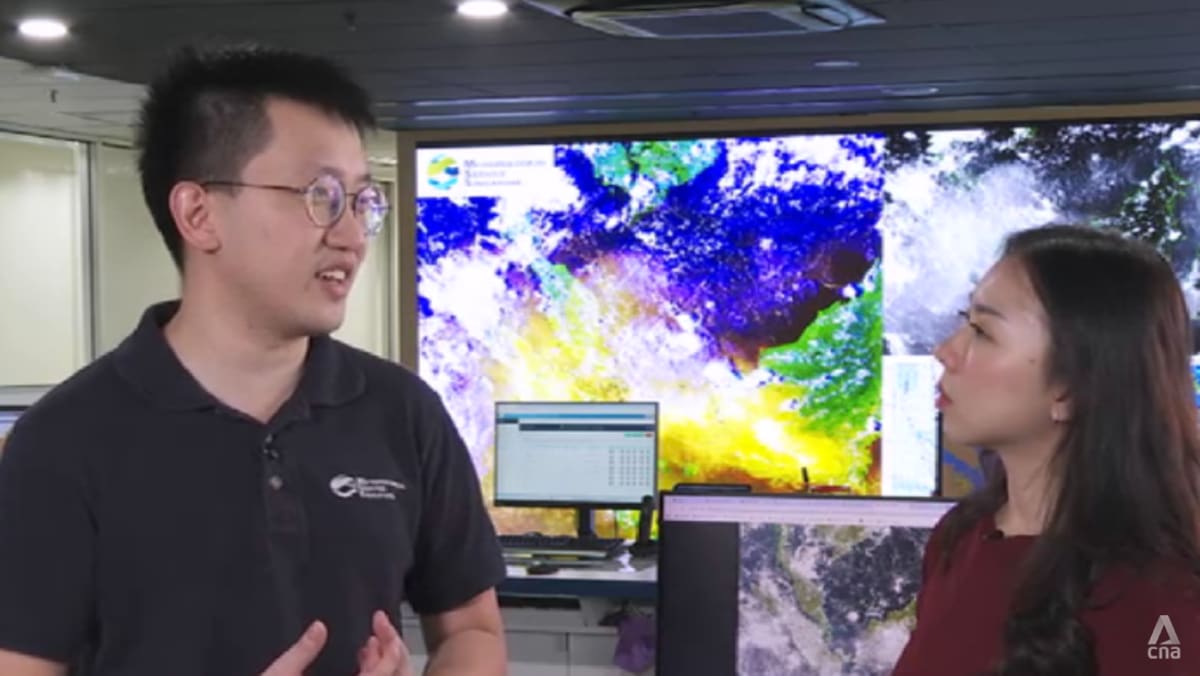
SINGAPORE: It may take just seconds to glance at a haze forecast, but for meteorologist Gabriel Lim, the responsibility behind it can weigh on him long after he leaves the office.“In the middle of a significant haze episode, I can't really switch off fully after work,” he told CNA.“So even after work, I do keep looking at the latest satellite image, replaying my assessment, and wondering if the call I made was the right one.”Sometimes, dinner with his family is pushed back, while on other days, he wakes up earlier to answer questions about the haze.For Mr Lim, an executive meteorologist at the National Environment Agency (NEA), the stakes are high, with many people relying on his forecasts to make decisions.“Knowing that my forecast will impact a lot of people, it makes it daunting, of course, and sometimes stressful,” he said.“But it also means a great deal because I know that the forecast I give impacts the people that I care about, and it makes it worthwhile.”AN UNPLANNED CAREERBecoming a meteorologist was not something that he had planned.Growing up, he was fascinated by the extreme weather depicted in movies, even though such conditions were rarely seen in Singapore.When he came across a job opening at the Meteorological Service Singapore (MSS), he decided to apply.“I find it quite interesting. Never heard of it before, so I just decided to give it a shot. I was curious to find out more,” he said.With a background in environmental studies, his move into meteorology was a natural fit. What began as curiosity soon became a greater appreciation for the science behind weather forecasting.“(There're) a lot of uncertainties. It's a lot of analysis and data, so that's what I find exciting and challenging,” he said. Today, Mr Lim is part of a team at MSS responsible for monitoring environmental hazards, including haze. As MSS hosts the Association of Southeast Asian Nations (ASEAN) Specialised Meteorological Centre, the team monitors haze conditions across the region, providing assessments and early warnings.The monitoring continues throughout the year, even when Singapore’s skies are clear. Mr Lim is part of a team at MSS responsible for monitoring environmental hazards, including haze. (Image: CNA) PREDICTING THE UNPREDICTABLEEach workday begins with a weather briefing, where forecasters review overnight developments, assess current conditions and discuss what could happen over the rest of the day.But even with all the information available, predicting where haze will travel is far from straightforward.“What's difficult is haze can develop very differently each time, because smoke plumes travel hundreds of kilometres,” said Mr Lim.“As it travels, it may disperse, it may change its direction, it may travel at different heights.”Rainfall can also affect how much haze remains in the air.To make their assessments, forecasters study satellite images to identify fires and track smoke plumes.They also examine wind and rainfall forecasts, along with models that estimate how haze may spread and affect air quality.“We believe that no particular one model is always correct, so we cross-check it with multiple models,” Mr Lim said. He recalled one particularly challenging haze episode when he spotted dense haze over Kalimantan, hundreds of kilometres away, drifting slowly towards Singapore. He could see the smoke approaching, but he could not tell whether the densest haze would reach Singapore, or how severely it might affect air quality.“The thing is, in this whole dense patch of haze, there were some (parts) that were more dense than others, and there are some parts of cleaner air,” he said. The uncertainties made the forecast particularly challenging, given the potential consequences of getting it wrong. "There's a lot at stake because a lot of stakeholders rely on the forecast to make decisions,” he said. Despite the pressure, Mr Lim said he takes comfort in knowing he can rely on his colleagues."It's not easy, but it's comforting to know that I have a team of forecasters with me, and they are all skilled professionals who have been doing this a long time,” he said.LIVING WITH UNCERTAINTYTo cope with the stress of his job, Mr Lim turns to simple routines, such as listening to music on his journey home.“That calms me down, that distracts me away from looking at my phone to see the haze,” he said. Despite spending his working hours analysing weather conditions, he still enjoys watching the sky.“There's something quite calming about it,” he said.But being a meteorologist has left him with a habit he finds hard to shake.“Ever since I joined this company, I do notice myself staring at the sky to see if it's gonna rain,” he said.“I'm not sure if it's a good or bad thing, but it became a habit of mine.”The job has also changed the way Mr Lim deals with unpredictability in his life.“Meteorology has taught me to be comfortable with uncertainty. So, not to be paralysed by uncertainty, but to make the best out of it,” he said. “When things just don't turn up your way, you will be in a better position to respond to it.”
‘A lot at stake’: Meet the meteorologist tasked with predicting Singapore’s haze
Full Article
Original Source
Read the full article at Channelnewsasia →KhanList aggregates and links to publicly available news content. We do not host full articles from third-party sources. Always verify important information with original sources.