
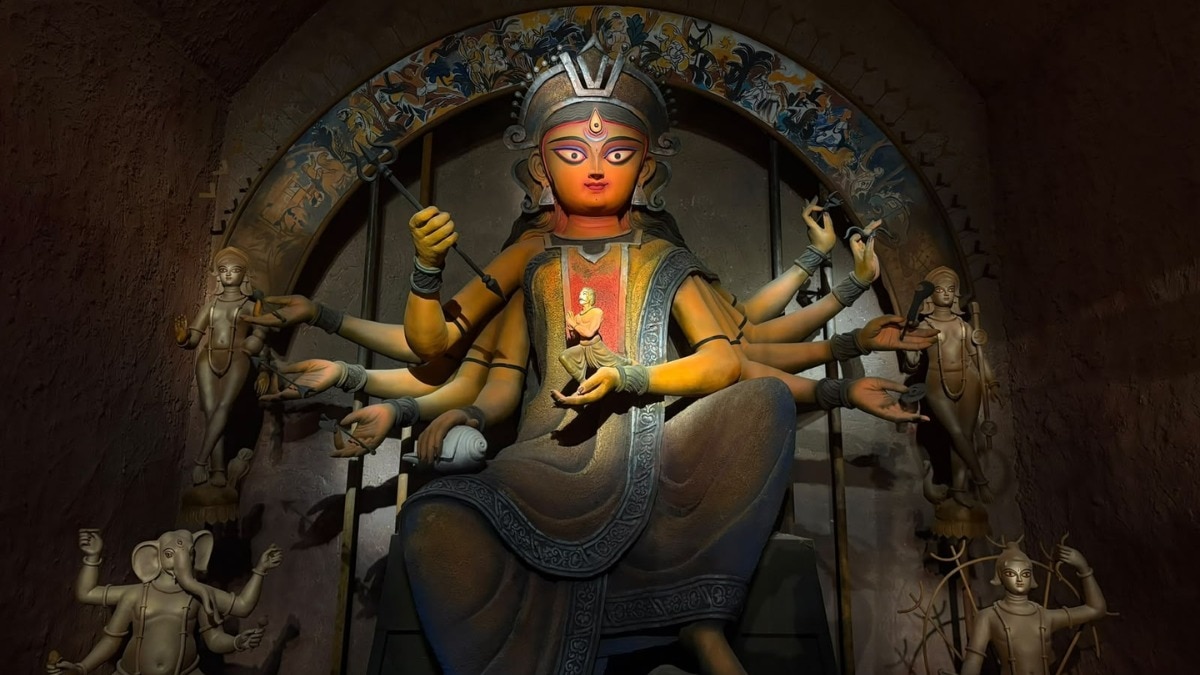
Thirteen years after she passed away, Shanu Lahiri, regarded as Kolkata’s First Lady of Public Art, is experiencing a sort of renaissance. As the city prepares to celebrate Durga Puja, one of its neighbourhood celebrations is turning the spotlight on the artist and her extraordinary body of work. At the same time, one of Lahiri’s most recognisable creations, which disappeared from a prominent city intersection, has resurfaced after remaining out of public view for 12 years.The two developments have brought Lahiri’s artistic legacy back into focus, reviving questions about the place of public art in a city whose landmarks have frequently been reshaped, removed or forgotten with changing political regimes.At Bhowanipore Abasar Sarbojanin Durga Puja, the artist’s work will be celebrated through a recreation of Paroma, the monumental sculpture that once stood at the Science City intersection on the Eastern Metropolitan Bypass. The original installation, conceived by Lahiri and created along with other artists, was demolished and removed overnight on November 24, 2014 during the Trinamool Congress government’s tenure.The disappearance left the city wondering how a familiar landmark could simply vanish. Unknown to most Kolkatans, however, the sculpture had survived. Hui Hao Howard Lee, a member of Kolkata’s Chinese community and an art enthusiast, discovered it discarded in Chowbaga, in the East Kolkata Wetlands area. He rescued the structure and kept it at the Lee family’s former tannery in Tangra. “In 2014, when I heard the statue had been removed—that was just a year after Shanu Di passed away—I was heartbroken,” Lee recalls. “I thanked God when I could salvage some of it.”The night Paroma disappearedInstalled in 1987, Paroma’s presence at a prominent roundabout on the Eastern Metropolitan Bypass became so familiar that the intersection came to be known as Paroma Island. Nearly 31 feet tall, the sculpture was a distinctive feature of Kolkata’s urban landscape, an artwork commuters encountered in the ordinary course of their day.But on the night of November 24, 2014, it was demolished and removed. By morning, only rubble remained. The sudden disappearance triggered questions about how such a large installation could be dismantled without a trace. A subsequent news report attributed the operation to the Kolkata Metropolitan Development Authority (KMDA), allegedly acting on the instructions of Firhad Hakim, then a minister in the Trinamool Congress government and who later became Kolkata’s mayor. Hakim was reported as having said that the sculpture was being relocated and got broken by mistake. Paroma. The face of the statue created by Shanu Lahiri, now residing in the former tannery of Hui Hao Howard Lee. The explanation did little to settle the disquiet in Kolkata’s artistic community. Soon after Paroma was removed, a giant metal globe bearing the Bengali letter ‘’, associated with the Trinamool Congress government’s Biswa Bangla branding, appeared at the intersection. The replacement sharpened the contrast between a work of art conceived as a shared civic landmark and an installation associated with a government.For the artistic community, the loss was unacceptable. Conceived as public art, Paroma represented an attempt to bring art into everyday life, beyond galleries and museums. Yet, even as Kolkata wondered what had happened to the sculpture, it had survived.A chance discoveryThe story of its recovery began with a visit to a Chinese temple in Chowbaga in the East Kolkata Wetlands area. Lee’s mother-in-law Yu Jung Yang had gone to the locality to visit the temple when she noticed what appeared to be the discarded sculpture. She alerted Lee, who hurried to Chowbaga to see it for himself.There, he found the familiar structure lying on the ground, with local boys playing nearby. When they appeared to exercise a claim over the discarded pieces, Lee paid them some money to secure the sculpture. He arranged for a truck to transport it to the Lee family’s former tannery to preserve it.“I was overjoyed and relieved,” Lee recalls. “I thanked God that I could salvage whatever was left of the sculpture. I even asked the boys to find the remaining parts.”The sculpture had suffered substantial damage. Its surviving figure had lost roughly five feet from the base and could no longer stand upright. The original installation had rested on a platform approximately 14 feet high, made of brick and mortar. While the base could be demolished, the figure itself, made of fibreglass, had survived. Lee as a child, in front of the statue when it was being erected. Lee brought the sculpture to the tannery and laid it out on the vast floor of the building. For nearly 12 years, he did not feel ready to speak publicly about it. Only a handful of people in his circle knew. It was only recently that news of its survival began reaching the wider artistic community.Having grown up in Tangra, Lee had a personal connection with the sculpture long before he learnt more about Lahiri’s artistic vision. He even has an image from his childhood, standing in front of Paroma while it was under construction. “We had photographs of us on the statue,” he has said, recalling how he and his brother would climb the spiralling base as children.Lee understood the value of what he had rescued. He had heard about Dilip Thakkar, the late father of his friend Reena Kataria, who had a painting by Lahiri on display. His attachment to Paroma also came from having grown up with it.The recovery of Paroma has restored a missing piece of Kolkata’s cultural memory. Only recently was Lee introduced to Damayanti, the daughter Lahiri, through Malika Jalan, a friend of his wife Mimi. Damayanti went to his tannery to check whether it is actually Paroma and was overwhelmed. “It was a surreal moment. I had goosebumps,” says Damayanti. Lee and the statue he salvaged. Shanu Lahiri's comebackNow, as Durga Puja becomes the setting for another encounter with Lahiri’s work, the emphasis will be on remembering not just Paroma but the artist’s larger vision of bringing art into the lives of people.At Bhowanipore Abasar, a group called Thinkers, comprising three members, is working on the Puja’s artistic concept. Subhrodip Pal, one of the members, says Lahiri was an important artistic presence in the Bhowanipore neighbourhood and a natural choice for the theme. Pal is working alongside Somnath Seal and Aritra Mukherjee. The Durga idol is being made by Arighna Saha, who works with Thinkers.“Shanu Lahiri and her work are too vast to be captured altogether. But we have tried,” says Pal. Shanu Lahiri working on a Durga idol for Bakulbagan Sarbojonin in 1996. The tribute also draws on Lahiri’s association with another neighbourhood Puja. In 1982 and 1996, she worked on the Durga idol at Bakulbagan Sarbojanin in the Kalighat-Bhowanipore area. Her contribution to the visual culture of the neighbourhood, therefore, extended beyond standalone sculptures and murals to the seasonal artistic traditions that animate Kolkata.The principal attraction at Abasar will be a replica of Paroma, measuring around 18 feet—smaller than the original but intended to evoke its distinctive presence. The accompanying idols of Lakshmi, Saraswati, Ganesh and Kartik will be three-dimensional recreations resembling the side figures Lahiri created for the 1982 Bakulbagan Puja.Pal says the group has studied Lahiri’s ideas about involving young artists in public art and helping them earn a livelihood through their work. It has also explored Lahiri’s thoughts on Kolkata’s Durga Puja, a cultural institution in which artistic innovation has long found a public platform. The tribute is thus also intended to revisit the philosophy behind Lahiri’s work—one that treated public spaces as places where art could be encountered organically, without the barriers of a gallery or the need for a formal introduction.Lahiri’s approach was evident in the original Paroma. Inspired by the Bengali folk-art figure known as the Diwali Putul, which combines the image of a woman or mother with a lamp, the sculpture represented a protective, light-bearing presence. Its appeal also came from its familiarity: children climbed its base, birds nested on it, and generations of commuters saw it as part of the city around them. The Durga idol Lahiri created for Bakulbagan Sarbojonin in 1982. The original project was funded by G.D. Pharmaceuticals, the makers of Boroline, and was an example of public art created through collaboration rather than as a government-funded monument. That history makes the sculpture’s disappearance and its subsequent recovery particularly poignant. And the upcoming Puja offers an opportunity to bring that memory back to a wider audience. Damayanti is expected to visit the Abasar celebrations on October 13, accompanied by Lee and his wife.As Paroma returns in a new form at Bhowanipore, Lahiri’s legacy is finding its way back into the city—through a rescued sculpture, a Durga Puja pandal and a renewed conversation about the art Kolkata chooses to remember. But what next for the original Paroma then?Damayanti believes it is public art and hence its future should be debated by the people of the city. “I was told by my lawyers that I might have some intellectual property rights over it. But I never pursued. The people must think what to do with Paroma or any public art,” she says.Lee believes Paroma must find its place back in any key city intersection. However, he needs guarantee it won’t be destroyed again.Subscribe to India Today Magazine- Ends
A lost-and-found sculpture, a Durga Puja theme: Kolkata revives Shanu Lahiri's legacy
Full Article
Original Source
Read the full article at Indiatoday →KhanList aggregates and links to publicly available news content. We do not host full articles from third-party sources. Always verify important information with original sources.