
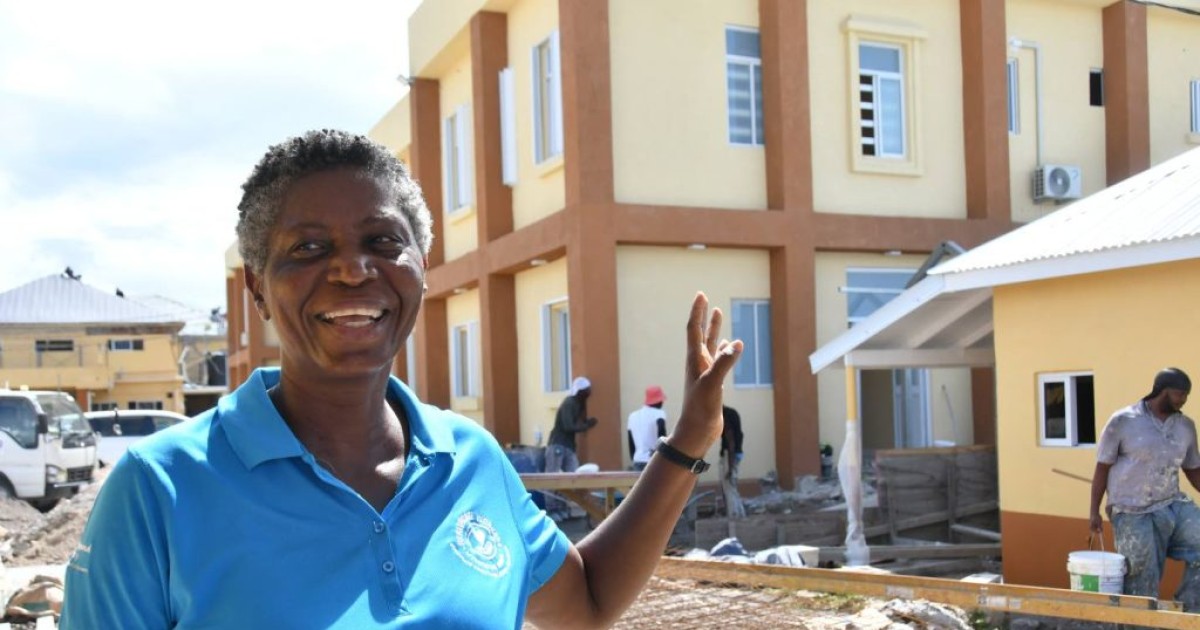
Chief executive officer at the Black River Hospital Diana Brown-Miller is all smiles as she stands in front of a new two-floor building at the facility, last Friday. (Photo: Garfield Robinson) BLACK RIVER, St Elizabeth — Even as four major wards are set to reopen today at the 180-bed Black River Hospital, the memory of the devastation caused by Hurricane Melissa exactly a year ago lingers in the minds of many here. Chief executive officer at the Black River Hospital Diana Brown-Miller still remembers the moment the roofs of all major buildings were ripped off and how staff had to rush to move babies to safety during the ordeal. Last Friday the hospital administrator monitored the final work on the four wards with anticipation for a return to normalcy. “It has been a long hard journey. There are times when we were frustrated, depressed, suffered anxiety and a lot of us were having post-traumatic stress disorder. Yes, help has been provided from the [southern] region and others came to assist, but it has been mixed feelings,” Brown-Miller told the Jamaica Observer. “We are happy with what we are seeing now and where we are at. We had hoped that it would have been completed before [now], but we are building back better and are going to be more resilient. When you look at the light at the end of the tunnel, we can only thank God for what has happened in terms of where we are now with the construction. We are looking forward to moving in,” added Brown-Miller. The four wards set for reopening at the seaside hospital today are two male, a female and the paediatric. Workmen putting the finishing touches to a two-floor building which will house four new wards at the Black River Hospital. (Photo: Garfield Robinson) Brown-Miller said operating theatres were reopened in June to serve patients at the facility. “Things have taken shape. Before the storm we had space for 150 beds; based on our calculations now we will reach 181. Two verandahs have been expanded for a new ward with 16 additional beds. The nursery is moving from five cots to 20 cots,” she said. Works are also ongoing for a sewage treatment plant and a contract has been signed for the now roofless maternity ward to be repaired. “They are now working on the control room. The plant itself is already constructed. The upper floor of the Accident and Emergency (A&E) Department has been under construction for the past six weeks. We have done some corrective work to the minor operating theatre that is attached to the A&E Department. The nurses’ quarters have been completed. Work is also ongoing on the walkways and the maternity ward,” she explained. Amid the reconstruction Brown-Miller reflected on the moment the Category 5 storm tore through the hospital and left patients and staff marooned for two days until help could reach them. Inside one of the four wards to be opened at the Black River Hospital today (Photo: Garfield Robinson) “It is customary that I always place myself on duty… for the many years that I have been working here. On the Tuesday morning we had an online meeting and while sitting there I heard water dripping on the floor… Then I heard a rumbling on the roof and I said, ‘This is serious.’ In no time the roof rolled up like a scroll. I ran out of the office by then the partitions were crumbling and the windows were broken,” she said while adding that within 45 minutes the roofs from every building were blown away on the day. She said the 82 members of staff on duty had moved the hospital’s 71 patients to safety before the storm battered the facility. “Except for [the babies] in the nursery, because we thought the hurricane shutters would make it safe, it was upstairs and the roof went, so we had to move downstairs, but then flooding started. We then had to move the babies across to the X-Ray Department,” she said. According to Brown-Miller, although she prayed throughout the storm she still felt despondent. “By 10:45 am most of the damage was already done. Rain and the strong winds continued. When I looked out all I could see were whirling winds moving in circular motion and then semi-circular motion. When we could come out about 11:45 am I saw that the surge was so high that it moved over the building closer to the seaside, which could be about 20 feet,” she said. Further afield from the hospital compound there was another painful reality awaiting staff whose homes were ripped apart. “Some staff members lost their entire homes, others lost their roofs. We had about 200-and-odd staff who suffered some amount of damage infrastructure wise. Mentally, we suffered as well, but we still came to work,” said Brown-Miller. “Thanks to my staff, people were doing what they could. The area we were using for the Dietary Department, the roof went. When the storm came the meals were almost finished cooking. The roof went and the pot had to stay on the stove. The staff had to run for shelter. “We were not able to give them that cooked meal, so after everything cooled down we served sandwiches for them and gave them hot tea. Early in the morning on the Wednesday we decided that we were going to get up and try to get them a good meal to suffice for whatever they had missed,” added Brown-Miller. With the hospital losing potable water staff relied on a nearby spa to source the precious commodity. “I had to get buckets of water to wash out the place and it was just three people cooking, so I had to help them in the kitchen,” said Brown-Miller as she remembered the difficult times in the days immediately after Melissa.
‘A long, hard journey’
Full Article
Original Source
Read the full article at Jamaicaobserver →KhanList aggregates and links to publicly available news content. We do not host full articles from third-party sources. Always verify important information with original sources.