
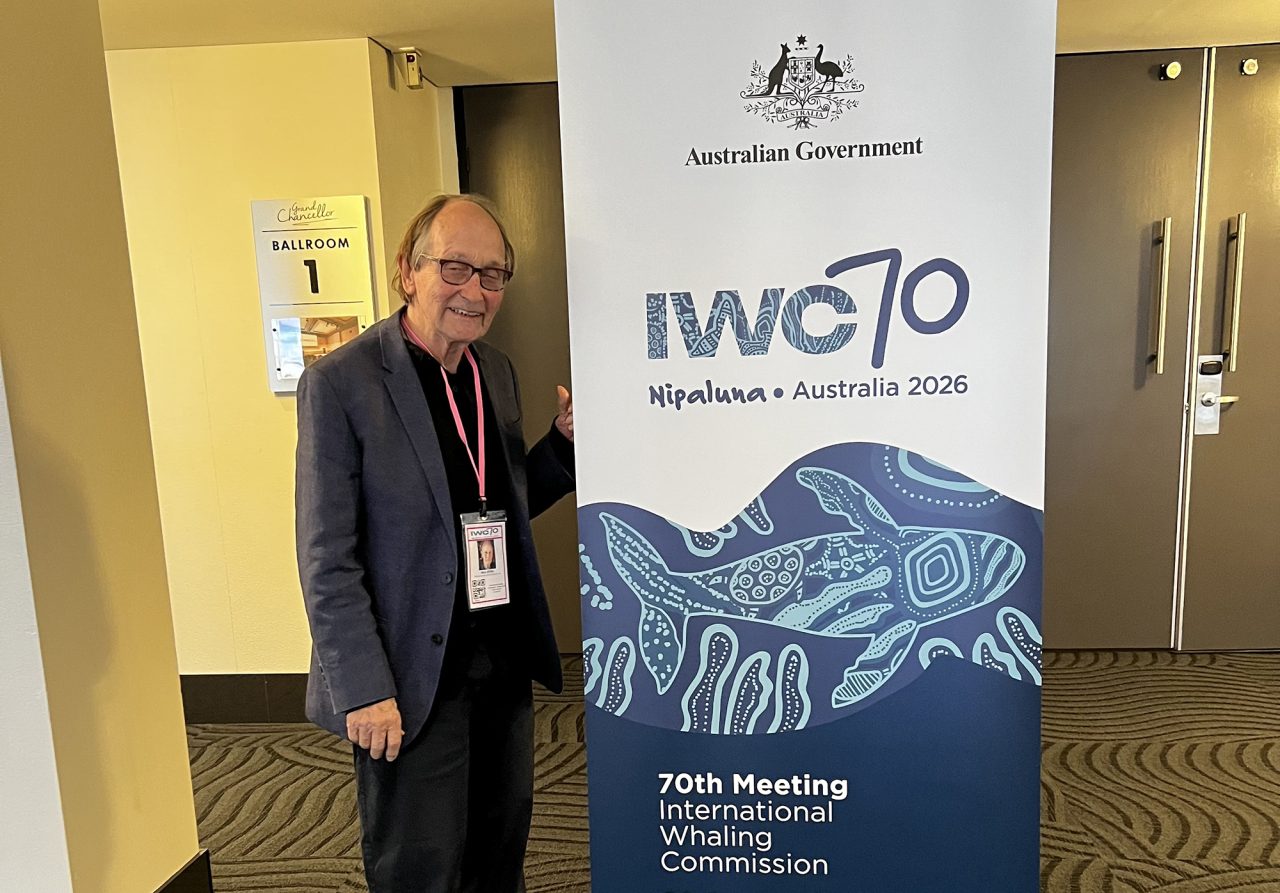
Scientist Paul Spong, whose career has been entwined with cetaceans for nearly six decades, advocates for a hands-off approach to studying orcas, using land-based hydrophones and cameras, rather than tracking the orcas by boat and physically tagging them.Spong is the founder and co-director of OrcaLab, a whale-research facility on Hanson Island in British Columbia, Canada.In addition to his cetacean research, Spong has long campaigned against whaling and the captivity of orcas.Mongabay interviewed Spong shortly after the 70th meeting of the International Whaling Commission (IWC) finished in Hobart, Australia. We discussed his work with orcas, his experiences at the IWC, and what needs to change for cetaceans to thrive in the future. Paul Spong’s life has been entwined with whales for nearly six decades. In the 1960s, Spong, who hails from Aotearoa New Zealand, moved to the U.S. to study physiological psychology at the Brain Research Institute at the University of California, Los Angeles. Then, in 1967, he entered the world of cetaceans when the Vancouver Aquarium in Canada hired him to study the behavior of a once-wild orca (Orcinus orca) named Skana, who’d been captured from Puget Sound that same year. While conducting behavioral, visual and auditory experiments on Skana, Spong quickly noticed the orca’s high intelligence and self-awareness, and advocated for her release. But the aquarium, which didn’t renew Spong’s contract, held onto Skana until her death in 1980. After his experience with Skana, Spong decided to investigate orcas in their natural habitat. In 1970, he landed on Hanson Island, off the northeastern coast of Vancouver Island, in British Columbia, Canada, with a tent and hydrophone, intending to study the local whales over the Northern Hemisphere summer. But his project stretched out longer than a single season, and by the late 1970s, Spong had founded a permanent research facility on Hanson Island, known today as the OrcaLab. Spong and his wife, whale researcher Helena Symonds, now serve as co-directors of the organization. Northern resident orcas near Hanson Island in British Columbia. Image courtesy of OrcaLab. Spong and Symonds made a conscious decision to take a hands-off approach, only observing the orcas using land-based hydrophones and cameras, rather than tracking them on boats and tagging them. “We believe the method we’ve developed, which is nonintrusive, is powerful and provides a lot of information without disturbing the whales,” Spong told Mongabay. Spong got involved with the environmental NGO Greenpeace in the fledgling days of the organization, helping the group confront whalers on the high seas after gaining access to whaling logs that helped them locate the whalers. He also began touring Canada with the so-called Greenpeace Whale Show to educate the public about whales and the impacts of whaling. In the early 1980s, Spong launched an ultimately unsuccessful campaign to free a captive orca known as Corky from a marine park in California. Corky still lives in captivity. While in London in 1975, Spong attended his first meeting of the International Whaling Commission (IWC), sneaking past security after finding a delegate’s red badge lying on the ground. Back then, the IWC was “little more than a whalers’ club,” according to Spong. But as he described in this interview, he watched the IWC transform into a group that works hard to understand and protect whales. In 1982, the IWC imposed a global moratorium on commercial whaling, a decision Spong said he believes will “never be overturned.” Spong went on to attend nearly every IWC meeting for decades. In 1970, Spong arrived on Hanson Island, off the northeastern coast of Vancouver Island, in British Columbia, Canada, intending to study the local orcas. Image courtesy of OrcaLab. Now 87, Spong recently traveled to Hobart, Tasmania, to attend the 70th meeting of the IWC, which took place from Sept. 28 to Oct. 2. He and Symonds decided this meeting would be their last, “passing the baton” to younger colleagues, as Spong wrote in an OrcaLab blog about the IWC. While Spong acknowledges the many threats facing whales, particularly from climate change, he said he remains hopeful that humanity can turn things around. Mongabay’s Elizabeth Claire Alberts interviewed Spong by phone shortly after the IWC meeting finished in Hobart. We discussed his work with orcas, his experiences at the IWC, and what needs to change for cetaceans to thrive in the future. This interview has been edited for length and clarity. Mongabay: You’ve spent nearly six decades researching whales. If there was one thing you wanted everyone to know about them, what would it be? Paul Spong: For me, I think the fact that orcas have possessed their massive brain — which is almost four times the size of a human brain — for 15 million years. This is an incredibly impressive fact. We have a fairly good brain, but we’ve only possessed it for about 100,000 years. Think about the scale of time there. I have no idea whether we will survive that length of time [15 million years]. I very much doubt it. But if we did, we might be quite different from what we are now. A bird’s-eye view of the OrcaLab research station on Hanson Island. Image courtesy of Claire Guillaume/OrcaLab. Mongabay: What’s so interesting to me about your work with OrcaLab is how you take this hands-off approach — not disturbing the orcas, but observing them from the island. At what point in your career did you decide this was the right approach? Paul Spong: Quite early on — 1981 or 1982. There was an issue about logging in the Tsitika Valley, and one of the whale-watching boats, the Gikumi, took some reporters out to explain the problem of logging in this valley. And on the way back, there was a report from one of the whale researchers about a birth happening in a little bay near Cracroft Point, and so that was observed — and it was reported in the newspaper. And the next day, a crowd of boats went out to observe the mum and this little baby, and they surrounded them. There was such a crowded scene. Helena and I went back to the lab afterwards and thought, “You know, this is wrong and there must be another way.” At that point, we pretty much decided to pull back off the water and figure out how to find out about the whales without disturbing them. Since then, we’ve developed methods that include a network of hydrophones that cover about 70 square kilometers [27 square miles] of the surrounding area that’s been designated a critical habitat for the northern resident orca community. And more recently, a network of remote cameras show us some detail of what’s going on, including cameras at the rubbing beaches. We believe the method we’ve developed, which is nonintrusive, is powerful and provides a lot of information without disturbing the whales. [Editor’s note: “Rubbing beaches” are places where resident orcas are known to rub their bodies against smooth pebbles.] Mongabay: I understand that you’ve been attending IWC meetings since 1975. Can you tell me about the first one you went to? Paul Spong: I had been on a very long trip across Canada to Iceland and then to Norway … there, the head of the Bureau of International Whaling Statistics, Dr. Einar Vangstein, allowed me to look into the records of whalers, and I was able to determine when the Russian whaling fleet would be off the coast of California. So I was able to get that information, and I sent it by mail back to Greenpeace in Vancouver to Bob Hunter [a co-founder of Greenpeace]. Subsequently, I had a little tour of Europe, and I ended up in London right at the time of the IWC meeting. There was a demonstration that Friends of the Earth had put together outside the venue that included coffins that represented the deaths of whales. At lunchtime, I sat with a group of people that had been in the meeting, and when they left to go back into the meeting, I was just sitting alone at a table, and I happened to glance down, and there was a delegate’s red badge on the ground, and I put it on and walked through security into the meeting. I didn’t do anything there — I just sort of hung out in the background and absorbed what was going on, trying not to be noticed, basically. So that was the beginning. Northern resident orcas in the coastal waters off British Columbia. Image courtesy of Cracroft Point platform by Momoko Kobayashi and Emily Vierling. The next year, I didn’t try because I was on the Greenpeace vessel James Bay, engaged in another confrontation with Russian whalers. But the year after, I came legitimately into the IWC as a representative of Greenpeace. I also have attended meetings of the scientific committee. At that point, I was quite good at taking notes for what was going on, and sometimes people would ask me what happened. It was interesting. Anyway, I can’t tell you how many meetings I’ve attended. Very, very many, over almost 50 years. Mongabay: You wrote in the OrcaLab blog that the IWC used to be a kind of “whaler’s club” before the moratorium had been put into place. What changes have you seen in the IWC over years? Paul Spong: I think the biggest change is just the number of countries participating, and there are some really great countries that have joined the IWC. If you look at the BAG — the Buenos Aires Group, all of the countries in Latin and Central America — they are great people, and they’re very, very focused on trying to help cetaceans. The whalers are still there. When you look at what’s going on and the interventions of Daven Joseph and so forth, you realize the whalers haven’t gone away and they probably won’t go away. [Editor’s note: Ambassador Daven Joseph is the IWC representative for Antigua and Barbuda, a nation that takes a pro-whaling stance.] But there are so many other really positive groups and influences in the IWC. I’m quite sure it will never sanction whaling again. I’m quite sure that the moratorium will never be overturned. I’m also, in a way, quite hopeful for the future of the IWC. If you look at the work of the scientific committee and the conservation committee, you realize they are doing really great work understanding whales and how to protect their habitat, understanding the issues that they face, and so forth. One of its biggest problems is that it doesn’t have the financial resources to do all of this work. This is why I came up with the suggestion of a $100 million endowment fund that would give the commission $3 million to $5 million annually. I think this would potentially transform the commission’s ability to do its work. But the commission does great work when it has the resources. Spong and his wife, Helena Symonds, who serve as co-directors of OrcaLab, made a conscious decision to take a hands-off approach, only observing the orcas using land-based hydrophones and cameras. Image courtesy of OrcaLab. Mongabay: How did you feel when the IWC established the moratorium on commercial whaling in 1982? Paul Spong: I obviously thought it was fantastic. I did not go to the IWC that year because I was quite sure that we had the votes to pass it — a three-quarters majority — which was true. In any event, what I decided to do at that time was just basically go back to the whale research that I was primarily interested in doing. Mongabay: But you started going back to IWC the following year. Why did you return? Paul Spong: Part of it was because I was involved with Greenpeace at the time, and we were very much focused on trying to stop whaling, and so it was kind of natural to be involved with the IWC at that point. The short answer is it just became a habit. Mongabay: What do you think is the biggest threat to whales right now? Paul Spong: Probably the biggest threat to them is climate. That the oceans are warming. When you look at the impact of the changing climate — not just on oceans, but the world in general — you have to really get worried about where we are and what’s coming at us. And I think what is really needed is some radical action that will halt this mad, mad dash to oblivion, which is what we’re engaged in right now. Everybody’s competing for the right to destroy the planet, basically. Mongabay: With climate change being such a big problem, what do you think can be done to try and preserve the lives of cetaceans into the future? Paul Spong: It’s pretty simple. What can be done is to stop burning fossil fuels and slow down what’s happening. I think we’re pretty close to a point of no return in terms of our ability to stop burning fossil fuels. Even in Canada, our prime minister [Mark Carney] wrote a book about climate, and yet he’s busily engaged on shipping more oil out of Canada in order to improve the economy, and that just makes no sense whatsoever. The whole world is just engaged in such short-term thinking. One of the biggest challenges facing the orcas in British Columbia is underwater noise, according to Spong. Image courtesy of OrcaLab. Mongabay: Can you tell me about the biggest pressures on the orcas that you work with in British Columbia? What are you hoping will change in their lives? Paul Spong: A really big problem for them is underwater noise, and it comes from all kinds of sources here, an area that’s been designated critical habitat for the northern resident community. There’s so much shipping traffic that happens — freighters, big boats, fishing boats, recreational boats. It’s just a long list of sources of noise, and it’s difficult for them to get a quiet day. I think if we could start to think about how to reduce noise, it would be quite helpful to them. They need space. They need quiet. They need to be able to do their normal things, which are to live their lives, communicate with one another, find food, and so forth. Mongabay: You’re picking up all that noise on your equipment, right? Paul Spong: For sure, yes. We have a network of hydrophones that we listen to. Our recordings, in fact, are broadcast 24/7, 365, so anyone who wants to understand us just needs to listen to our broadcast from our website. Mongabay: Is there a question about whales that still keeps you up at night? Paul Spong: I suppose the biggest question I have is what’s going to happen to the oceans as the climate continues to deteriorate. That, for me, is the largest issue here. When you have a stable ocean, you have stable situations within the ocean, which also include stable lives for whales. That’s not happening anymore. Symonds and Spong, seated from left, and their colleagues Mark Worthing of the Pacific Orca Society and Shari Manning of OrcaLab attending the IWC70 meeting in Hobart, Tasmania. Image courtesy of Mark Worthing. Mongabay: Are you hopeful for the future? Paul Spong: I am hopeful for the future, because what choice do we have? Ultimately, we’re going to have to face the fact that we’ve got to do some really radical things in order to keep surviving. And I believe that humanity is not stupid, and I don’t think that we’re going to just let it all go. I do think that at a certain point we will have to do something. When you look around the room at the IWC, you see so many signs of hope in terms of the way in which different nations are facing the issues, and they’re not abandoning the field. They’re just trying to make their way through it. Mongabay: If there was a message you’d like to give the world, what would it be? Paul Spong: Don’t give up. Don’t give up. Don’t give up. Banner image: Paul Spong at the 70th meeting of the IWC in Hobart, Tasmania, which took place from Sept. 28-Oct. 2. Image courtesy of OrcaLab. Elizabeth Claire Alberts is a senior staff writer for Mongabay and was a 2024-2025 fellow with the Pulitzer Center’s Ocean Reporting Network. Find her on Bluesky and LinkedIn. International Whaling Commission rejects push to revive commercial whaling Credits Topics
A lifetime studying and advocating for cetaceans: Interview with Paul Spong
Full Article
Original Source
Read the full article at News →KhanList aggregates and links to publicly available news content. We do not host full articles from third-party sources. Always verify important information with original sources.