
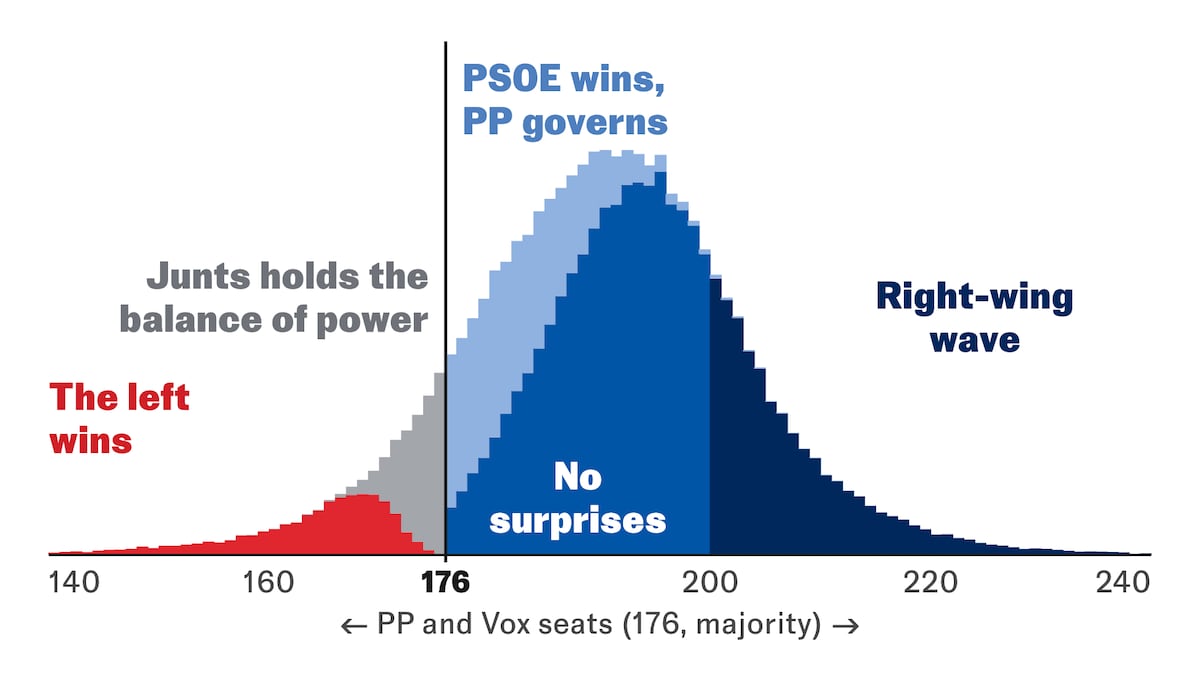
Sunday’s election in Spain has a clear frontrunner scenario: a combined majority for the conservative People’s Party (PP) and far-right Vox, giving them enough seats to form a government. But likely does not mean certain. Our model puts the odds at 87%, a figure we lowered to 83% in our final forecast. In other words, one in six times, the outcome will be different.Surprises are possible because polls are an exercise in estimation. I made the same point three years ago, on the Saturday before the July 23 election. Polls give us a high degree of confidence about some things: that PP and the Spanish Socialist Party (PSOE) will be the two most-voted parties, for example, or that the PP will fall short of an outright majority on its own. But we cannot expect polls to be exact. It is not unusual for a party’s seat count to be off by 10. That is why we express our forecasts in terms of probabilities. And it is why, just hours before voting begins, I am writing about five possible surprises.Scenario 1: A left-wing majorityPolls put PP and Vox’s combined share of the vote at 49%, while they need around 46% or 47% to secure a majority of seats. But what if the polls make a significant — though not unthinkable — error, and the result turns out to favor the left? Such an error is more likely than the opposite, because trends tend to continue until election day, and the trend in recent weeks has been toward the left. If PP and Vox lose four percentage points, falling from 49% to 45%, they would win 168 seats, short of a majority. In that scenario, the most likely outcome would be Spanish Prime Minister Pedro Sánchez securing enough support to form a government, with backing from his 2023 allies but without needing Together for Catalonia, also known as Junts, a group bent on achieving independence for the northeastern region of Catalonia.The shift the left needs could come about in two ways: through a continuation of the trend or because the polls have got it wrong. When polling ended on Monday, the trend was pointing to gains for the left, and that momentum may have continued since. The alternative is that polls have been overstating support for the right for weeks, something we will only find out on Sunday.Based on my calculations, and taking into account the typical margin of error in Spanish polls, there is a 7% chance they will be wrong by enough to produce the result the left needs. That probability is slightly higher if you believe the trend has continued. It is about as likely (or unlikely) as getting four heads in a row when flipping a coin.Scenario 2: Political deadlockThe second possible surprise is a variation on the first: the result shifts in the left’s favor, but by only around three percentage points. That would leave the parties facing complicated parliamentary arithmetic. Could it even lead to another election?If PP and Vox win 46% of the vote rather than 49%, the People’s Party’s path to power becomes more complicated. It would struggle to reach the 176-seat threshold with Vox, even if it persuaded the Canary Islands Coalition to support its bid to form a government.But the Socialists would also find it difficult to secure an investiture vote, as they would need Junts’ support. The Catalan party would effectively hold the balance of power, with the ability to tip the scales either way. If it refused to back either side, Spain could face another election.Similar deadlock scenarios have around a 6% chance of occurring. Combined with the previous scenario, the chances of PP and Vox falling short of a majority stand at around 13%, or 17% if the trend continues, as our forecast assumes. That is the “one in six times” mentioned at the beginning.Scenario 3: The Socialists win, but the right governsThe third possible surprise is that the Socialists win the election but PP and Vox still secure a parliamentary majority. If the Socialists rise from 29% to 32% of the vote while PP slips from 31% to 30%, the left-wing party would finish first with 126 seats, ahead of the PP’s 120. But Vox’s 63 seats would give the right a majority. It would be the mirror image of 2023, when the PP won the election but the Socialists formed the government.This scenario could materialize if the Socialists hold up better than the parties to their left, a trend that has been evident since the election was called. It has an 18% probability — about as likely (or unlikely) as rolling a six on a die.Scenario 4: A right-wing surgeSunday’s surprise could also come from the right. I consider this less likely than the alternative, but by no means impossible. If PP and Vox gain two percentage points, rising from 49% to 51% of the vote, for example, they could win more than 200 seats.It would run counter to the trend of recent weeks, but it has happened before: in 2000 and 2016, the right outperformed the polls by more than four percentage points. This scenario has a 21% probability — a one-in-five chance.Scenario 5: No surprisesThe final surprise would be if the result turned out exactly as expected. As I said at the beginning, our model puts PP and Vox at around 190 seats, giving them a clear majority to govern. Even without any surprises, Vox would achieve its best-ever result, with around 60 seats — eight more than it won in November 2019.This is the most likely scenario, but it occurs only half the time. It is about as likely (or unlikely) as getting heads when flipping a coin. The other half of the time, Sunday will bring one of the four surprises.Which of those surprises is most likely also depends on something we do not know: what has happened since Monday, when the final polls were published. If the trend of recent weeks has continued, surprises favoring the left would become more likely. The law prevents me from citing any new polls, but it does not stop me from looking at prediction markets, where people bet money on the outcome and some may have access to unpublished polling data. On Polymarket, the probability of PP leader Alberto Núñez Feijóo becoming prime minister fell from 90% to 88% after Monday’s polls, and has barely moved since. That does not suggest the trend has continued, but neither does it show that it has reversed.The fact is that elections often produce surprises. And that entirely predictable fact explains the classic trick of the false forecaster: you can confidently declare that “someone will be surprised” on Sunday, because that is easy to predict. The hard part is getting right who will be surprised. Methodology. The scenarios are based on 20,000 simulations from the EL PAÍS model, using polls published through November 23. We grouped the simulations into five scenarios according to which bloc wins a majority and which party comes first in the popular vote. Each chart shows a typical simulation from its group. The probabilities assigned to each scenario are those produced by the model without factoring in the recent trend.
A left-wing victory and other possible surprises in Spain’s election, according to the polls
Full Article
Original Source
Read the full article at English →KhanList aggregates and links to publicly available news content. We do not host full articles from third-party sources. Always verify important information with original sources.