
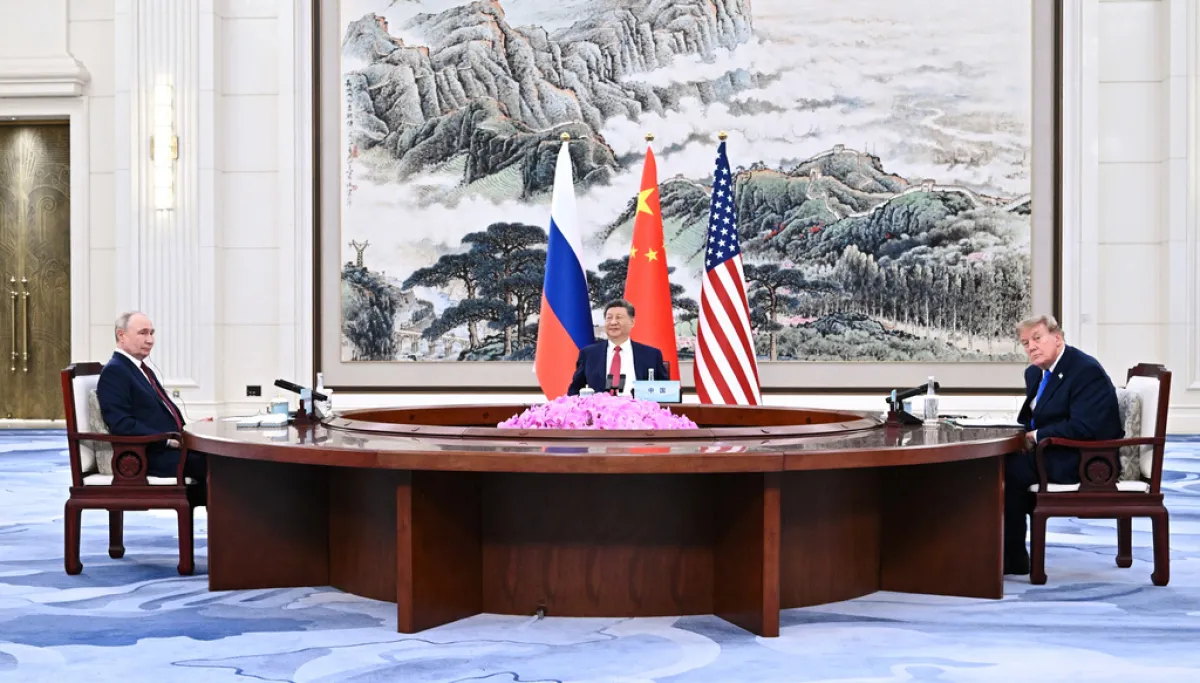
Xi Jinping welcomed Donald Trump to Shenzhen with the honors reserved for a great power. Vladimir Putin joined them for an unprecedented trilateral summit on Thursday. Three leaders representing the world’s largest nuclear powers emerged with a four-point declaration promising peace, strategic stability, and further dialogue.They produced no nuclear arms limits, no verification provisions, no negotiating timetable, and no agreement on Ukraine or Iran. What they did produce was a photograph for history and a declaration whose most consequential provisions had remarkably little to do with nuclear disarmament.For Trump, the summit offered the possible beginnings of a foreign-policy legacy. For Xi and Putin, it offered something more immediate: International standing without meaningful concessions. That distinction matters because Trump has lost much of his political runway. Democrats swept both chambers of Congress on Nov. 3, with new majorities arriving in January. When Congress closes the door, presidents often look abroad for achievements that can define their remaining years.Ronald Reagan’s Republicans lost the Senate weeks after Reykjavik in 1986. Reagan nevertheless signed the Intermediate-Range Nuclear Forces Treaty the following year, winning Senate ratification in 1988. Barack Obama lost the Senate in 2014, opened relations with Cuba six weeks later, and concluded the Iran nuclear agreement without treaty ratification. Both Obama initiatives proved vulnerable to reversal.Trump has similar ambitions but faces more complicated counterparts. New START, the last treaty limiting American and Russian strategic arsenals, expired in February. Trump wants China included in its successor. A credible three-power agreement could rival Reagan’s INF Treaty in strategic significance.Shenzhen demonstrated how far away that remains.The declaration’s nuclear provision reaffirmed that nuclear war cannot be won and pledged dialogue on reducing nuclear risks and preventing proliferation. It contained no commitment to reduce a single weapon.China has rejected trilateral arms-control negotiations for years, arguing that its arsenal remains substantially smaller. Estimates place China’s stockpile above 600 warheads, compared with American and Russian military stockpiles numbering in the thousands. Xi has little incentive to accept numerical limits while narrowing that gap.Instead, Beijing hosted a historic summit, elevated its international standing and accepted a dialogue that leaves its nuclear expansion unconstrained. Xi called the meeting positive and constructive. He had reason to be pleased.Putin had even more.The declaration’s third provision elevated state consent and the immunities of government officials while warning that the International Criminal Court and similar institutions must not abuse their jurisdiction. That language deserves considerably more attention than the familiar assurances about nuclear peace.Putin faces an ICC arrest warrant over alleged war crimes in Ukraine. Russia rejects the court’s jurisdiction. For Moscow, language emphasizing official immunities is not an incidental diplomatic flourish. It reinforces a position Putin has defended throughout the war.The United States has its own long-standing objections to aspects of ICC jurisdiction. But Washington’s objections do not make the political benefits to Putin any less real. A declaration signed by an American president now echoes Moscow’s arguments about the limits of international criminal accountability.The energy provision also deserves scrutiny. The three governments pledged to increase production and supply of refined petroleum products while supporting stable energy flows. That sounds unobjectionable until one considers the sanctions, oil markets, and geopolitical disputes surrounding Russian and Iranian energy exports.The declaration specifies no quantities, mechanisms, or obligations. Its language could serve competing interpretations, including arguments for easing restrictions on energy trade. Once again, the ambiguity benefits those seeking room to maneuver.And what of Ukraine?The leaders discussed the war, but their declaration never mentioned it. Putin participated as an equal in a discussion of global peace without committing to negotiations, a ceasefire, or withdrawal. Ukraine had no seat at the table.For Moscow, the diplomatic process itself is valuable. Every additional meeting restores Putin’s standing and creates another opportunity to seek concessions without necessarily changing his military objectives.Iran presents another complication. Trump declared the war militarily, effectively over on Nov. 9, yet American pressure on Tehran continues. Beijing purchases Iranian oil, while Moscow maintains ties with Tehran. Neither government has agreed to help Washington impose a durable settlement.Trump could eventually seek their cooperation on Iran or Ukraine. But Beijing might demand concessions on trade or Taiwan, while Moscow could press for sanctions relief or territorial concessions. The summit established no safeguards against such bargaining.None of this means diplomacy was a mistake. Communication among three nuclear powers is valuable, particularly after New START’s expiration. Preventing miscalculation is a legitimate achievement even without a treaty.But dialogue is not disarmament, and a declaration is not an agreement.Trump knows the difference. At Hanoi in 2019, he walked away from Kim Jong Un rather than accept an inadequate nuclear bargain. He demonstrated that the prospect of a historic photograph need not dictate American negotiating decisions.Dwight Eisenhower offers another warning. In May 1960, eight months before leaving office, he arrived in Paris seeking détente. Nikita Khrushchev exploited the U-2 incident to wreck the summit. Eisenhower wanted an achievement. Khrushchev had other priorities.Shenzhen did not collapse like Paris. Its danger is subtler. Xi and Putin offered enough diplomatic language to sustain future negotiations while preserving their freedom of action.Trump still has considerable presidential authority, but he has just over two years remaining. Xi and Putin face no comparable American electoral deadline. They can negotiate, delay and wait for Washington’s political circumstances to change.TRUMP, PUTIN, AND XI TARGET THE INTERNATIONAL CRIMINAL COURT IN JOINT STATEMENTThe summit was not a failure simply because it produced no binding agreement. It becomes a failure if Washington mistakes the declaration for progress and begins offering concessions to manufacture an achievement.The danger is not that Trump returned from Shenzhen empty-handed. It is that Xi and Putin gave him something he may eventually pay dearly to turn into a legacy.
A lame-duck Trump was exactly what Xi and Putin wanted
Full Article
Original Source
Read the full article at Washingtonexaminer →KhanList aggregates and links to publicly available news content. We do not host full articles from third-party sources. Always verify important information with original sources.