
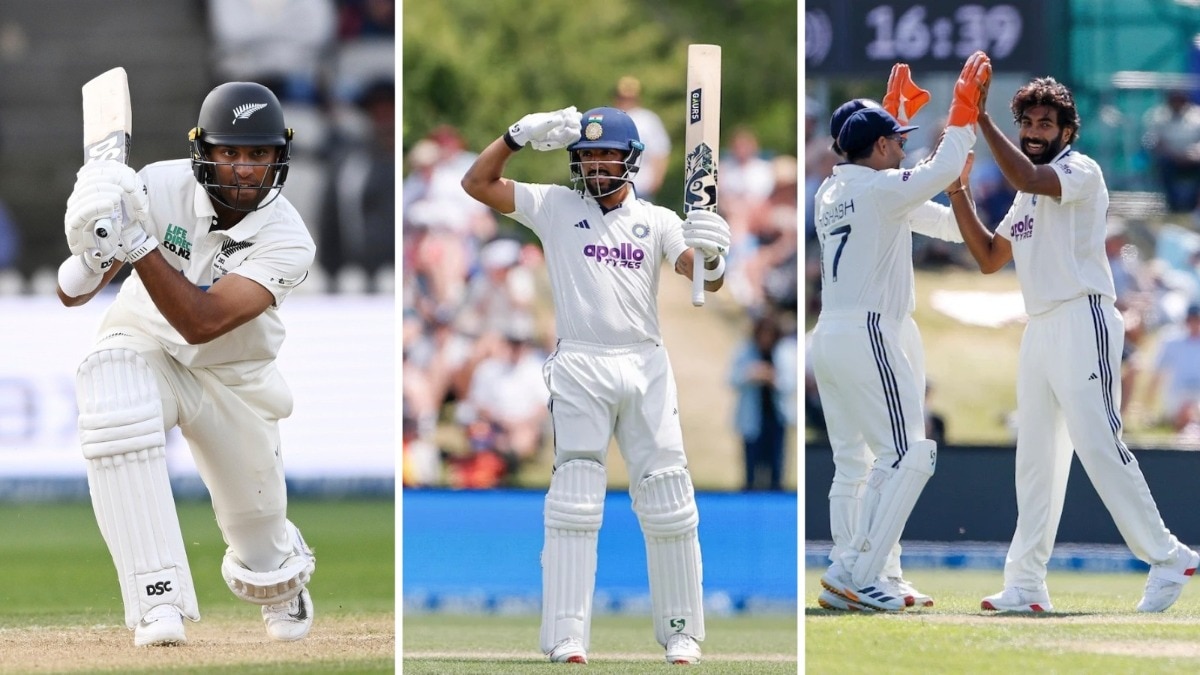
Brief Scores: New Zealand (356 & 133/3) lead India (246) by 243 runs at stumps on Day 3 of the second Test in Christchurch.India found some fight at Hagley Oval on Day 3, but New Zealand still had the last word. Dhruv Jurel stood tall when the visitors were seven down, Jasprit Bumrah rediscovered his wicket-taking touch with two quick strikes, but neither effort was enough to shift the balance of the Christchurch Test. New Zealand finished the day at 133/3, stretching their overall lead to 243 runs and keeping India firmly on the back foot.NZ vs IND, 2nd Test Day 3: Updates | ScorecardIt was a day when nothing came easily. Jurel had to fight for every run, New Zealand's batters took their share of blows, and India's bowlers had to be patient for every breakthrough. There were moments when the visitors looked capable of making a game of it, particularly when Bumrah found his rhythm in the second innings. But New Zealand have been a step ahead for most of this contest, and they managed to absorb India's best efforts without losing sight of the bigger picture. JUREL GIVES INDIA SOMETHING TO FIGHT FORThe morning could hardly have started worse for India. Dhruv Jurel was left with the lower order for company after Washington Sundar departed at 116/6. Four balls into the third day, Anshul Kamboj followed him back to the pavilion. India were 117/7, still 123 runs behind New Zealand, and in danger of conceding a massive first-innings lead.Jurel had little choice but to dig in. He could not afford to lose his wicket, but he also knew that simply blocking everything would not help India out of trouble. With the tail for company, he had to take responsibility for the scoring while making sure his partners were not exposed to the New Zealand attack more than necessary. It was a demanding exercise in game awareness. Jurel had to understand not just his own batting, but also the strengths and limitations of the men at the other end. When to take a single, when to keep the strike, which bowler his partner could handle and when to take the attack back to New Zealand—he had to make those decisions almost ball by ball.He had already been through a difficult examination on Day 2. Dropped on seven, he had been beaten repeatedly outside the off-stump. The pressure continued on Sunday when he took a blow on his gloves while defending off the front foot. But he showed little inclination to throw his wicket away.Jurel also made subtle adjustments to his technique. His contact point is naturally low, and he was careful not to jab at deliveries, which could have brought the outside edge into play. At times, he even took his bottom hand off the bat while defending, trying to ensure that any edge fell short of the slip cordon.His partnership with Akash Deep was built around a different understanding. Akash had starred with a five-wicket haul in the first innings and was willing to take the attack to the bowlers. Jurel allowed him that freedom, playing second fiddle as the pair added 46 runs. Akash contributed 29 and faced 54 of the 72 deliveries in the stand.There was a worrying interruption when Akash was struck on his helmet by Kyle Jamieson in the 53rd over. He initially continued after passing a concussion assessment, but another blow four deliveries later forced a longer examination. He was subsequently ruled out of the remainder of the Test, with Prasidh Krishna coming in as his concussion substitute.Jurel then had to start afresh with debutant Gurnoor Brar. This time, he took greater control of the strike, making sure Brar was not exposed too often. The two added 64 runs from 126 balls, with Jurel contributing 49 and Brar chipping in with 15.It was a partnership that demanded patience from both batters. Jurel was prepared to wait for scoring opportunities, while Brar showed enough composure to stay alongside him. India were no longer just trying to avoid an embarrassing collapse. They were making New Zealand work for the final three wickets.There was plenty of quality in Jurel's batting, too. His drives through the off side were a treat to watch, while he picked the length quickly to put away the short deliveries. He did not let the situation turn his innings into a desperate exercise in survival. He scored when the opportunity presented itself and knew when to shut shop.When Jasprit Bumrah joined him, Jurel briefly looked to raise the tempo, scoring 15 off 17 balls. But Jamieson found some extra bounce and seam movement with the new ball to take his outside edge. Jurel walked back for 88 off 160 deliveries, just 12 short of a hundred that would have been thoroughly deserved.His dismissal brought India's innings to an end at 246. The visitors had recovered from 117/7, cutting their deficit from 240 to 110. Their last three wickets had added 129 runs, a remarkable effort given where they had stood at the start of the day. Jamieson finished with four wickets for 69, but India had at least avoided the follow-on and given themselves a chance to make a contest of the match.BUMRAH STRIKES, AND THE GAME BRIEFLY OPENS UPIndia needed a strong start with the ball. New Zealand had a 110-run lead, and allowing their top order to settle would have made an already difficult task considerably harder. Bumrah made sure the hosts did not have an easy beginning.He had gone 292 balls without a Test wicket, the longest such drought of his career. The wait ended in rather unremarkable fashion. Tom Latham, who had negotiated Bumrah successfully for a long period, played a loose push at a delivery well outside off-stump. The inside edge rolled back onto his stumps, and the New Zealand captain was gone for the third time against Bumrah in this series.The Indian pacer did not have to wait long for another breakthrough. Henry Nicholls tried to work a straight-length delivery towards the leg side but got a leading edge. The ball went straight back to Bumrah, who completed a comfortable return catch.There was a noticeable change in his run-up, too. Instead of his usual movement with both hands holding the ball, he came in with his arms pumping. After dismissing Nicholls, he broke into a little dance, seemingly acknowledging the change.It was a small moment, but it reflected the energy with which Bumrah was bowling. At 63/2, New Zealand had been forced to regroup, and India suddenly had an opportunity to make further inroads.Bumrah's two wickets had come at a crucial time. He was asking questions, finding enough movement to trouble the batters and making New Zealand work for their runs. For a brief spell, India had the upper hand.But the hosts had no intention of letting the innings unravel.CONWAY SURVIVES, JAISWAL MAKES NO MISTAKEDevon Conway was not having an easy time in the middle. He was struck on the body repeatedly, beaten outside the off-stump and made to work for almost every run. Yet, he kept finding ways to stay at the crease.India came close to removing him when Bumrah induced an edge after giving the left-hander some width. KL Rahul, stationed at first slip, got a hand to the ball but could not hold on to a difficult chance that flew high to his left.It was an opportunity India would have loved to take. Conway was still finding his feet, and another wicket at that stage could have put New Zealand under serious pressure.Instead, he settled down and brought up a half-century from 97 balls. It was not a fluent knock, but it was an important one. With India spreading the field, Conway picked up singles and made sure the scoreboard kept ticking.Washington Sundar eventually found a way past him, but it was Yashasvi Jaiswal who provided the finishing touch.Conway tried to manufacture a shot against a delivery that Sundar had pushed sufficiently wide of him. The ball ballooned towards backward point, where Jaiswal first let it travel over him before stretching out his left hand and diving to complete a stunning one-handed catch.It was an outstanding effort, particularly from a fielder who has had his share of difficult moments in recent times. Jaiswal started out as a good gully fielder before a string of dropped catches saw him moved into the outfield. Now, he has two spectacular catches in this Test to go with a fine effort at short leg in the previous match.If catching form exists, Jaiswal has certainly found it again.Conway departed for 51 off 97 balls, leaving New Zealand at 93/3 with a lead of 203. India had another wicket, but the hosts still had enough batting in the dressing room to extend their advantage.GILL'S FIELD PLACEMENTS RAISE QUESTIONSThere was another aspect of India's bowling effort that invited scrutiny: the absence of close catchers when the bowlers were finding edges. Rachin Ravindra edged Gurnoor Brar, but there was no first slip waiting to take the chance. It was the third such instance in the match. Daryl Mitchell had twice found the edge in the first innings with no third slip in place.For a side chasing the game, those decisions were difficult to overlook. India needed to create chances and make the most of the movement their bowlers were extracting. Leaving catching positions vacant meant some opportunities went begging before they could even become genuine chances.The field settings raised questions about Shubman Gill's captaincy, particularly at a stage when India needed to attack rather than simply contain the scoring.Ravindra, meanwhile, was beginning to look increasingly comfortable. He followed the edge with a lovely off-drive and moved to 46 off 84 balls. Daryl Mitchell, at the other end, was content to dig in, remaining unbeaten on five from 38 deliveries.The pair ensured New Zealand reached stumps without further damage. Their score read 133/3, and the lead had grown to 243.NEW ZEALAND HAVE THE LUXURY OF TIMEThat is the curious thing about this Test. India have not been short of fight, and Day 3 was arguably their best day of the match. Jurel refused to let the innings collapse, Bumrah rediscovered his wicket-taking touch and the bowlers kept New Zealand from scoring at a rapid rate.Yet, the scoreboard tells a different story. New Zealand have been better at managing the important passages. Their bowlers made the most of India's vulnerable position, Jamieson eventually found a way past Jurel, and their batters have ensured that Bumrah's double strike did not turn into a collapse.The surface at Hagley Oval has also made this a more demanding contest than the venue's reputation might suggest. It has started to flatten out, but there is still enough movement and bounce to keep the bowlers interested. Whenever the batters have tried to force the pace, a false shot has often followed.The ground's history offers India some encouragement. Of the 12 Tests at Hagley Oval that have reached the fourth innings, eight have been won by the chasing side, two by the defending side and two have ended in draws. The fourth-innings batting average is close to 40, higher than that of any other innings at the venue.There is also rain forecast for the fifth afternoon, which could become significant if India manage to stay in the game. However, the conditions in this particular Test may not be as friendly for batting as those historical numbers suggest. The pitch has retained enough life to make a fourth-innings challenge uncomfortable.New Zealand have the luxury of deciding how they want to approach the fourth morning. They could bat for another session or so, add quick runs and then declare with sufficient time for their bowlers to attack the Indian batting line-up. The weather forecast will be part of their calculations, but they are under no pressure to take unnecessary risks.India, on the other hand, need wickets early. Another substantial partnership could push the target beyond their reach, even on a ground where chasing has traditionally been rewarding.Jurel has ensured that India will not leave Christchurch without putting up a fight. Bumrah has shown that the hosts cannot afford to relax with the ball in hand. But the visitors need more than individual performances now.Three days of hard-fought cricket have produced plenty of resistance, some fine bowling and moments of genuine quality. The contest has been closer in effort than the scoreline suggests. But New Zealand have been the better side when it has mattered, and they have put themselves in a position from which they can dictate the final two days.India have made them work for it. They have not yet made them worry.- Ends
A Jurel fight and a Bumrah burst, but New Zealand still hold the cards
Full Article
Original Source
Read the full article at Indiatoday →KhanList aggregates and links to publicly available news content. We do not host full articles from third-party sources. Always verify important information with original sources.