
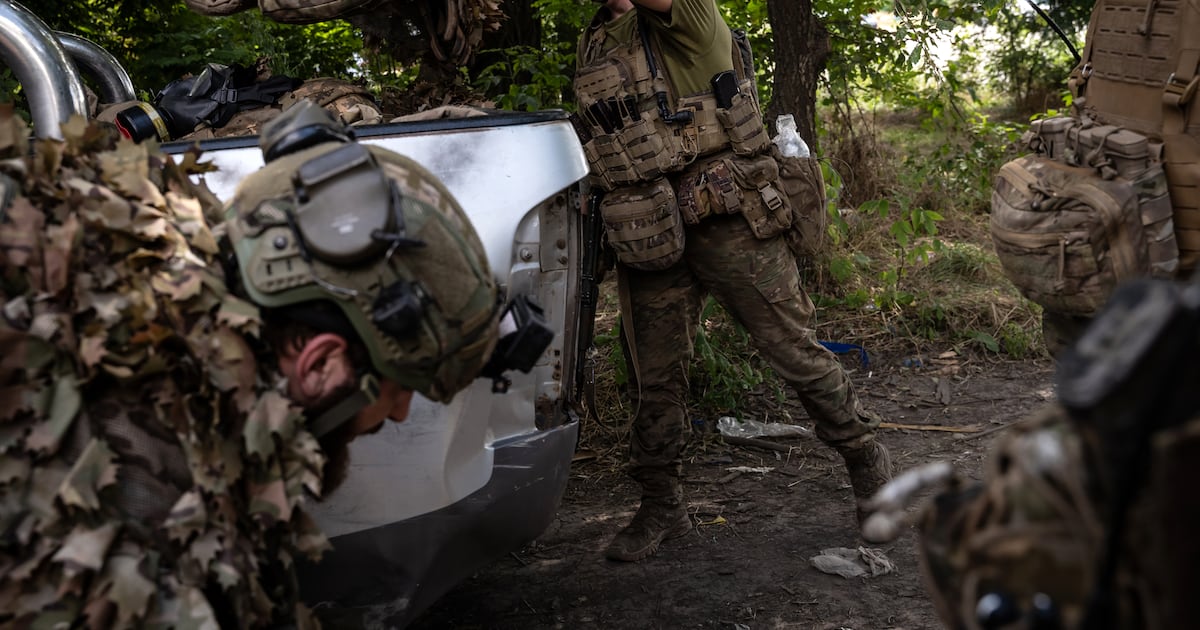
Soldiers describe it as a dense jungle, suffocatingly hot and infested with mosquitoes, where you cannot see the enemy, or your own buddy, less than 3m away.It used to be one of Ukraine’s largest reservoirs, a wide body of water swelling the lower reaches of the Dnieper river in southern Ukraine.Since the Russian army blew up the Kakhovka Dam three years ago, draining the reservoir, the former flood plain has become a forest of reeds, scrub and willow thickets.This inhospitable terrain is now a front line between the Russian and Ukrainian armies, where drones cannot penetrate the cover of the tall weeds, and soldiers hunt each other on foot in a deadly game of cat and mouse.READ MOREThe Russian soldiers are trying to carve out trails towards their main target, the city of Zaporizhzhia, on the northern shoreline of the former reservoir; the Ukrainian soldiers lie in wait to ambush them.“It is opaque, difficult, disorienting and very dangerous,” an operations commander with the call sign Divisiya says after overseeing an early-morning operation. Divisiya asks to be identified only by his call sign, in keeping with military protocol, as do most others in the battalion.The water level of the Dnieper river, which was significantly reduced by the destruction of the Kakhovka Dam by Russian forces in 2023. Photograph: Nicole Tung/The New York Times Four years ago I joined the battalion, Bratstvo, to report on troops crossing the Dnieper river by boat to scout out and attack Russian positions on the southern bank. This summer I was invited back to follow their operations in the overgrown reservoir basin from an underground command post as they fought a completely different kind of battle.[ CIA director gives bleak assessment of Russia’s war in Ukraine during Moscow visitOpens in new window ]Now that the flood plains of the former reservoir have dried out and the summer foliage offers thick cover, Russian troops are trying to infiltrate through the basin, says Oleksiy Serediuk, the battalion commander.It is the latest chapter in a bitter, four-year contest for Zaporizhzhia, an industrial powerhouse with a prewar population of 750,000. Last summer, Russian troops advanced to within 32km of the city centre. Ukrainian troops, spearheaded by military intelligence units such as the Bratstvo battalion, succeeded in beating them back in recent months.A tram passes through a street in Zaporizhzhia, Ukraine. Photograph: Nicole Tung/The New York Times The Bratstvo battalion returned to the area last winter, tramping on foot through head-high reeds to scout the basin for ways to penetrate Russian lines.In December a Bratstvo reconnaissance squad encountered Russian units who had set up positions on a rocky outcrop, once an island jutting above the reservoir waters. In a clash, the Ukrainian forces killed four Russian soldiers and captured two others. Such forays have allowed them to gather intelligence on Moscow’s plans, Serediuk says.“They are trying to control the entire reservoir,” he says. “First, so they can operate there. Second, to reach the opposite bank.”Soldiers who have fought in the area say the Russian military has deployed hundreds of troops into the reservoir, which is about 95km long and 24km wide.Oleksiy Serediuk, commander of the Bratstvo battalion, in Zaporizhzhia region, Ukraine. Photograph: Nicole Tung/The New York Times Serediuk says, “They have already brought everything there, set up observation posts and staging areas for troop concentrations, which is exactly what they need to do.”“We are looking for them, and they are looking for us,” he adds.Divisiya compares the Russian logistics operation to the Ho Chi Minh Trail during the Vietnam war, which became a vital lifeline under jungle cover for the Viet Cong to ferry weapons and supplies and personnel.As the men of Bratstvo like to point out, the reservoir basin is a domain of infantry.“In the reeds, it’s like the old kind of war, like at the beginning of the full-scale invasion: direct contact,” a squad commander with the call sign Apach says on his return from a two-week operation in the basin. “Once you step into a tree line, you’re gone.”A platoon commander with the call sign Apach unpacking after returning from an operation in the Kakhovka reservoir basin. Photograph: Nicole Tung/The New York Times Drones have transformed the battlefield in many ways in Ukraine, allowing much of the fighting to be conducted remotely by pilots from bunkers. But they have proved of limited use over the dense vegetation of the reservoir, commanders and soldiers say.“There were times when we spent three days looking for one of our own fighters, not to mention enemy soldiers,” Serediuk says. The battalion uses drones in a support role, to ferry supplies and sometimes to drop explosives in a general area to drive Russian soldiers into an ambush.The difficulty for the Ukrainian battalion in tracking even its own soldiers is evident on a recent morning when a unit prepares to trek out from the reservoir to bring a Russian prisoner back to base. From a command post, an operations commander asks the unit’s troops to step out from the trees so that a drone pilot can track their progress.Four figures emerge, one waves. Then they disappear again into the trees. The only indication of their progress is the gentle movement of the tree tops.Drone footage showing soldiers of the Bratstvo battalion making their way out of the reservoir basin. Photograph: Nicole Tung/The New York Times Over several hours the group comes into view only when they cross an area of sand and scrub or tramp through a patch of waist-high grass.The Ukrainian unit twice ran into Russian soldiers and engaged them in firefights, Apach, the squad commander, said in an interview upon their return.The first time, they came across a couple of Russian soldiers sitting smoking in some bushes. One of the Russians reached for his weapon and the lead Ukrainian opened fire and killed him, Apach said. The second Russian pulled the pin of a grenade until, after a few tense minutes, the Ukrainians talked him into replacing the pin.They took him prisoner, and for three days he hiked through the forest with them back to their base.They ran into two more Russian soldiers who appeared as no more than shadows in the trees. Footage from Apach’s body camera shows him opening fire and then ducking down as bullets zing through saplings.He crawls backward, pulling the prisoner with him. “We started retreating because the contact was too close,” Apach says. “It was very dangerous.” They later found one dead Russian soldier, but the second shooter had escaped.Two days later, the squad, still fired up with tension from the operation, arrives back at base with the prisoner.A lot of the Russian troops seem focused on evading attention, Apach says.“Their task is to sit, listen and pass on information,” he says. “They don’t seem motivated to shoot or fight.”Serediuk and his head of planning, an officer with the call sign Chornyi, are both veterans of multiple battles around Ukraine. Serediuk says they have encountered some very skilled fighters among the Russian forces in recent months.But Chornyi says the quality of soldiers in the Russian army has declined and most troops deployed now are inexperienced, recent recruits.Since the spring Russian soldiers have been surrendering in larger numbers than in previous months, Chornyi adds. He says that from his intelligence gathering, he has learned they are less battle-hardened, but also that word has been trickling back through the Russian ranks that captives are not being tortured or killed, as Moscow has led soldiers to believe, but are being treated well in Ukraine.“Many people are returning from captivity, and they talk about what captivity is really like and what the actual situation is,” he says.– This article originally appeared in The New York Times
A jungle war emerges in southern Ukraine’s vanished reservoir
Full Article
Original Source
Read the full article at Irishtimes →KhanList aggregates and links to publicly available news content. We do not host full articles from third-party sources. Always verify important information with original sources.