
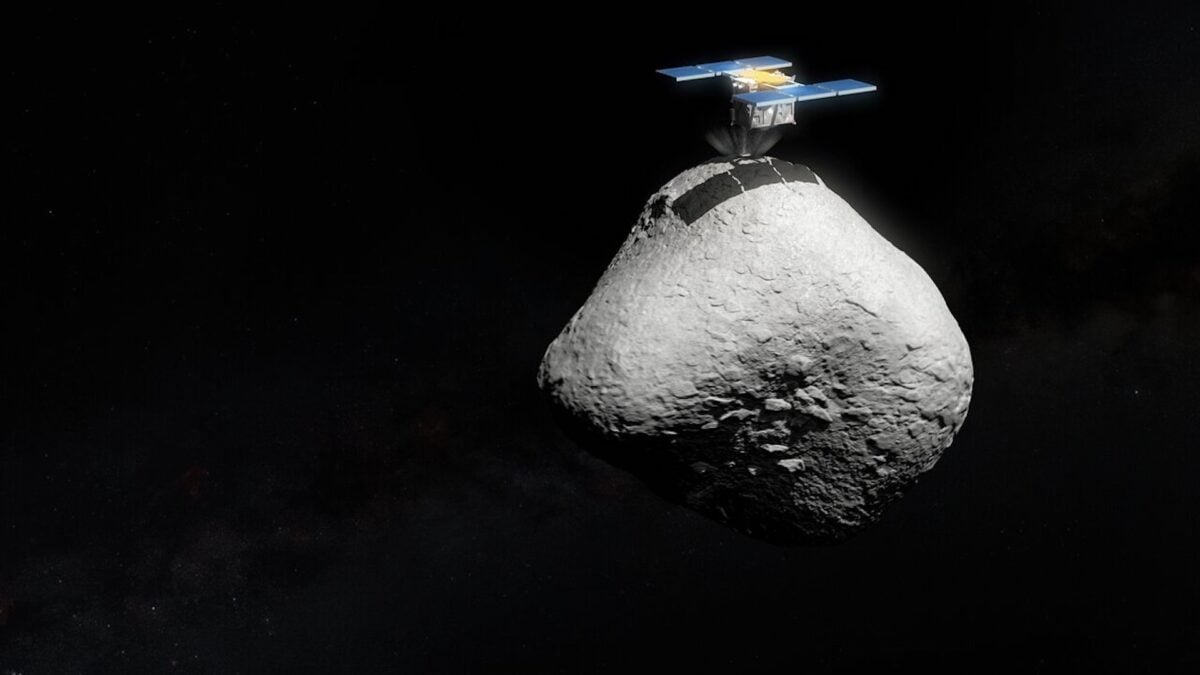
On December 6, 2020, Japan’s Hayabusa2 probe dropped a capsule of precious samples from asteroid Ryugu into the Australian outback, then set off on an extended mission that will end at a much smaller space rock. Its next encounter may prove more challenging, however, as the new target is moving in ways scientists still can’t explain. The object, designated 1998 KY26, is accelerating in a way that cannot be accounted for with gravity alone. This has led some scientists to suggest that it’s not an asteroid but rather a dark comet or even an alien artifact (a theory we’re not going to entertain, at least for the time being). Now, a new paper challenges the idea that it’s a comet, finding that the space rock is too warm to hold on to buried ice. The findings, published in the journal Icarus, reignite the mystery surrounding 1998 KY26 as the Japanese spacecraft races toward the unknown. Playing catch-up Hayabusa2 is set to rendezvous with the space rock in 2031 as part of its extended mission to collect more dust and rock straight from the source. 1998 KY26 is a small, lumpy near-Earth object that rotates so quickly that a day on the rock ends almost as soon as it begins. Things have not been looking good for the mission for a while now. In a previous paper published in 2025, astronomers revealed that Hayabusa2’s new target is about a third the size previously estimated and spinning much faster than originally thought. Hayabusa2’s first target measures nearly 3,000 feet (900 meters) wide. The spacecraft first touched down on asteroid Ryugu on February 22, 2019. That April, it shot a copper impactor into the asteroid to form an artificial crater and then returned in July for a second touch-and-go encounter to collect material from beneath the surface. Touching down on 1998 KY26, however, may prove far more challenging, as the rock is just 36 feet (11 meters) wide—barely twice the span of the spacecraft’s solar panels—and completes a full spin roughly every 5 minutes. To make things more complicated, the asteroid’s trajectory shows unusual, non-gravitational accelerations, according to a paper published in The Planetary Science Journal in 2023. The magnitudes of the accelerations are greater than those typically induced by the Yarkovsky effect, a tiny force imparted by sunlight that can gradually alter an asteroid’s orbit, according to the paper, and “there is no radiation-based, non-radial effect that can be so large,” the authors wrote. Asteroid, comet, or something else entirely? After examining the object, the team suggested that it was not an asteroid but rather a dark comet. A dark comet is an object that looks and behaves somewhat like an asteroid but moves through space as though it were a comet. Scientists are still learning about these hybrid objects and whether they may have delivered the building blocks of life to Earth. If 1998 KY26 were a dark comet, that would explain its acceleration: as the object heats up, ice beneath its surface turns to gas and vents into space, nudging the rock like a faint thruster. That explanation, however, may not cut it anymore. The newly published research suggests that if 1998 KY26 were in fact a comet, it would have depleted its ice reserves long ago. Without ice to vent, the reason for the object’s unusual acceleration is once again a mystery. Using pre-existing data, the team modeled the object’s temperature and found that even its coldest regions have an average temperature of at least 212 Kelvin (-61 degrees Celsius). To maintain its buried ice, the object’s temperatures would need to remain below around 145 Kelvin (-128 degrees Celsius). “Here, we show that all locations on the surface or in the interior of 1998 KY26 have orbit-averaged temperatures significantly above the sublimation point of volatiles in vacuum,” the authors wrote. “Our temperature model results indicate that the water outgassing rate on 1998 KY26 would be too high to maintain buried ice.” Instead, the new paper suggests that the object may belong to a classification of asteroids that are largely devoid of water. That still leaves the rock’s strange acceleration unexplained, but Hayabusa2 may finally get some answers when it arrives at 1998 KY26 in 2031.
A Japanese Spacecraft Is Chasing a Space Rock That Defies Gravity. The Best Explanation Just Took a Hit
Full Article
Original Source
Read the full article at Gizmodo →KhanList aggregates and links to publicly available news content. We do not host full articles from third-party sources. Always verify important information with original sources.