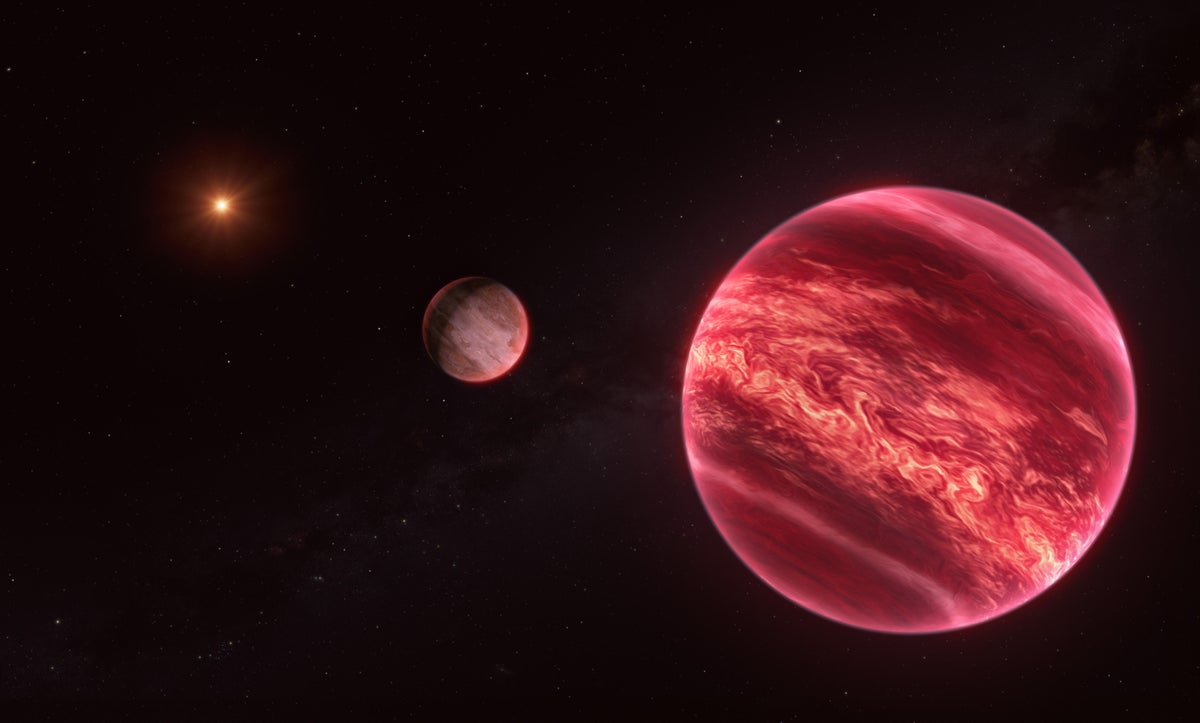
The almost Jupiter-sized object is orbiting a brown dwarf, which, in turn, is circling around a small starArtist’s impression of CD-35 2722, a system with a moon-like object ESO/M. KornmesserWhen is a moon not a moon? That’s the riddle raised by a new study, and the answer appears to be, when it’s a planet. Or maybe it’s vice versa.Such are the strange semantic questions raised by studies of CD-35 2722 b, a brown dwarf with about 30 times the mass of Jupiter that’s orbiting a small star some 73 light-years from Earth. The brown dwarf appears to have its own satellite, much like Earth has the moon, albeit one almost as big as the largest planet in our solar system. While astronomers have discovered thousands of exoplanets, CD-35 2722 may be the first star system found that exhibits this three-tiered “star-brown dwarf-satellite” hierarchy.Earlier observations of CD-35 2722 b, taken at the W.M. Keck Observatory in Hawaii, had shown hints of an exomoon - a type of object that’s yet to be definitively found - but the data wasn’t conclusive. To settle the matter, Kevin Hoy, a PhD student at the Institute of Astrophysics Studies in Santiago, Chile, turned to the European Southern Observatory’s more powerful Very Large Telescope (VLT) and its CRIRES+ instrument on a mountaintop in the high Chilean desert.On supporting science journalismIf you're enjoying this article, consider supporting our award-winning journalism by subscribing. By purchasing a subscription you are helping to ensure the future of impactful stories about the discoveries and ideas shaping our world today.CRIRES+ is a spectrograph, an instrument that parses a star’s light into a rainbowlike spectrum of colors; fluctuations in that spectrum track a star’s motion in the sky, with the spectrum growing bluer if a star is approaching Earth and redder if a star is receding. Astronomers hunt for hidden orbiting companions by the way their gravity can pull a star to and fro, creating subtle stellar wobbles that register as a telltale series of “blueshifts” and “redshifts” in a star’s spectrum.Across almost two-and-a-half years, ending in February, Hoy and his colleagues used the VLT and CRIRES+ to periodically measure the brown dwarf’s spectrum in search of such wobbles, a technique known as radial velocity analysis. As they described in a new paper published in Nature on Thursday, CD-35 2722 b is wobbling indeed, from some sort of otherwise-unseen satellite circling it once every 170 days.Exactly what to call this companion is a matter of debate. While it acts like a moon, it’s big – really, really big, with a minimum mass 90 percent that of Jupiter’s. “The mass could be even higher,” Hoy notes, adding that the object’s sheer size likely means it’s mostly made of gas, rather than rock, ice or metal. Were it orbiting a full-fledged star rather than a distinctly substellar brown dwarf, astronomers would simply call the object an exoplanet—and a relatively unremarkable one, at that.Brown dwarfs occupy a peculiar place in the cosmic pecking order. They’re gassy orbs many times larger than Jupiter, yet too small to have hit the critical mass for sustaining the thermonuclear fusion reactions that make stars shine. (This is why brown dwarfs are often referred to as failed stars). Given how weird they are, it makes sense that whatever orbits them would be oddities as well.The closest analog to Hoy’s finding may be HD 206893 b, a conspicuously wobbling 28-Jupiter-mass exoplanet 129 light years away from Earth, says David Kipping, an exomoon-hunting astronomer at Columbia University, who did not work on the new study. But while HD 206893 b’s wobble is consistent with the persistent tug from an accompanying satellite of about half Jupiter’s mass, he says, a paper published in January showed this signal could just as well have other explanations, making the wobble evidence for a “candidate” exomoon, at best. CD-35 2722 b’s putative exomoon is technically just a candidate, too, but its associated wobble is much clearer and harder to explain away.“It’s a candidate object, but it probably is real,” Kipping says. “In this case they feel like it’s more secure, and I would probably buy that. It does look a really clean detection.”As astronomical instruments continue to improve, it’s likely more small, strange candidate companions will be found for brown dwarfs and exoplanets alike, says Hoy. That means astronomers will have to start coming up with better definitions for what constitutes an exomoon versus an exoplanet in the first place. For now, he suggests, we could stick with a more neutral term for all these objects: exosatellites.An already-borderline object like the brown dwarf CD-35 2722 b is “the perfect place to kickstart this kind of conversation, because the system is like the perfect test bed for arguing about things,” Hoy says. “The star is clearly a star. The brown dwarf is also clearly a brown dwarf. Now we have this new object that is too big to obviously be a moon. How we draw the line between what’s a moon and what’s a binary planet is all very fuzzy at the edges.”It’s Time to Stand Up for ScienceIf you enjoyed this article, I’d like to ask for your support. Scientific American has served as an advocate for science and industry for 180 years, and right now may be the most critical moment in that two-century history.I’ve been a Scientific American subscriber since I was 12 years old, and it helped shape the way I look at the world. SciAm always educates and delights me, and inspires a sense of awe for our vast, beautiful universe. I hope it does that for you, too.If you subscribe to Scientific American, you help ensure that our coverage is centered on meaningful research and discovery; that we have the resources to report on the decisions that threaten labs across the U.S.; and that we support both budding and working scientists at a time when the value of science itself too often goes unrecognized.In return, you get essential news, captivating podcasts, brilliant infographics, can't-miss newsletters, must-watch videos, challenging games, and the science world's best writing and reporting. You can even gift someone a subscription.There has never been a more important time for us to stand up and show why science matters. I hope you’ll support us in that mission.
A huge cosmic object could force astronomers to rethink what a moon is
Full Article
Original Source
Read the full article at Scientificamerican →KhanList aggregates and links to publicly available news content. We do not host full articles from third-party sources. Always verify important information with original sources.