
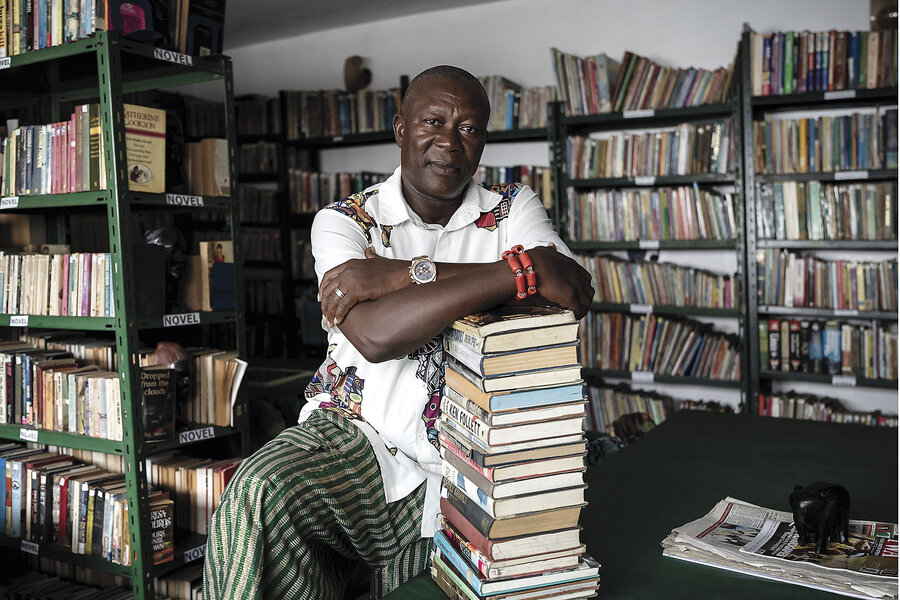
At age 9, Raphael James began collecting a trove of Nigerian history. Coins withdrawn from circulation during the Nigerian Civil War lay scattered across the boy’s village, Ahuwa-Oboro, in southeastern Abia state. He picked them up, intrigued that they had survived while so much else of his country was destroyed.Ahuwa-Oboro’s elders who could not read summoned the boy whenever they received letters from beyond their village. He read the correspondence to them and was usually paid in dried fish. He was much happier when they gave him the postage stamps. “They carried faces, events, animals – each one made me ask questions,” he says. Why We Wrote This Raphael James' boyhood collection of coins and stamps has grown into a compound in Lagos, Nigeria, that houses a free public library and a private museum open to all. The site contains tens of thousands of books, photographs, and artifacts chronicling Nigerian history, from the transatlantic slave-trade era to the present. Five decades later, Mr. James remains transfixed by his country’s past. The coins and stamps are still part of his collection, which has grown into a compound in Lagos that houses a free public library and a private museum open to all. The site contains tens of thousands of books, photographs, and artifacts chronicling Nigerian history, from the transatlantic slave-trade era to the present.“When tomorrow comes, this place should remind our children of today,” Mr. James says.Addressing a shortageNigeria maintains a network of libraries and museums, but they have been underfunded for years. Experts also say public engagement with these institutions is low.During his college years in the late 1980s, Mr. James began seeing the importance of his collection. “Every time I spoke to friends, I realized how little they knew about our history,” he says. “That’s when I saw the need to document Nigeria for generations yet unborn.” Light Oriye Tamunotonye/Special To The Christian Science Monitor Mr. James holds up a Biafran banknote, part of the extensive collection of old Nigerian currency displayed at the Centre for Research, Information Management and Media Development Museum, which he opened in 2012. Curators from other institutions are sometimes consulted to verify the authenticity of the museum’s artifacts. After graduating in 1991, Mr. James built a career in journalism and research, beginning at the publication Newswatch before moving into other editorial and research roles across Nigeria. All the while, his collection grew. At times, he recalls, he and his wife went to bed hungry because he had spent their money on books and artifacts.“Once you have interest in something, you get to a point where you don’t look at how much money is involved,” he says with a chuckle.The idea for a free library came in 2000 while Mr. James was running a business center in Lagos. Almost every day, he says, young people came in carrying examination results that weren’t theirs. They would cover the original name on the paper, write down their own, and then photocopy the document in the hopes that it would help them secure a job or gain admission to college.“At that time, there were only a handful of libraries, and even now, they are not enough for our huge population,” says Mr. James.He decided that lecturing young people wouldn’t solve the problem; they needed somewhere to learn and pass the exams on their own. In 2004, he opened a free public library with fewer than 100 books. Today, it contains more than 50,000 publications and has served more than 22,000 visitors, according to Mr. James.“I’ve found materials here that I couldn’t find at the state library,” says Michael Olaniyan, a history and international relations student in his final year at Lagos State University. “It’s worth the long journey to get here.” Light Oriye Tamunotonye/Special To The Christian Science Monitor The museum that Mr. James started contains historical artifacts and publications that he has purchased with his own money or acquired through donations. By 2009, Mr. James had decades’ worth of newspapers, photographs, and historical documents. The collection was beginning to outgrow the room where he stored them, and he wanted the public to see it.So three years later, he opened the Centre for Research, Information Management and Media Development Museum. Outside, a tree-shaped sculpture built from books rises above the compound. Inside, the museum is arranged as a journey through Nigeria’s past, containing more than 48,000 historical photographs, alongside thousands of books, newspapers, maps, and other artifacts. Much of the collection has been assembled through a nationwide network of local researchers and community contacts who identify historical objects. They then photograph the items, gather information about their origins and ownership, and send the details to Mr. James for verification before he acquires the items through donation or purchase.“We do fact-checks on all [artifacts],” he says, adding that curators from other museums are sometimes consulted.One gallery displays bird feathers, stones, and old clay pots. Another is filled with political campaign posters, portraits, and books from the colonial era. Elsewhere are a scale model of a slave ship for an interpretive display, guns from the Benin-British wars, samples of every currency Nigeria has issued, and relics from the civil war, including a typewriter that Mr. James says belonged to the secretary for Biafran leader Chukwuemeka Odumegwu Ojukwu. Nearby, old cameras, telephones, and cassette players trace the country’s technological and cultural evolution. Light Oriye Tamunotonye/Special To The Christian Science Monitor Mr. James looks through photographs inside his archival storage space at the museum. “I’m not exaggerating when I say that if you’re researching Nigeria’s history, his museum is one of the places you should visit,” says Nnenna Fakoya-Smith, a national tourism promoter who also collects stamps, postcards, and coins. “The breadth of the collection is remarkable.”Detective workApart from collecting, Mr. James is sometimes a sleuth. Over the years, for example, he noticed that books and websites credited different people, including civil servant Michael Taiwo Akinkunmi and military commander David Ejoor, with designing Nigeria’s coat of arms. “The accounts didn’t add up,” Mr. James says flatly.He interviewed Akinkunmi and worked with John Redhead, a British member of his research team, to examine records at the College of Arms in London. There, he says, they found documents showing that the coat of arms was commissioned before independence and designed by the London firm Messrs Beverley Pick Associates. Mr. James says the findings have yet to be formally acknowledged by Nigeria’s government.Nearly 50 years after preserving coins and stamps in his village, Mr. James is still collecting in the hope that future generations will better understand the country they inherited.“I want a place where you can get every information you need” about Nigeria, he says. “We’re not there yet.”
A history buff is on a quest to keep Nigeria’s past alive
Full Article
Original Source
Read the full article at Csmonitor →KhanList aggregates and links to publicly available news content. We do not host full articles from third-party sources. Always verify important information with original sources.