
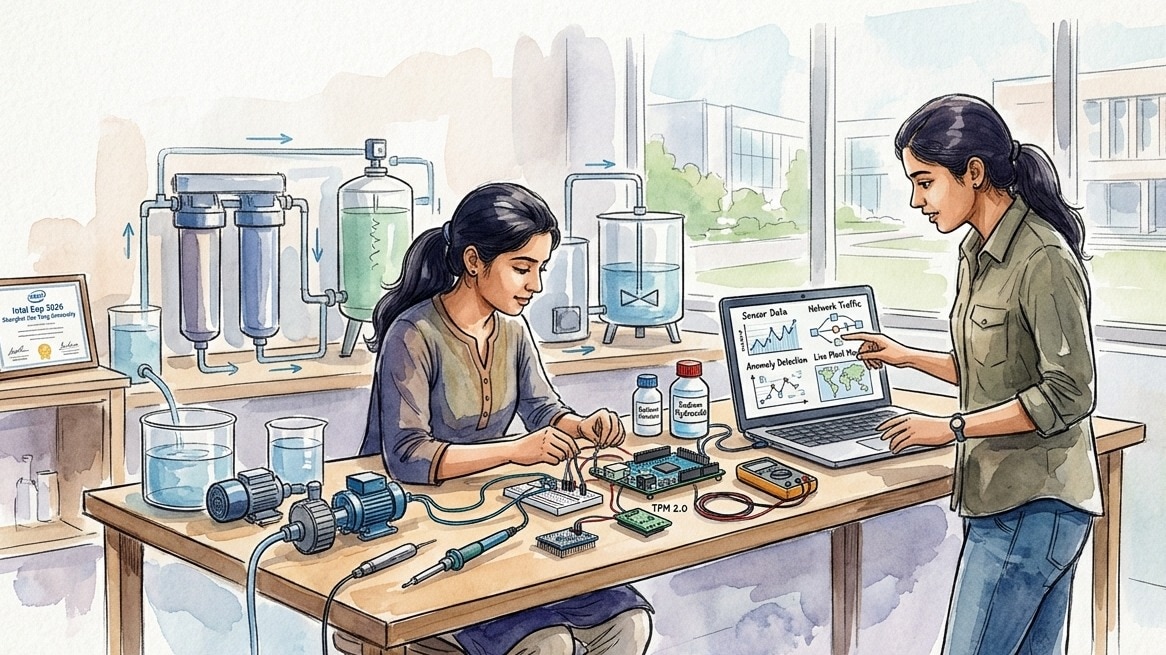
Two IIT Gandhinagar students have developed TrustGate, an AI-powered system that detects cyberattacks on water plants by analysing network activity and sensor data, offering a new way to safeguard critical infrastructure.IIT Gandhinagar students develop AI system to detect cyberattacks on water plants (AI-generated image)New Delhi,Nov 9, 2026 13:10 ISTA cyberattack on a water treatment plant may not always begin with an obvious warning. Sometimes, a command that looks legitimate on a computer screen can put an entire town's water supply at risk. Two undergraduate students at the Indian Institute of Technology (IIT) Gandhinagar have developed an artificial intelligence-powered system that aims to identify precisely such threats.According to an announcement by IIT Gandhinagar, the system, called TrustGate, combines network traffic and physical sensor data to detect cyberattacks on industrial infrastructure, including water treatment plants, power grids and manufacturing facilities. The project also won the second prize at the Intel Cup, the international Undergraduate Electronic Design Contest 2026, held at Shanghai Jiao Tong University in China.The innovation was developed by Miloni Thakkar, a third-year Computer Science and Engineering student, and Mitwa Goswami, a third-year Electrical Engineering student, under the mentorship of Dr Sameer Kulkarni, Assistant Professor at IIT Gandhinagar.THE INCIDENT THAT INSPIRED THE PROJECTThe idea was partly inspired by a 2021 cyberattack on a water treatment plant in Oldsmar, Florida. An unidentified attacker remotely accessed the plant's control system and attempted to increase the concentration of sodium hydroxide, a chemical used to balance water pH, to nearly 100 times its safe level. The attack was not detected by an automated security system. A plant operator noticed the computer mouse moving on its own and reversed the command in time, preventing a potentially dangerous situation.The incident highlighted a gap in conventional industrial cybersecurity tools. While these systems can identify suspicious network activity, unauthorised access and malware, they may not recognise when an apparently legitimate command could have dangerous physical consequences. Miloni Thakkar explained that TrustGate addresses this gap by analysing both the cyber and physical aspects of an attack, according to IITG's website.HOW DOES IT WORK?Unlike conventional systems that largely examine network activity, TrustGate analyses two streams of information simultaneously: network traffic and readings from physical sensors installed in plant equipment.The system uses a dual-stream Bi-directional Long Short-Term Memory (BiLSTM) model combined with a technique called cross-modal attention. In simple terms, the AI allows information from the two streams to be cross-checked, helping it identify suspicious patterns that might otherwise go unnoticed.This is particularly useful in detecting gradual or disguised manipulations designed to avoid triggering conventional security alarms.When an anomaly is identified, TrustGate can indicate the likely nature of the attack, identify the affected physical component, and display the information on a live map of the plant. This could help operators understand where a problem is occurring instead of having to investigate a generic security alert.WHAT HAPPENS NEXT?The students tested the system using the Secure Water Treatment (SWaT) dataset, based on a scaled-down, six-stage water treatment testbed maintained by the iTrust Centre at the Singapore University of Technology and Design.TrustGate is also designed to operate on embedded hardware without depending on cloud connectivity. It uses Trusted Platform Module (TPM) 2.0 technology to verify system integrity and a self-healing mechanism to restart core processes if they crash.However, the project remains a research prototype validated in a laboratory environment. Before it can be tested at an operational facility, it needs trials using live plant data, support for additional industrial protocols, and formal security certifications.The students believe the approach could eventually be adapted to other critical infrastructure, including power grids and oil and gas facilities. Both have expressed an interest in continuing to develop TrustGate rather than treating it as a one-time academic project.- Ends
A hacker could threaten your water supply. These IIT students have an AI answer
Full Article
Original Source
Read the full article at Indiatoday →KhanList aggregates and links to publicly available news content. We do not host full articles from third-party sources. Always verify important information with original sources.