
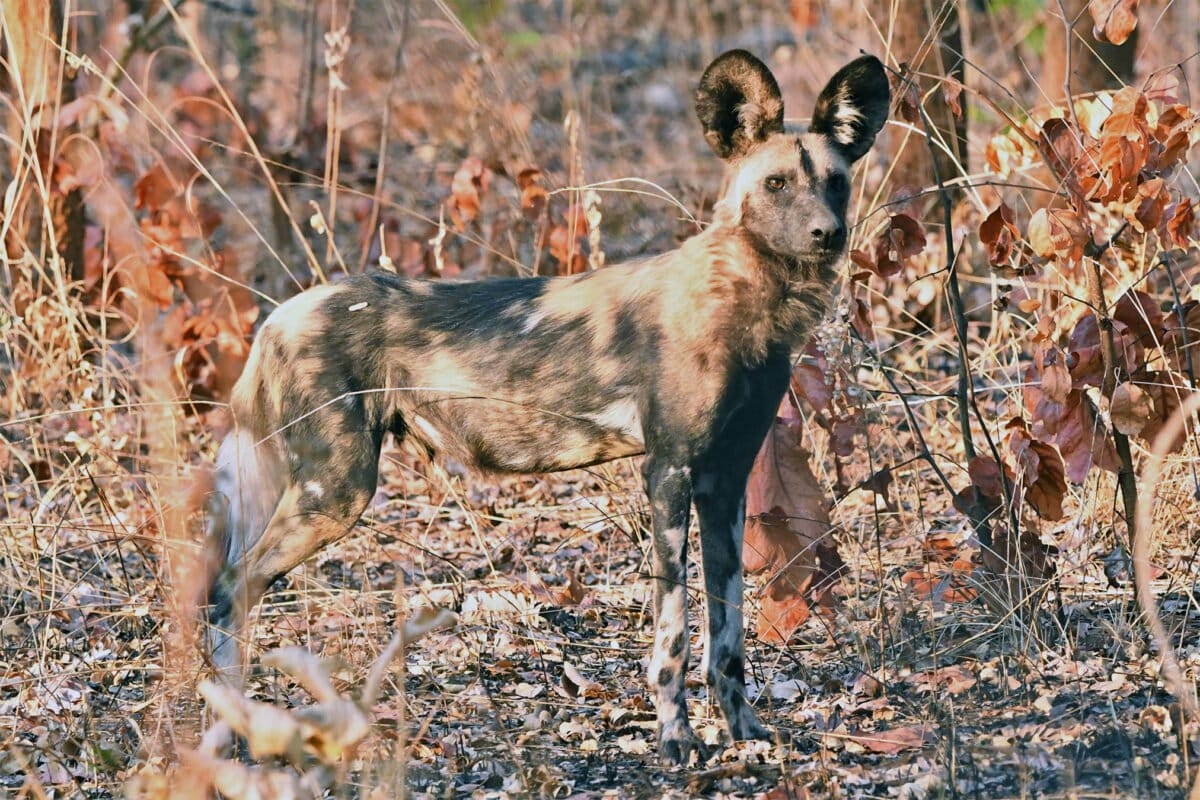
A pack of wild dogs has recorded the longest journey by an African mammal by clocking up more than 4,100 kilometers (2,500 miles).The record is documented in a new study that tracked wild dog dispersals over nearly 20 years across Zambia.Some of the dogs studied were killed in wire snares at the end of similarly epic journeys.Connections between separate landscapes still exist, the researchers say, but work must be done to ensure they aren’t lost within the next decade to unchecked human expansion. In mid-2025, a trio of male African wild dogs headed east through the open woodlands of Kafue National Park in west-central Zambia, away from the pack they’d grown up in. Roughly two weeks earlier, four of their sisters had also left the pack. One dog in each of the groups was wearing a GPS collar fitted and monitored by a team of researchers from the Zambian Carnivore Programme, Zambia’s Department of National Parks and Wildlife, and other partners. The tracking data showed that the females headed northward, into a game management area (GMA), a partially protected buffer zone adjacent to the park. But their brothers, known to the researchers as the Mayukuyuku males, entered an unprotected area east of Kafue, then turned north toward the cities of Kitwe and Ndola. The two dispersing groups were doing what wild dogs (Lycaon pictus) tend to do when they reach the age of around 3 years old. They break from their birth packs and head out in search of territory and mates to form packs of their own. But it’s also extremely risky behavior. “A good way to die, if you’re an African wild dog, is to leave your pack,” said Scott Creel, an ecologist at Montana State University in the U.S. and lead author of a new study recording these and other epic wild dogs movements across Zambia. But, he added, the alternative is also grim: “A good way to never reproduce is to stay in your pack.” African wild dogs in Kafue National Park. Image courtesy of Scott Creel. The miombo woodlands that dominate Kafue National Park are productive hunting grounds for wild dogs: home to plenty of their favored prey, antelopes, and few of their most formidable competitors, lions. When the Mayukuyuku males headed north toward Kitwe and Ndola, both located in Zambia’s highly-industrialized Copperbelt province, they were likely looking for similar habitat, Creel said. But, encountering lots of signs of human presence in that landscape, they moved as they would through perilous lion-occupied territory: fast and straight. “I bet you if you could get between their ears and know what they were thinking,” Creel said, “they were thinking, ‘I just got to get through this stuff here and hope I bump into something good on the other side.’” But the three brothers found no wide-open plains, no game-rich savanna, or expanses of intact woodland like Kafue. So, they doubled back, literally retracing their steps until, remarkably, having logged more than 1,200 kilometers (about 750 miles), they encountered their dispersing sisters, whose number was now down to three. By this time, their littermates had travelled more than 1,400 km (870 mi). “That is mind-boggling,” Creel told Mongabay. “It shows you both how good [wild dogs] are at finding other dogs, but also how difficult the task is of dispersing between ecosystems.” KWD2061, one of the Mayukuyuku males, a trio of wild dogs that dispersed from Kafue National Park on an epic 4,000-km (2,485-mi) journey across a vast swathe of Zambia in 2025. Image courtesy of Stephi Matsushima/ZCP. Out of all the wild dogs in Zambia the two groups didn’t want to find, it was each other, because they were siblings. The two groups parted company after a day. Now the Mayukuyuku males headed east, toward the Luangwa River Valley and its 400-or-so-strong wild dog population. By April this year, nine months after they first started out, they’d reached a GMA located in the southern Luangwa Valley, between South Luangwa National Park and Lower Zambezi National Park. “We think they’ve actually established a [territorial] range, but we haven’t quantified who they’re with and how many dogs there are,” said Matt Becker, chief executive of the Zambia Carnivore Programme and a co-author of the study. The trio’s nine-month odyssey, traversing 4,126 km (2,564 mi), is the longest recorded wild dog dispersal. They and their sisters were just two of 19 such groups tracked by the ZCP over the past decade and a half. Wild dogs moving along the Luangwa River in South Luangwa National Park, which holds one of the largest remaining populations. Image courtesy of Scott Creel. But while the Mayukuyuku males achieved an amazing feat, their sisters weren’t so lucky. After their brief reunion on the outskirts of Kitwe and Ndola last September, the sisters headed south, to an unprotected forest outside the city of Kabwe, in Zambia’s Central province. Shortly after that, according to the GPS data gathered by the research team, the collared member of the group started moving back and forth repeatedly to a fixed location. Such movements are characteristic of dogs travelling to and from their dens. But in the case of dispersing dogs, which don’t spend the night in the same place twice, it suggested something was terribly wrong. “It hinted that her packmate had been caught [in a hunter’s snare], and [the collared dog] was still able to move, but kept going back to the same location,” Creel said. Wild dogs are reluctant to leave injured pack mates. When one of the research team travelled to the location to try to find out what the problem was, she discovered it was on private land — fenced off. It took three days before she was given access to the property. The only evidence of the tragedy she found was the collar of the tracked dog — cut off with a knife and disposed of — likely after she too was found dead by a hunter in his snare. Snares are often laid in sets that can capture several dogs from the same pack. It’s unclear what happened to the third sister. “It was one [rescue attempt] where we failed, but in a lot of cases we’ve succeeded,” Creel said. Rescue missions are harder when dogs are dispersing because they’re in places where the team has no logistics set up to be able to take action, he said. “I would say if there’s a single problem that we want to focus on for wild dog conservation right now, continent-wide, it’s dealing with the impact of prey depletion from snaring, and the direct impacts of snaring [on the dogs].” The tragedy that befell the sisters was not unique. Half the dispersing wild dog groups tracked by the team ended with snare deaths. But it also highlights the importance of creating or maintaining corridors linking protected areas. “These connections [between disparate habitats] are important for allowing dispersal, promoting genetic diversity, and supporting connectivity between populations,” said Stephen Ngoma, a field ecologist with Conservation Lower Zambezi, who wasn’t an author of the study. Ngoma said he and his colleagues are separately monitoring dogs dispersing from Lower Zambezi National Park, in southern Zambia. One group he and his colleagues tracked recently has moved extensively across the park and an adjoining GMA, exploring areas close to the Zambezi River and the Mozambican border. “If suitable habitats were connected across the landscape, it is conceivable that the dogs could move even further,” he told Mongabay. KWD2058, one of the Mayukuyuku males. Image courtesy of Stephi Matsushima/ZCP. But maintaining those corridors, he admitted, isn’t always straightforward. “In many cases, local people feel that conservation places greater value on wildlife than on the needs and welfare of the people who live alongside it,” he said. “I believe the best approach is therefore not simply to exclude people from these landscapes, but to promote coexistence and identify ways in which both people and wildlife can persist.” That could be achieved through improved conservation models, such as ones that provide economic benefits through nature-based tourism, or those that produce meat sustainably and legally through game ranching, Becker told Mongabay. “We don’t need to separate people from nature,” he said. “We can have these large landscapes, large, connected areas, beneficial to both.” Nearly 40% of Zambia’s land surface is under some form of nature conservation, whether as national parks, reserves, or game management areas. For Creel, Zambia is a “poster child for the entire [African] continent” of a country running national parks that protect rare animals like wild dogs very well. The GMAs aren’t as well protected as the parks and reserves, and are more heavily impacted by people, he acknowledged, but they still facilitate the kinds of movements he and his colleagues have documented over the past 16 years. “They [wild dogs] are successfully making movements on the scale of thousands of kilometers, mostly through areas like [the national parks and their surrounding GMAs].” Bruce Ellender, Zambia-based conservation director for The Nature Conservancy and another of the paper’s co-authors, said in a statement that some of Zambia’s GMAs are being rapidly degraded. Half the land in the game management areas around Kafue National Park, for example, has been converted to agriculture. If left unchecked, the opportunity to maintain connectivity between ecosystems will be lost within a decade, he said. But the routes documented by the research team in their study will show which pathways and corridors are the most important. “It helps government and conservation partners focus [our] limited resources where we can have the greatest impact,” he said. Banner image: KWD1980, a wild dog from Zambia’s Kafue National Park that has been tracked by researchers. Image courtesy of Scott Creel. Rising temperatures further threaten already endangered African wild dogs Why did Serengeti’s wild dogs disappear? Study challenges controversial hypothesis Citation: Creel, Scott, Stephani Matsushima, Henry Mwape, Bridget Mayani-Nkhoma, Kachama Banda, Ben Goodheart, Johnathan Reyes de Merkle, et al. 2026. “ Extraordinary Movements Connecting Distant Ecosystems by African Wild Dogs (Lycaon Pictus).” Ecology 107(9): e70504. doi:10.1002/ecy.70504 Feedback: Use this form to send a message to the author of this post. If you want to post a public comment, you can do that at the bottom of the page. Credits Topics
‘A good way to die’: triumph and tragedy among dispersing African wild dogs
Full Article
Original Source
Read the full article at News →KhanList aggregates and links to publicly available news content. We do not host full articles from third-party sources. Always verify important information with original sources.