
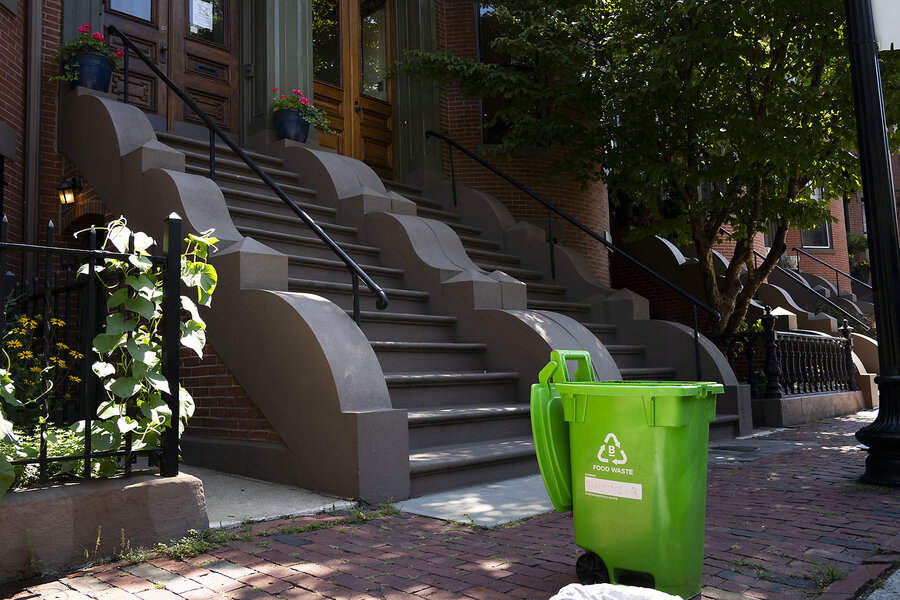
Gretchen Nash notices when her kids toss produce into the trash instead of into the family’s compost bin. “I saw that peach pit,” she says, laughing.The Nashes’ bin is part of something bigger. Ms. Nash, an artist in the Bellevue Hill neighborhood, is one of some 27,000 Bostonians who participate in weekly free food-waste collection in this port city of 675,000. Started in 2022, the Curbside Food Waste Collection program is just one example of Boston’s continued efforts to manage food waste, a growing challenge across America, where an estimated 30% to 40% of the nation’s food supply – more than 100 billion pounds, worth hundreds of billions of dollars – is discarded each year.Bostonians now have several composting options: enroll in free city pickup, drop their compost at city-sponsored bins, pay for private pickup, or build their own compost pile. Why We Wrote This Cities like Boston are making strides in expanding composting to reduce food waste, though one big challenge is getting residents to make it a habit. Program costs, hungry pests, and limited access are other hurdles. Many are doing it, and some cities are hoping more will join in.Boston currently ranks fourth in the nation in food composting, behind San Diego, New York, and Los Angeles. (This ranking compares composting services and food waste policies across America’s largest cities.) While comparable statistics are hard to find, Washington, D.C., which has one of the larger municipal composting programs, announced this week that it has collected over 11 million pounds of food waste since 2014.The composting rate, experts and city leaders say, ultimately depends on residents making the effort to toss old salad, eggshells, leftover chicken, and other meal scraps in a separate bin.But each composting option comes with its own barriers.Composting’s success, in the end, depends on how conveniently a resident can adopt a new habit, experts say. And as cities like Boston work to reduce waste, convenience will be key to behavior change.“The way you form the habits [is] you make it easy for people,” explains Jackson Somers, assistant professor in the Department of Agricultural and Resource Economics at the University of Connecticut. “You have to make it so convenient that it’s seamless.”Moving up the compost chainWhile West Coast cities like Seattle and San Francisco were early leaders in food waste recycling, Boston has been aggressively moving up the compost chain. In 2014, the city set a goal of becoming carbon-neutral and producing zero waste by 2050. It has also imposed a commercial food waste ban requiring restaurants and other businesses that generate more than half a ton of food waste per week to compost it.Boston isn’t the only one. Some 19% of the nation’s largest cities have composting programs. Twelve states – from California to Vermont – also have food waste bans, with a growing number of composting programs.The upshot? Between 2021 and 2023, out of America’s 130 million households, the number with access to food waste collection grew by almost 50%, from 10 million to 14.9 million.Come and get itBoston is joining a growing cohort of cities with free curbside pickup. Washington, D.C., launched its own composting pilot program in 2023. Now officially part of city pickup, their Food Waste Collection Program grew from 9,000 to 12,000 households in the most recent fiscal year, netting 1 million pounds of compostable material.While cities can use the compost for public landscaping, park maintenance, community giveaways, and local agriculture, both Boston and Washington also host events and pickup sites where residents can retrieve free composted soil for their own plants and gardens.Composters say they care about food waste not only because it’s a waste of a valuable, and increasingly costly, commodity, but also because of its negative impact on landfills.“We’re trying to figure out how to get to zero waste, and I like being part of that,” says Marie Fukuda, a Boston resident who drops off compost at a pickup site.Trapping organic waste in a landfill produces toxic liquid runoff as well as methane, which the Environmental Protection Agency notes is 28 times more potent than carbon dioxide in trapping heat in the atmosphere, contributing to global warming. Food systems account for one-third of global emissions, with food waste alone responsible for 10%. Medara Udoekong/The Christian Science Monitor A composting guide atop a Project Oscar bin at the South End Library Park in Boston helps residents know what they can – and cannot – put in for compost pickup, on Aug. 7, 2026. Free but limited supportAs a child, Ms. Nash disliked turning or stirring her family’s compost pile, a chore required to ensure the organic material had the sunlight, water, and air needed to decompose. Yet as an adult, she built a pile of her own. It was still smelly and messy. So when she learned that Boston was piloting free curbside pickup, she signed up.The city now picks up her leftover food items, like bones, meat, and dairy, that she doesn’t want to put in her compost pile because of the smells. Now there is no odor, less food garbage hanging around, and no dreaded compost stirring. Plus, there’s a sense that she’s doing something to try to reduce her carbon footprint.“I don’t feel any real barriers to composting with the city program because it’s so easy.’’Composting and city pickup haven’t been easy for everyone. Some detest the compost odor; others say decaying food attracts rats.Justin Sandler, owner of Black Earth Compost, a private composting company, says these challenges “can be alleviated by trying it or talking to a neighbor who does it.”Since 2022, when the city launched its curbside food-waste collection pilot program, providing collection bins to an initial group of 10,000 households, interest has more than doubled.One tricky part about city composting is collecting from apartment buildings. In Boston, if buildings have six or fewer units, they can use the city pickup, which now has a waiting list. The city plans to add more residents to the program this fall. If residents live in a building with more than six units, they can use the city-sponsored bin program, Project Oscar (named after Oscar the Grouch from “Sesame Street”), to drop off compost or hire a private composting service.A walk to Project OscarStarted in 2014 with a few sites, Project Oscar now provides 20 locked compost bins. In 2025, Project Oscar bins collected 223,446 pounds of food scraps. Black Earth turns these food scraps into soil.Ms. Fukuda heard about Project Oscar while working on a neighborhood project with the Fenway Civic Association. Having used her garbage disposal for years, she worried composting would be tough. But her short walk to the pickup site and free, easy-to-store compost bins made the change easier. Ms. Fukuda now drops off compost nearly every day.But those living farther from a Project Oscar bin may find it hard to add drop-offs to their garbage routines.Pay to playThe answer for many eager Boston-area composters is to pay for compost pickup.Helen Hakin, who lives in a senior living complex in Waltham, pays $13.99 per month to Black Earth for biweekly pickup of her two compost bins. She worries about climate change and is inspired by her sister, who composts food scraps.“I started to think, ‘What can I do?’” she says. “I have to put my money where my mouth is.”It took her a while to set up her own food-waste collection system. Flies are in her compost bin in the summer. And she wishes her city would offer free compost pickup. Paying for compost is “a little bit of a stretch for me,’’ says Ms. Hakin. “But I’m committed.”Her best compost tips? A tight bin lid helps keep hungry pests at bay, and if you stir compost and let it get oxygen, foul odors are less of a problem.While making composting easy is important, affordability matters, says Brenda Platt, the Director of the Institute for Local Self-Reliance’s Composting for Community project. “It’s really important to have your organics collection programs be as convenient … as your trash.”Finding that balance is a challenge, adds Ms. Fukuda. But it’s worth it, she says. “I highly encourage anyone who has an opportunity just to jump in.”
A good kind of rot: Boston wants your old lasagna
Full Article
Original Source
Read the full article at Csmonitor →KhanList aggregates and links to publicly available news content. We do not host full articles from third-party sources. Always verify important information with original sources.