
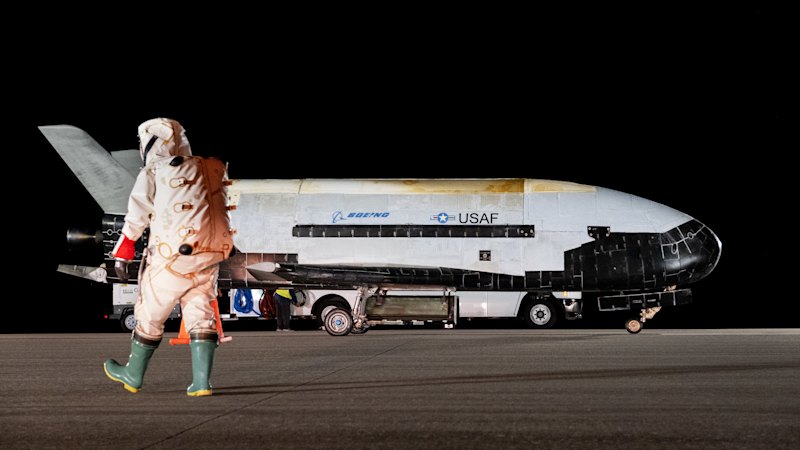
Casell Bryan-Low, Joey Roulette and Staff reporterSeptember 16, 2026 — 3:57pmThe US acknowledgement that the Pentagon is operating weapons in Earth’s orbit is a milestone in the militarisation of space, and comes at a time when American officials say they are encountering ever more aggressive orbital activities from China and Russia.Space manoeuvres, known as rendezvous and proximity operations (RPOs), have seen Western satellites “buzzed” by other satellites in low-Earth orbit. In any conflict, analysts suggest this capability could quickly transform any regular satellite into a crude “hunter-killer”, switching off vital communication links and tipping the strategic balance.The US Space Force’s secretive X-37B autonomous spaceplane returns to Earth in 2022.US Space ForceUS Space Force chief Douglas Schiess on Tuesday (US time) said his branch was operating “on-orbit weapons that can defend the Joint Force against space-enabled attacks”. The service will make “disciplined and responsible choices” as it scales its orbital defence arsenal in the coming years, he added.A day earlier, US Air Force Secretary Troy Meink said the US “has on-orbit space control weapons capable of defending the Joint Force against hostile adversary action”.Their comments are part of “the increasing comfort level of the US government to speak about aggressive actions in space” that has been building up in recent years, said Victoria Samson, chief director of space security and stability at the nonprofit Secure World Foundation.What exactly are space weapons, and what could they do?Schiess and Meink declined to get into detail about the types of weapons they were referring to when they spoke to reporters after their remarks. But while specifics remain vague, space weaponry is currently considered to exist in two basic forms.Kinetic weapons would use a warhead or other projectile to strike or detonate near a target, likely another satellite or spacecraft, to destroy or disable it.A United Launch Alliance Vulcan rocket lifts off at Cape Canaveral on the first US national security mission in August 2025.Non-kinetic types, meanwhile, would employ jammers, lasers, and cyberattacks to shut down or interfere with enemy space systems, rendering them useless.For decades, satellites have provided communications, navigation and intelligence services to armed forces on Earth, and once placed in orbit, they typically remain on fixed paths.Increasingly, however, militaries view them as active weapon platforms capable of employing both kinetic and non-kinetic methods to disrupt, destroy, or damage enemy spacecraft. In 2022, China demonstrated that it could command a satellite to grapple onto another spacecraft and move it in orbit. Theoretically, a satellite guided in such a way could also capture and disable another satellite.Satellite manoeuvring technology is also being developed for peaceful purposes – such as the European Space Agency’s collaborative Clearspace-1 project designed to clean up space junk.ESAMeanwhile, the US recently conducted its largest orbital exercise, called Apollo Manoeuvres, designed to demonstrate dynamic space operations. This involved satellites in multiple orbits simultaneously, as well as participation from international and commercial partners.Dual-use systems could even blur the line between weapons and non-weapons, according to space and Russia specialist Thibaut Stussi from Georgetown University. A range of methods could be used in addition to rendezvous and proximity operations, such as robotic arms, space-based nuclear weapons, spaceplanes, and space-based interceptors.The US is already operating its own secretive military spaceplane, the X-37B, which resembles a scaled-down Space Shuttle. Known as the Orbital Test Vehicle, or OTV, its true purpose and capabilities are undisclosed, and its missions remain classified. In 2022, an X-37B returned to Earth having spent more than two years in space.The sixth OTV mission returns to Earth in November 2022 after more than two years in space.Manufacturer Boeing states that the eight-metre X-37B has completed eight missions to date, travelling more than 2 billion kilometres and spending thousands of days in space, with each mission adding “new capabilities and technology tests”.Fighting wars in spaceSpace exploration has been closely linked to warfare since the dawn of the space age. The American space program was born in the presence of Wernher von Braun, the man who created the first modern ballistic missile, the V2, for Nazi Germany and moved to the US after the war.In the late 1960s, the Soviet Union deployed the “Istrebitel Sputnikov” (satellite destroyer) system, consisting of satellites that released shrapnel-like projectiles intended to detonate near another (usually American) satellite. As the Cold War progressed, both sides developed missile and space technologies in parallel, with systems initially designed to detect space launches adapted into early-warning missile-alert systems.Shuttle Atlantis flew a series of clandestine military missions during its career.AP LaserphotoMeanwhile, the US military was heavily involved in the development of NASA’s Space Shuttle in the 1970s, which evolved from the US Air Force’s earlier “Dyna-Soar” concept for a reusable spaceplane.In 1985, Space Shuttle Atlantis began its career with a series of classified military missions, with a media blackout imposed immediately after its first blast-off. Six years later, it would also become the first American spacecraft to carry US Army personnel into space.Today, as warfare becomes more technologically advanced, analysts expect the use of military hardware in space to increase. Advanced militaries deploy satellites in space for a range of purposes, including reconnaissance, secure communications, missile launch detection, and providing precise location information for targeted strikes.Despite the intensifying demonstrations, US officials still have not openly discussed specific space weaponry, leaving room for assumptions and interpretations that will shape how US adversaries respond and risk accelerating an arms race in space, said Craig Albert, graduate director of the Master of Arts in Intelligence and Security Studies at Augusta University.“In the absence of complete information, competitors may assume the systems threaten their own space assets and invest in counter-space capabilities or comparable weapons,” Albert said.The head of US Space Command warns that adversaries are developing capabilities to deny access to key systems and reduce military effectiveness, and that adversaries would likely seek to target American space assets early in a conflict.One expert told the BBC that Russia, which has far fewer and less sophisticated satellites than its rivals, could seek to redress the balance by firing nuclear missiles into space to blow up enemy spacecraft, or as a “last resort”, could simply “fry” their electronics with the electromagnetic pulses created by nuclear explosions.“The Russians ... have ground-based missiles which can be launched into space to strike [satellites] in low Earth orbit. They also have ASAT [Air-Launched Anti-Satellite] missiles that can be launched from a great height by aircraft,” said Rod Thornton, reader in Russian Defence and Security Studies at King’s College, London.Thornton suggested that Russia could even end up the “big winner” in any space war because it has so few satellites and is therefore less reliant on them, unlike China and the US.Who else has weapons in space?While the US, China and Russia remain the world’s top three space powers, other nations are catching up rapidly.India and North Korea are also understood to possess some space weapon capabilities, and Germany has a €35 billion ($56.6 billion) military space-spending plan aimed at countering growing threats from adversaries.Responding to the US disclosure, China’s Foreign Ministry spokesperson Guo Jiakun said on X that Beijing “stands for peaceful use of outer space and keeping it safe, and opposes any arms race in outer space or any attempt to weaponise it and turn it into a war zone”.US officials have been closely monitoring Chinese satellite companies believed to be supporting actors in the Middle East that threaten US security.APAnd Russia’s Foreign Ministry said Washington’s acknowledgement of orbital weapons ignored the possible consequences of a conflict and threatened long-term stability in space-based activity.As military norms, strategic precedent and laws of war in the relatively unfamiliar battleground of space remain underdeveloped, no nation is known to have taken the more consequential step of physically attacking another’s satellite in space.Still, the US remarks underscore how quickly developments in spacecraft technologies have escalated into increasingly open preparations for the prospect of conflict extending into space.Speaking at a Paris space defence conference on Tuesday, Richard Palmer, the director of the Capability and Resource Integration Directorate at US Space Command, said Washington’s acknowledgement of its space weapons program was “fundamental to ensuring that we prevent deterrence from failing”.“The bottom line is that our joint force and our allied forces require space. Our economies require space,” added Palmer. “We are ready in the US to preserve that.”ReutersGet a note directly from our foreign correspondents on what’s making headlines around the world. Sign up for our weekly What in the World newsletter.From our partners
A global race to put weapons in space is under way. How concerned should we be?
Full Article
Original Source
Read the full article at Smh →KhanList aggregates and links to publicly available news content. We do not host full articles from third-party sources. Always verify important information with original sources.