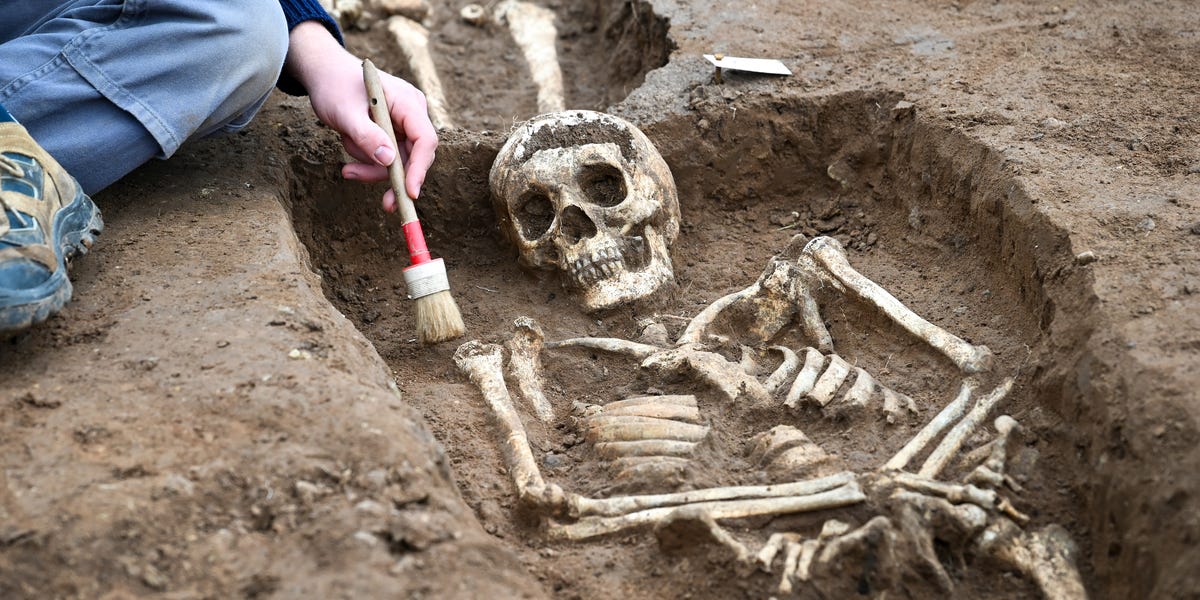
3 min readHere’s what you’ll learn when you read this story:The discovery of a human bone led to the reveal of mass graves in Adolf Hitler’s hometown.So far, archaeologists have discovered nine mass graves holding the remains of at least 120 individuals. Mystery remains about just how the group of young men died. A young girl playing in the Austrian town of Braunau am Inn—where Adolf Hitler was born—uncovered what archaeologists are calling a sensational find. After the girl’s mother reported the discovery of a human bone, archaeologists descended on the site, digging up nine mass graves (so far) and the remains of at least 120 individuals across an area of 1,600 square feet.The find is “unique in the whole of Central Europe,” said project leader Michaela Binder of the excavation firm Novetus, according to the Kronen Zeitung. Despite the link to Hitler, when Austria’s Federal Monuments Office brought in archaeologists for excavation, the remains instead dated to deeper in history than World War II.Early data reveals that the majority of the remains are of males aged between 15 and 25. The bodies were dumped without order, face-down, on their sides, and some head-to-foot. No personal belongings were found (perhaps the dead were stripped before burial) nor have any gunshot wounds turned up. That said, one man’s lower leg had been amputated shortly before he died, and several skeletons show broken ankle bones that anthropologist Sheridan Strang believes may reflect long marches. Radiocarbon dating placed one skeleton between 1723 and 1813—a window which points researchers to the French Wars of 1792–1815. Based on the ages of the individuals, the hastily-tossed-together burials, and the medical condition of at least one man, the leading theory ties the graves to a military hospital.The French Wars—which included the Napoleonic Wars—encompassed multiple battles fought by Austrians. Braunau am Inn in upper Austria was at one point controlled by French troops and was reportedly visited by Napoleon Bonaparte in 1805. No major battle was fought in the town itself, though local accounts record a skirmish with French troops in 1805 near the burial site.The archaeological team plans to complete more in-depth DNA and isotope studies in an attempt to gain a deeper understanding of the soldiers’ lifestyles and causes of death. Further excavations at the site could uncover more remains.The town where the remains were discovered, Braunau am Inn, gained internationalnotoriety as the birthplace of Hitler. In 2026, government officials converted the 17th-century house of Hitler’s 1889 birth into a police station. The interior was remodeled and the façade overhauled to help prevent the site from becoming an attraction for Nazi sympathizers.While Hitler lived in the home for just a few weeks before moving to another address and eventually leaving the town entirely when he was 3 years old, the site was long linked to the Nazi leader. “This house will now become a place of democracy, rule of law, security, freedom, and human dignity,” said Austrian interior minister Gerhard Karner, according to the BBC.The discovery of a single human bone has expanded Braunau am Inn’s conflict-laden history.Tim Newcomb is a journalist based in the Pacific Northwest. He covers stadiums, sneakers, gear, infrastructure, and more for a variety of publications, including Popular Mechanics. His favorite interviews have included sit-downs with Roger Federer in Switzerland, Kobe Bryant in Los Angeles, and Tinker Hatfield in Portland.
A Girl Found a Bone While Playing. It Led Archaeologists to 9 Mass Graves in Hitler’s Hometown.
Full Article
Original Source
Read the full article at Popularmechanics →KhanList aggregates and links to publicly available news content. We do not host full articles from third-party sources. Always verify important information with original sources.